
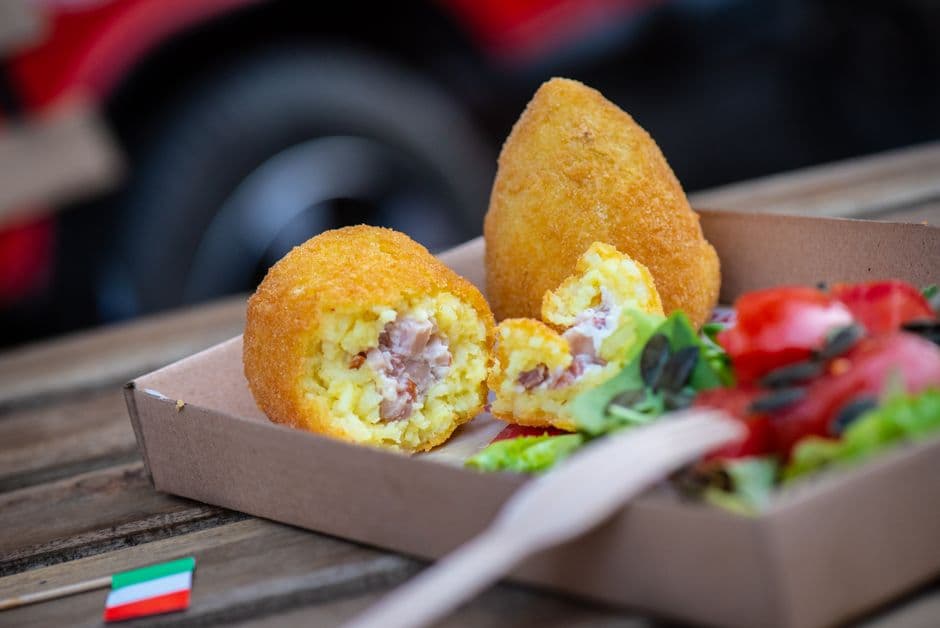
Arancini Siciliani (Sicilian Fried Rice Balls)
Crispy golden rice croquettes filled with ragù, peas, and melted cheese — Sicily's street food and celebration staple.
About This Recipe
Arancini (literally 'little oranges' for their round shape) are one of Sicily's most iconic street foods and a dish served at every celebration, from children's birthday parties to weddings. The traditional arancini Siciliani consists of risotto or cooked rice mixed with butter and cheese, shaped into a ball, stuffed with a small amount of ragù (meat sauce), peas, and mozzarella, then breaded and deep-fried until golden. The contrast is essential: a crispy, shattering breadcrumb exterior gives way to creamy rice, and then a burst of warm ragù and melted cheese in the center. Arancini are eaten as street food (from vendors in Palermo and Catania), at celebrations, and at home — every Sicilian grandmother has her own recipe, variations exist throughout the island, and debates about the 'correct' filling are passionate. The dish reflects Sicily's history of multiple occupations and cultures: the rice preparation is Arabic, the ragù is Spanish, the frying technique is Iberian, and the final form is entirely Sicilian. Arancini can be made with different fillings: some versions use butter, peas, and cheese (arancini bianchi — white arancini), others use ragù, and some even use spinach or seafood.
Ingredients
Serves 4
- 300 garborio or carnaroli rice
- 700 mlchicken or vegetable stock, warm
- 1 smallonion, diced
- 100 mlwhite wine (optional)
- 50 gbutter
- 80 gParmigiano-Reggiano, grated
- 3 egg yolksegg yolks, beaten
- 200 gragù (meat sauce with beef or pork) or ground beef
- 100 gfrozen peas (or fresh shelled peas)
- 100 gmozzarella, cut into small cubes
- 100 gall-purpose flour (for dredging)
- 2 largeeggs, beaten
- 150 gpanko or fine breadcrumbs
- for fryingvegetable oil (or a mix of olive and vegetable)
- 1 pinchsea salt
Instructions
- 1
Make the risotto
Heat a splash of olive oil in a wide saucepan. Add diced onion and cook over medium heat until softened (about 2 minutes). Add the rice and stir for 1 minute until the grains are coated in oil. Pour in white wine if using and stir until absorbed.
- 2
Cook the risotto
Add warm stock one ladle at a time, stirring constantly and allowing each addition to be absorbed before adding the next. Continue for 18–20 minutes until the rice is al dente and creamy. The risotto should fall off the spoon easily.
- 3
Finish the risotto
Remove from heat and stir in butter, Parmigiano-Reggiano, and egg yolks. This creates a creamy binding. Season with salt. Spread on a baking sheet to cool to room temperature, about 30 minutes.
- 4
Prepare the filling
While the risotto cools, warm the ragù and cook the peas (if using frozen, just thaw them). The filling components should be warm but not hot when used.
- 5
Shape the arancini
Once the risotto is cool but still pliable, scoop a palm-sized portion (about 60g) into your hand and press a thumb into the center to create a small well. Add a small spoonful of ragù, a few peas, and a cube of mozzarella. Fold the rice around the filling, shaping into a ball. Repeat with remaining rice.
- 6
Bread the arancini
Set up three bowls: flour, beaten eggs, and breadcrumbs. Roll each arancino in flour, shaking off excess, dip in egg, then roll in breadcrumbs, pressing gently. Place on a plate lined with parchment. Chill for at least 30 minutes before frying.
- 7
Heat the oil
Heat oil in a deep saucepan or pot to 170°C (340°F). Use a thermometer — temperature is critical. Too hot and the exterior burns before the inside heats through; too cool and the arancini absorb oil and become greasy.
- 8
Fry the arancini
Carefully lower arancini into the hot oil a few at a time. Fry for 2–3 minutes, turning occasionally, until deep golden brown on all sides. The arancino should sound crispy when tapped. Transfer to paper towels.
- 9
Serve hot
Serve arancini immediately while still hot and crispy. They are best eaten within 5 minutes of frying. Provide napkins — they are handheld street food meant to be eaten hot and often messily.
Did you make this?
Rate it and help other cooks find the recipes that actually work.
One tap to sign in, and we'll save the rating you just picked.
Everything you need to plan your week — free
- Meal calendar
- Grocery list
- AI recipe ideas
Track what you eat
Snap your meal to log calories and macros, run fasting timers and track water in the free SnapCal app.
Pro Tips
- →
The risotto must be completely cooled before shaping, or it will be too soft to hold a shape. Some cooks chill it overnight for easier handling.
- →
The filling must be placed in the very center of the rice ball or it will leak out during frying. Be generous with the filling but precise with placement.
- →
Do not skip the chilling step after breading (30 minutes minimum). This allows the coating to set and the rice to firm up further.
- →
The oil temperature is critical — use a thermometer. Too hot = burnt exterior, cold interior. Too cool = greasy, soggy arancini.
Variations
- •
Arancini bianchi (white arancini) — omit the ragù and fill only with peas, butter, mozzarella, and Parmigiano for a lighter version.
- •
Arancini al burro (butter arancini) — add a cube of butter to the center along with cheese and peas for extra richness.
- •
Arancini with seafood — fill with shrimp, scallops, or swordfish for a coastal variation.
- •
Baked arancini — brush breaded balls with olive oil and bake at 190°C (375°F) for 15–18 minutes instead of frying (lighter but less crispy).
Storage
Uncooked, breaded arancini can be frozen for up to 3 months — fry from frozen, adding 1–2 minutes to cooking time. Cooked arancini can be reheated in a 160°C (320°F) oven for 5–8 minutes, but they are best eaten fresh. Do not refrigerate cooked arancini; they become soggy within hours.
History & Origin
Arancini are believed to have originated in Palermo during the Arab occupation of Sicily (9th–11th centuries), when rice cultivation and the Arabic method of stuffing foods were introduced. The dish became especially popular among the poor and became a street food — vendors sold hot arancini from small carts (carretti siciliani). Today, arancini are sold at festivals, street fairs, and bakeries across Sicily, and are a symbol of Sicilian identity and culinary tradition.
Frequently Asked Questions
Why did my arancino burst open in the oil?
The filling was too hot, too much, or too close to the surface. Let the risotto cool completely, place filling in the very center, and enclose it fully in rice.
Can I use day-old risotto?
Yes, cold risotto from the day before can be reshaped and fried. It may be a bit firmer, which is actually helpful for shaping.
What's the difference between ragù and ragu?
No difference — 'ragù' is the Italian spelling. It's a slow-cooked meat sauce. You can use homemade, jarred, or bolognese sauce.
Can I make arancini vegetarian?
Yes, fill with sautéed mushrooms, spinach, or just peas and cheese. Omit the ragù entirely.
Nutrition Facts
Per serving (140g / 4.9 oz) · 4 servings total
Time Summary
Have Questions?
Ask our AI cooking assistant anything about this recipe — substitutions, techniques, scaling.
Chat with AI Chef →Featured in Guides
This recipe is featured in the following curated guides:
More Sicilian Recipes
You Might Also Like
Similar dishes from other cuisines around the world.
Free Kitchen Tools
Calculators and converters that pair with this page — no signup needed.
Put This Into a Plan
Schedule it, shop for it, and track what you already have.
Read Next
Longer reads that go deeper on the ideas behind this dish.
Community
Join the conversation
Sign in to leave a comment and save your favourite recipes