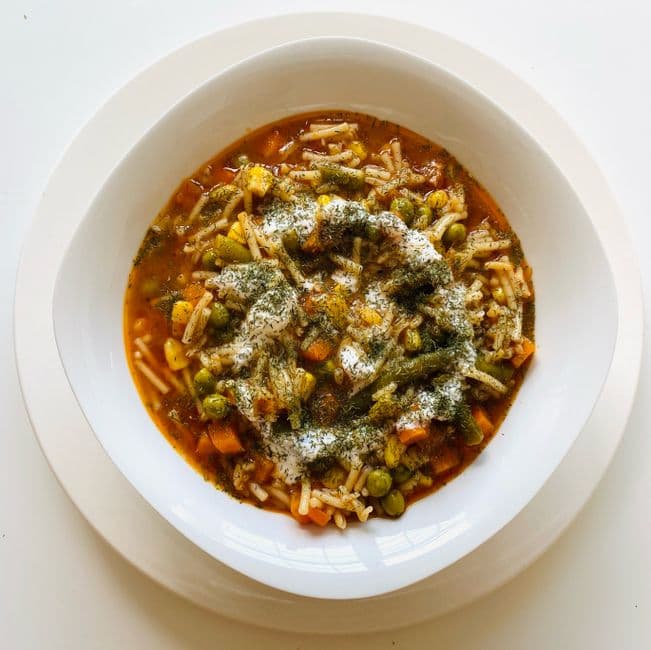
A thick Persian soup of beans, lentils, fresh herbs and chewy reshteh noodles, finished with caramelized onions, mint oil and a swirl of tangy kashk — the iconic dish of Nowruz.
Ash reshteh is the queen of Iranian ashes — the vast family of thick, hearty Persian soups that occupy a category unto themselves between stew and porridge. It is the food of Nowruz, the Persian New Year, when families across Iran and the diaspora cook enormous pots for the spring equinox: the noodles symbolize the unraveling of life's tangled paths, and serving ash reshteh at the new year is said to help untangle the year ahead. The soup is built in layers of slow flavor: chickpeas, white beans, brown lentils and kidney beans are simmered for hours until creamy; mountains of fresh chopped spinach, parsley, cilantro, dill and chives go in next, turning the broth a deep mossy green; chewy hand-stretched reshteh noodles (essentially a Persian fettuccine) are added at the end. The crown is what makes it: a generous swirl of kashk (Persian fermented whey), drifts of na'na dagh (mint sizzled in oil until almost burnt and intensely aromatic), and a halo of golden-brown caramelized onions and garlic. The result is rich, deeply herbal, tangy and umami all at once — a vegetarian soup that feels like the most luxurious thing in the kitchen, perfect for cold evenings and ceremonial occasions alike.
Serves 8
Drain the soaked chickpeas, white beans and kidney beans. Place in a large pot with 3 litres fresh cold water, bring to a boil, skim the foam, then simmer 60–75 minutes until tender but still holding shape. Do not salt yet — salt toughens the skins.
If using canned beans for speed, drain and rinse 2 cans each of chickpeas, white beans and kidney beans and skip to step 3.
While the beans cook, thinly slice 1 onion and sauté in 3 tbsp neutral oil in a wide pan over medium heat 10 minutes until golden. Add 1 tsp turmeric and cook 30 seconds. Scrape onions into the bean pot. Add the brown lentils. Continue simmering 25 minutes until lentils are tender.
Stir in the chopped fresh herbs and spinach by the handful — they will look enormous and will wilt down. Simmer 25 minutes uncovered until the broth turns deep green and the herbs are tender. Stir often to prevent sticking on the bottom.
While herbs simmer, heat 4 tbsp oil in a large skillet over medium-low. Add the remaining 2 sliced onions and a pinch of salt. Cook 25–30 minutes, stirring often, until deeply golden-brown and crisp at the edges. In the last 3 minutes, add the sliced garlic and a pinch of turmeric. Lift onto paper towel and reserve.
In a small saucepan, heat 4 tbsp olive oil over medium heat. Add the dried mint and swirl 20–30 seconds — it will sizzle, darken, and release an intensely toasted, almost smoky aroma. Pull from heat immediately; mint burns in seconds.
Add the reshteh noodles to the simmering ash, broken into 5 cm pieces if long. Stir well to prevent sticking. Cook 8–10 minutes until al dente; the soup will thicken noticeably as the noodles release starch.
Stir in half the kashk (or half the yogurt), 2 tsp salt, and the black pepper. Taste and adjust — the soup should be tangy, herbal, and assertively salted. If too thick, thin with a splash of boiling water.
Ladle into wide bowls. Drizzle each bowl with the remaining kashk in a swirl, drift over the mint oil so it makes dark green pools, and crown with a generous handful of caramelized onions and garlic. Serve immediately with warm flatbread on the side.
Real reshteh noodles are sold at Persian grocers — they're sturdier and chewier than pasta and stand up to long simmering. Linguine broken into pieces is a decent substitute.
Use FRESH herbs, not dried, and a LOT of them. The volume looks comical raw but cooks down into the soul of the soup.
Don't be tempted to skip the kashk if you can find it — it adds the funky-tangy depth that defines ash reshteh.
Burn the mint oil ON PURPOSE — it should smell smoky and almost too dark. Underdone mint oil tastes flat.
Add 500 g of cubed lamb or beef shoulder, browned and simmered with the beans, for a meaty version popular in Tehran homes.
Replace half the spinach with chopped beetroot greens for a more rustic Caspian Sea version.
Use barley instead of noodles for ash-e jo, a similar but more grain-forward soup.
Vegan: use blended cashews with lemon juice in place of kashk for the same creamy-tangy effect.
Refrigerate up to 5 days; the flavor deepens beautifully overnight. Reheat gently, adding a splash of water as it thickens. Freezes well 3 months in airtight containers — re-add fresh mint oil and onions when reheating from frozen.
Ash is one of the oldest forms of Persian cookery, with recipes documented in Sasanian-era texts predating Islam in Iran. Ash reshteh specifically rose in cultural importance during the Safavid period (16th-17th centuries) and became the dish of Nowruz, the spring equinox new year that has been celebrated in Iran for over 3,000 years.
Persian and Middle Eastern grocers stock it in jars or bottles, usually labeled 'kashk' or 'liquid kashk.' If unavailable, mix Greek yogurt with a teaspoon of lemon juice and a pinch of salt.
Yes — reshteh is made specifically for soup, with a chewier texture that doesn't go mushy in long simmers. Buy it from a Persian grocer if you can; otherwise, linguine or fettuccine broken into pieces works.
Yes — drain and rinse 2 cans each of chickpeas, white beans and kidney beans, and add them with the lentils. Reduces total cooking time by an hour.
You probably burned the mint oil for too long. Mint goes from toasted to acrid in about 5 seconds — pull it the instant it sizzles and darkens.
Per serving (480g / 16.9 oz) · 8 servings total
Ask our AI cooking assistant anything about this recipe — substitutions, techniques, scaling.
Chat with AI Chef →Join the conversation
Sign in to leave a comment and save your favourite recipes