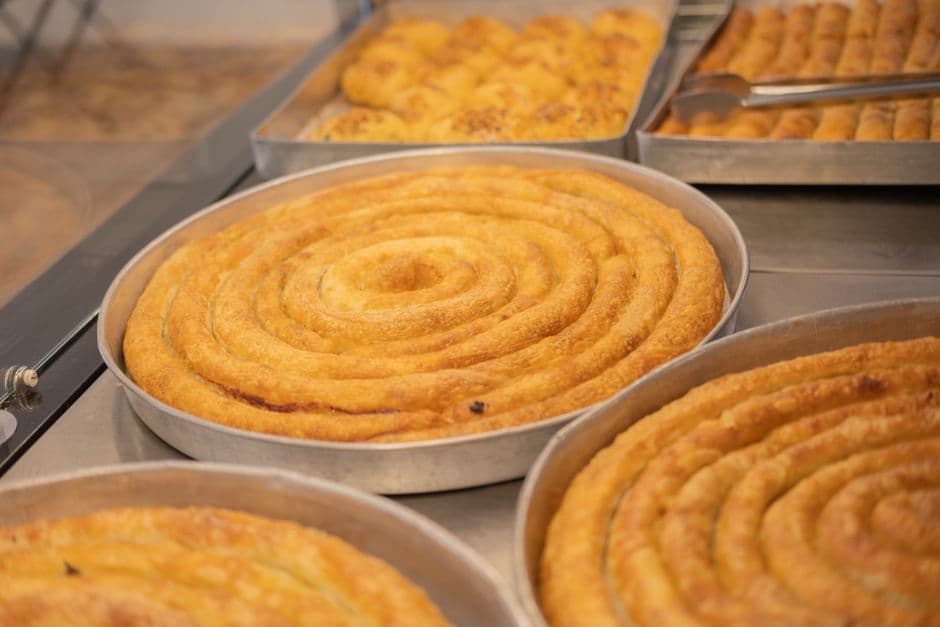
Crispy, golden layers of yufka pastry filled with salty white cheese and herbs — the quintessential Turkish savory pastry eaten at breakfast and as a snack across the country.
Börek (also spelled burek) is a vast family of savory pastries found across Turkey, the Balkans, and the Middle East — all connected by the use of thin, unleavened pastry sheets. In Turkey, the pastry is called yufka (similar to phyllo but slightly thicker and less brittle), and the fillings range from white cheese and parsley (peynirli), spinach and feta (ıspanaklı), to seasoned ground meat (kıymalı). The version described here is the archetypal su böreği — 'water börek' — which involves par-boiling the yufka sheets briefly before layering, creating an extraordinarily soft, silky interior beneath the crispy outer crust. It is considered by many Turkish food experts to be the most refined börek form, requiring patience but yielding a result that is incomparably tender. The assembly method is deliberate: layers of boiled and drained yufka are alternated with generous brushings of a milk-and-egg mixture and the filling, then the entire tray is baked until the top layer is deep golden and slightly puffed. The final börek should have distinct layers that pull apart into soft, molten sheets. White cheese (beyaz peynir — similar to feta but less salty) crumbled with abundant flat-leaf parsley is the classic filling. Börek appears at virtually every Turkish breakfast table, in every bakery (börekçi) as a morning snack, and is commonly eaten alongside a glass of tea or ayran.
Serves 6
Crumble the white cheese into a bowl and mix with the chopped parsley. Taste — if the cheese is very salty, rinse it briefly under cold water and drain well. The filling should be savory and herby. Set aside.
Use genuinely crumbly white cheese — pre-shredded mozzarella or processed cheese will not give the right texture.
Whisk together the eggs, milk, and oil in a bowl. This mixture is both the binding agent and what gives the börek its soft interior and golden color. Season with a pinch of salt.
Bring a large pot of lightly salted water to a rolling boil. Have a large bowl of cold water ready beside it. Lower one yufka sheet into the boiling water for 20-30 seconds until it softens and becomes pliable, then immediately transfer to the cold water for 20 seconds, then gently squeeze out excess water. Lay flat on a clean cloth. Repeat with all sheets.
Work quickly — over-boiling makes the pastry too fragile to handle. 20-25 seconds in boiling water is enough.
Oil a 30x20cm baking tray. Lay 2 boiled yufka sheets in the tray, allowing them to overhang the edges. Brush generously with the egg-milk mixture. Spread half the filling evenly over the surface.
Add 2 more boiled yufka sheets, pressing gently. Brush with more egg-milk mixture and spread the remaining filling. Finish with the last 2 sheets folded over the top. Fold in the overhanging edges to seal. Pour any remaining egg-milk mixture over the top.
Scatter nigella seeds and sesame seeds over the top. Bake at 180°C for 35-40 minutes until the top is deep golden brown and the edges are crispy. Let rest for 10 minutes before cutting into squares and serving.
The par-boiling step (su böreği method) is what separates a restaurant-quality börek from a dry, brittle version — don't skip it.
Beyaz peynir is less salty than feta — if using feta, taste the filling and adjust salt accordingly, or mix feta with ricotta 50:50.
Let börek rest for 10 minutes after baking before cutting — cutting immediately makes the layers collapse and steam escapes too quickly.
For a crispier exterior, brush the top with additional oil or beaten egg just before baking.
Börek reheats extremely well — a cold piece placed in a 180°C oven for 10 minutes crisps up beautifully.
Kıymalı börek: fill with seasoned ground beef cooked with onion, tomato paste, and cumin.
Ispanaklı börek: use sautéed and squeezed spinach mixed with white cheese as filling.
Sigara böreği: roll filling in thin strips of yufka into cigar shapes and deep-fry or pan-fry for a crispy appetizer.
Pan börek (tava böreği): assemble and cook in a non-stick pan on the stovetop rather than baking — faster and with an especially crispy base.
Börek keeps in an airtight container in the refrigerator for up to 3 days. To restore crispiness, reheat individual pieces in a 180°C oven or air fryer for 8-10 minutes — microwaving makes it soft and chewy. Börek can be frozen before baking; bake from frozen at 180°C for 50-55 minutes.
Börek's roots lie in the nomadic Turkic tradition of thin flatbread cookery that predates the Ottoman Empire. As Turkic peoples settled in Anatolia and established the Ottoman state, börek became a court food, with specialist börek makers (börekçi) employed in the Topkapı Palace kitchens as early as the 15th century. The word börek is derived from the Old Turkic word 'bur' meaning to twist or fold. Ottoman food culture spread börek across the Balkans and North Africa, explaining why variations like Macedonian burek and Moroccan bastilla share the same ancestor.
Yufka is slightly thicker and more pliable than Greek phyllo — it can be handled more easily without tearing and is sold in larger round sheets. Phyllo is a fine substitute but is drier and more prone to cracking, so brush it with oil between every layer and work quickly to prevent drying.
Yes — skip the boiling step for a crispier, flakier result. Brush each dry sheet generously with the egg-milk mixture before layering. The texture will be drier and more like a classic filo pie, but the flavor is the same. The boiled version (su böreği) produces a distinctly softer interior.
Usually the filling contained too much moisture. If using fresh spinach, wilt it, then squeeze out as much liquid as possible before using. If using feta, drain it well. Also ensure the oven is fully preheated to 180°C before the börek goes in.
Yes — assemble the börek, cover tightly with cling film, and refrigerate overnight before baking. This actually improves the result as the pastry absorbs the egg-milk mixture and the layers meld. Add 5-10 minutes to the baking time if going from cold.
Per serving (200g / 7.1 oz) · 6 servings total
Ask our AI cooking assistant anything about this recipe — substitutions, techniques, scaling.
Chat with AI Chef →Join the conversation
Sign in to leave a comment and save your favourite recipes
Have feedback or need help?
We read every email and reply within 1–2 business days.
© 2026 MyCookingCalendar. All rights reserved.