
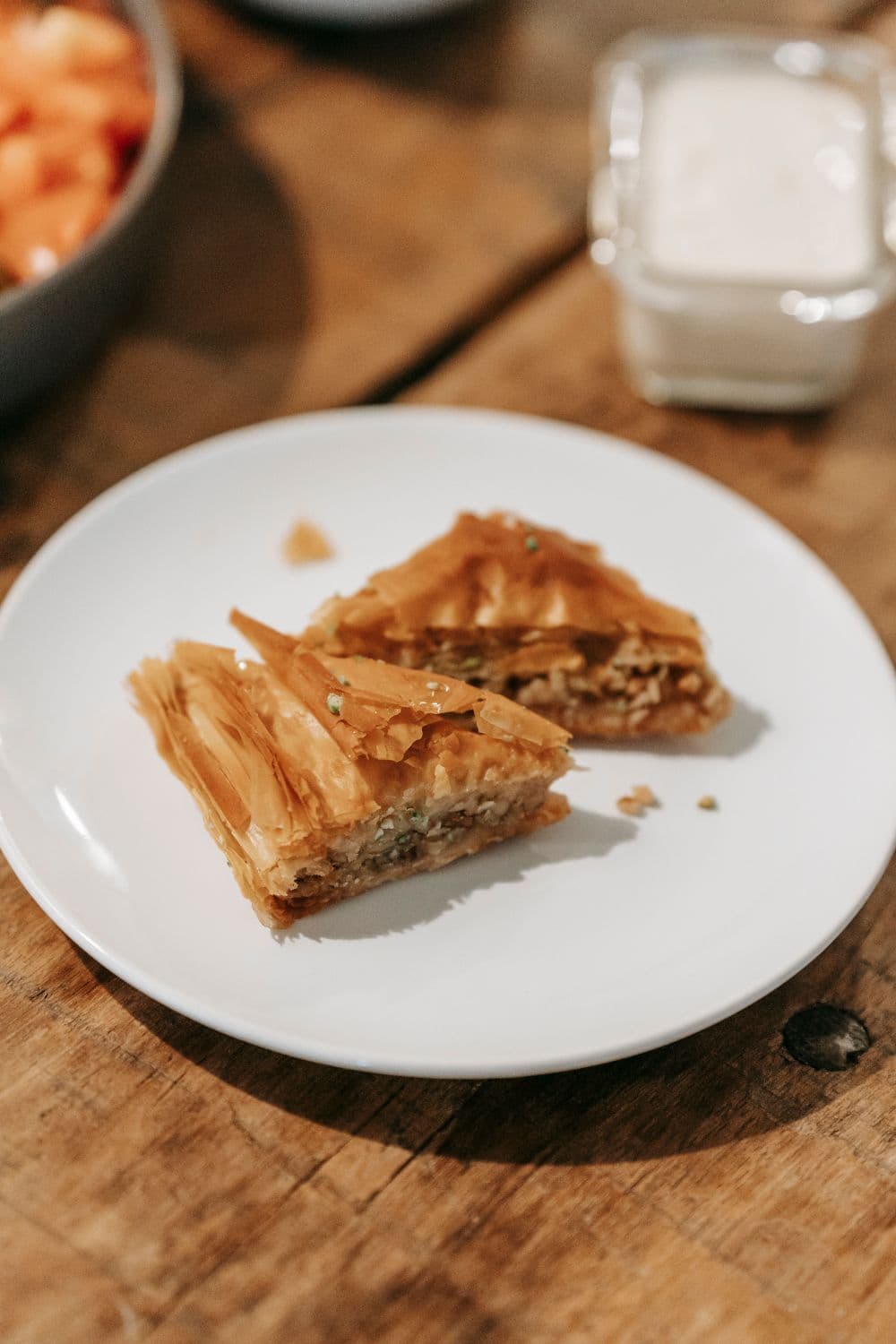
Baklava
Layered phyllo pastry with walnuts, pistachios, and honey syrup — buttery, sweet, sticky perfection.
About This Recipe
Baklava is one of the world's great desserts — dozens of paper-thin phyllo sheets, each painted with melted butter, layered with cinnamon-spiced walnuts and pistachios, baked to deep gold, and then drenched in a honey-lemon syrup that crackles and hisses as it hits the hot pastry. The defining rule is the temperature contrast: cool syrup over hot baklava (or the reverse) is what keeps the layers crisp instead of soggy. Greek baklava leans on honey and warm spices, while Turkish versions favor plain sugar syrup; both demand patience, since the pastry needs at least four hours to absorb its syrup before cutting. Made well, it shatters at the fork and stays sticky-sweet for two weeks.
Ingredients
Serves 24
- 500 gphyllo dough, thawed
- 300 gwalnuts, finely chopped
- 200 gpistachios, finely chopped
- 1 tspground cinnamon
- 1/4 tspground cloves
- 300 gunsalted butter, melted
- 1.5 cupssugar
- 1.5 cupswater
- 1/2 cuphoney
- 1lemon, juiced
- 1cinnamon stick
- 3whole cloves
Instructions
- 1
Prepare nuts
Pulse or chop the walnuts and pistachios until finely chopped but not powdered — small pebbly pieces give the best texture. Toss them with the ground cinnamon and cloves until evenly fragrant and set aside.
- 2
Layer phyllo
Brush a 9×13 inch baking dish generously with melted butter. Lay in 8 phyllo sheets one at a time, brushing each sheet completely with butter before adding the next — the butter between layers is what creates the shattering crispness.
Keep the phyllo stack covered with a barely damp towel while you work; exposed sheets dry out and crack within minutes.
- 3
Add nuts
Sprinkle one-third of the spiced nut mixture in an even layer over the phyllo, spreading it right to the edges so every cut piece gets its share. An offset spatula or your palm helps level it without tearing the pastry beneath.
- 4
Repeat layers
Cover the nuts with 4 more sheets of phyllo, buttering each, then another third of the nuts. Repeat once more, then finish with a final lid of 8 buttered sheets, brushing the top sheet especially well. Tuck any overhanging edges down into the sides of the dish.
- 5
Score
With a sharp knife, cut diagonal parallel lines about 4cm apart through the layers, then cross them in the opposite direction to form diamonds. Cut through the top layers cleanly but stop just short of the bottom — fully cut pastry can shift and drown in syrup later.
Score before baking, never after — baked phyllo shatters under the knife instead of cutting.
- 6
Bake
Bake at 175°C for about 50 minutes, until the top is deep golden brown and the layers look dry and crisp at the cut lines. If the top browns too quickly while the middle is pale, tent loosely with foil and continue baking.
- 7
Make syrup
While the baklava bakes, simmer the sugar, water, honey, lemon juice, cinnamon stick, and whole cloves for 15 minutes until lightly thickened. Remove the spices and let the syrup cool — it must be no more than lukewarm when the baklava comes out hot.
The lemon juice isn't just for flavor; its acidity prevents the syrup from crystallizing as the baklava sits.
- 8
Soak
Pour the cooled syrup slowly and evenly over the baklava the moment it leaves the oven — it will sizzle and bubble along the score lines. Let it sit uncovered at room temperature for at least 4 hours, preferably overnight, so the syrup fully penetrates before you finish cutting and serving.
Did you make this?
Rate it and help other cooks find the recipes that actually work.
One tap to sign in, and we'll save the rating you just picked.
Everything you need to plan your week — free
- Meal calendar
- Grocery list
- AI recipe ideas
Track what you eat
Snap your meal to log calories and macros, run fasting timers and track water in the free SnapCal app.
Pro Tips
- →
The golden rule: hot baklava + cool syrup, or cool baklava + hot syrup — never both at the same temperature, or it turns soggy.
- →
Score before baking and don't cut through the bottom layer until after the syrup has soaked in.
- →
Work fast with phyllo and keep waiting sheets under a barely damp towel; dried phyllo cracks and won't layer.
- →
Don't skimp on butter between layers — it's the laminating fat that makes the pastry crisp and flaky rather than papery.
- →
Wait the full 4+ hours before serving; under-soaked baklava tastes dry on top and wet at the bottom.
Variations
- •
Use all walnuts for the classic mainland Greek style, or all pistachios for a Gaziantep-inspired version.
- •
Add strips of orange zest to the syrup for a bright citrus perfume.
- •
Substitute a splash of rose water or orange blossom water in the syrup for a Middle Eastern accent.
- •
Roll the phyllo and nuts into cigars (saragli) instead of layering for an elegant rolled presentation.
Storage
Store covered at room temperature for up to 2 weeks — the flavor actually deepens over the first few days. Never refrigerate; the chilled humidity softens the layers and dulls the butter. It also freezes surprisingly well for 3 months.
History & Origin
Baklava's origins are genuinely contested — Greeks, Turks, and several Middle Eastern cultures all lay claim, and food historians trace possible ancestors from Byzantine layered breads to Central Asian stacked pastries. What's certain is that it reached its refined, paper-thin form in the Ottoman imperial kitchens at Topkapi Palace, from which regional styles spread across the empire. Greek baklava became distinct through its use of honey, cinnamon, and walnuts — some versions traditionally made with 33 layers, one for each year of Christ's life.
Frequently Asked Questions
Why is my baklava soggy?
Almost always a temperature error: hot syrup poured over hot pastry steams the layers soft. Follow the contrast rule — cool syrup over hot baklava, or hot syrup over fully cooled baklava. Other culprits are underbaking (the layers must be crisp and deeply golden before syruping) and refrigerating, which condenses moisture into the pastry. Stored at room temperature, properly made baklava stays crisp for days.
How do I keep phyllo from tearing and drying out?
Thaw it slowly overnight in the refrigerator, never on the counter or in the microwave, then let it sit at room temperature an hour before unrolling. Once open, immediately cover the stack with plastic wrap topped by a lightly damp towel, pulling one sheet at a time. Small tears don't matter at all — they vanish between buttered layers, so just patch and keep going.
Is baklava Greek or Turkish?
Both — and neither exclusively. The pastry's deep history spans the Byzantine and Ottoman worlds, and modern Greek and Turkish versions evolved side by side from the same Ottoman court tradition, so claiming a single origin is more nationalism than food history. The practical differences today: Greek baklava typically uses honey syrup, walnuts, and warm spices, while Turkish baklava favors sugar syrup and pistachios with thinner, crisper layers.
Can I make baklava ahead for an event?
It's actually ideal make-ahead dessert — baklava needs at least 4 hours, and is better after 24, for the syrup to fully saturate the layers. Bake and syrup it a day or two before your event and hold it covered at room temperature. It keeps beautifully for up to two weeks, making it perfect for holidays where it traditionally appears, like Greek Easter and Christmas.
Nutrition Facts
Per serving (80g / 2.8 oz) · 24 servings total
Time Summary
Have Questions?
Ask our AI cooking assistant anything about this recipe — substitutions, techniques, scaling.
Chat with AI Chef →Featured in Guides
This recipe is featured in the following curated guides:
More Greek Recipes
You Might Also Like
Similar dishes from other cuisines around the world.
Free Kitchen Tools
Calculators and converters that pair with this page — no signup needed.
Put This Into a Plan
Schedule it, shop for it, and track what you already have.
Read Next
Longer reads that go deeper on the ideas behind this dish.
Community
Join the conversation
Sign in to leave a comment and save your favourite recipes