
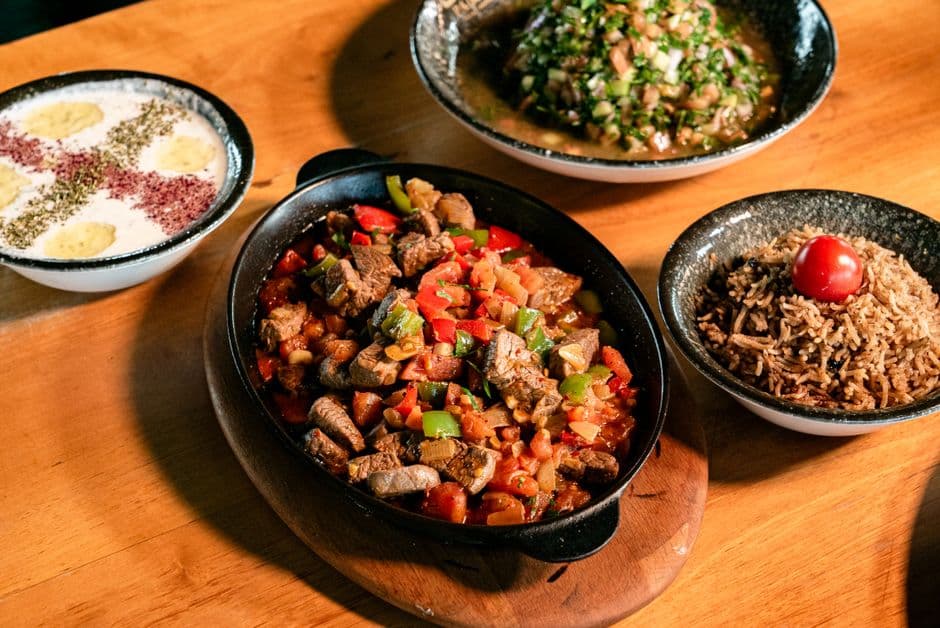
Bazin (Libyan Barley Dough with Lamb and Tomato Stew)
Libya's iconic celebration dish — a dense dome of cooked barley flour dough served at the center of a deep red lamb stew with potatoes and hard-boiled eggs, eaten communally by hand.
About This Recipe
Bazin is the most distinctive of all Libyan dishes — a deeply traditional preparation that defines the cuisine of Tripoli, Benghazi and the Libyan countryside, and the centerpiece of every important family gathering, wedding, and religious holiday. The dish is constructed in two parts: at its heart sits a large dome of bazin dough, made by cooking barley flour with boiling water and salt into a stiff, almost clay-like paste, then beating it furiously with a wooden stick until smooth and almost rubbery. This pale-grey dome is placed in the center of a wide platter, and around it is ladled a deep red, intensely spiced stew of lamb on the bone, potatoes, chickpeas, eggs hard-boiled in the same sauce, and a generous spoon of Libyan hararat spice mix — heavy on turmeric, cumin and dried chilli. To eat bazin, diners gather around the single platter, tear small balls of the dough with the right hand, press them into the sauce until soaked, top with a piece of lamb or potato, and pop into the mouth. The texture is initially strange to outsiders — the dough is dense and chewy, almost like a savory unsweetened mochi — but within a few bites the genius reveals itself: the bazin acts like an edible spoon that absorbs every drop of the powerful sauce, and the combination of starch, fat, spice and meat is profoundly satisfying. It is the original communal feast of the Sahara.
Ingredients
Serves 6
- 500 gbarley flour (or 60% barley flour and 40% whole wheat flour as substitute)
- 1 tspsalt (for the dough)
- 1 kgbone-in lamb shoulder or shank, cut into chunks
- 2 largeonions, finely chopped
- 4 tbsptomato paste
- 3 tbspLibyan hararat spice mix (or substitute: 1 tbsp paprika, 1 tbsp turmeric, 1 tsp cumin, 1 tsp coriander, 1 tsp black pepper, 1/2 tsp cinnamon)
- 2 tspground dried chilli or cayenne (Libyan bazin is hot)
- 4 mediumpotatoes, peeled and halved
- 1 can(400 g) chickpeas, drained
- 6eggs (hard-boiled in the last 15 minutes of stewing)
- olive oil, sea salt, and lemon wedges to serve
Instructions
- 1
Brown the lamb
Pat the lamb pieces dry. Heat 3 tbsp olive oil in a large heavy pot over high heat. Brown the lamb in batches, 4 minutes per side until deeply caramelized. Don't crowd the pot. Transfer to a plate.
- 2
Build the stew base
Reduce heat to medium. Add the chopped onions to the same pot and cook 10 minutes until softened and golden. Stir in the tomato paste and cook 2 minutes until darkened. Add the hararat spice mix and chilli and toast 60 seconds until intensely fragrant.
- 3
Simmer the lamb
Return the lamb and any juices to the pot. Add 1.5 litres water, 2 tsp salt, and bring to a boil. Skim foam, then reduce to a gentle simmer, cover, and cook 60 minutes. The lamb should be becoming tender; the broth should be a deep brick-red.
Skim the surface fat partway through and reserve — you'll drizzle some over the dough at serving.
- 4
Add potatoes and chickpeas
Add the halved potatoes and chickpeas to the pot. Simmer uncovered 25 more minutes, or until potatoes are fork-tender and the sauce has reduced and thickened slightly. Taste for salt and chilli — bazin sauce should be assertively spiced.
- 5
Hard-boil the eggs in the sauce
Carefully lower the whole raw eggs into the simmering stew. Cook 12 minutes. Lift out and peel. The eggs will have absorbed some color from the sauce — a hallmark of bazin.
- 6
Make the bazin dough
While the stew finishes, bring 600 ml water to a rolling boil in a heavy pot with 1 tsp salt. Reduce heat to low. Pour in the barley flour all at once and stir vigorously with a strong wooden spoon — it will form a stiff mass almost immediately. Keep stirring and beating for 4–5 minutes; the dough should become smooth, glossy, and pull away from the sides of the pot.
- 7
Shape the dome
Wet your hands with cold water. Working quickly while the dough is still hot, gather it into a ball and shape into a smooth dome about 15 cm across. Place dome-side-up in the centre of a deep, wide serving platter. The dough must be served hot.
- 8
Assemble and serve
Ladle the stew generously around (not over) the bazin dome — lamb, potatoes, chickpeas all visible. Tuck the halved eggs into the sauce around the dome. Drizzle a tablespoon of the reserved fat over the top of the dome. Carry to the table and serve communal-style: diners tear small pieces of the dough, dip in the sauce, top with meat, and eat with the right hand. Lemon wedges on the side.
Did you make this?
Rate it and help other cooks find the recipes that actually work.
One tap to sign in, and we'll save the rating you just picked.
Everything you need to plan your week — free
- Meal calendar
- Grocery list
- AI recipe ideas
Cook this hands-free
Get AI meal plans, step-by-step cooking mode, and your saved recipes in the free Bento app.
Pro Tips
- →
The bazin dough is unforgiving — work fast while it's hot, with wet hands. If it cools, it hardens like clay.
- →
If barley flour is unavailable, a mix of barley and whole wheat is acceptable; pure wheat changes the flavor too much.
- →
Hararat is a uniquely Libyan spice mix sold at North African groceries. The substitute blend above works but lacks the slight smokiness of the real thing.
- →
Don't fear the heat — Libyan bazin is meant to be spicy. If you're unsure, start with 1 tsp chilli and add more after tasting.
Variations
- •
Bazin abyad (white bazin) — vegetarian version with no meat, just chickpeas, potatoes and eggs in a turmeric-heavy sauce.
- •
Replace half the lamb with bone-in chicken for a lighter family version.
- •
Add 100 g of dried apricots to the stew for a sweeter southern Libyan version.
- •
Use buckwheat flour for a gluten-free approximation (texture will be slightly different).
Storage
Stew refrigerates 4 days; reheat gently. Bazin dough does not store well — it hardens irreparably. Make fresh dough each time; the stew is delicious the next day as a sauce for couscous or with bread. Freezes (stew only) 3 months.
History & Origin
Bazin is one of the oldest dishes of the Maghreb, with origins in the Berber communities of the Libyan and Saharan interior. Barley has been the staple grain of North Africa for over 3,000 years, and bazin developed as a way to make a quick, dense, nutrient-rich starch to pair with slow-cooked meats. It remains Libya's defining national dish.
Frequently Asked Questions
Can I make bazin in a stand mixer?
Yes — the dough hook on high speed for 4 minutes after you've combined hot water and flour works very well and saves the arm workout. Make sure the water is rolling-boil hot when you add the flour.
What does bazin taste like?
The dough is mildly nutty from barley, dense, and chewy — closer to a savory mochi than to bread. It's neutral by design, meant to soak up the powerful sauce.
Is it really eaten by hand?
Traditionally yes, with the right hand only. In modern households, forks are common and acceptable. Even at family gatherings, communal hand-eating remains the norm for major celebrations.
Where do I find hararat?
Larger Middle Eastern and North African groceries, or online from Maghreb specialty sellers. The substitute spice mix in the ingredients list gets you 90% of the way there.
Nutrition Facts
Per serving (480g / 16.9 oz) · 6 servings total
Time Summary
Have Questions?
Ask our AI cooking assistant anything about this recipe — substitutions, techniques, scaling.
Chat with AI Chef →Featured in Guides
This recipe is featured in the following curated guides:
More Libyan Recipes
You Might Also Like
Similar dishes from other cuisines around the world.
Free Kitchen Tools
Calculators and converters that pair with this page — no signup needed.
Put This Into a Plan
Schedule it, shop for it, and track what you already have.
Read Next
Longer reads that go deeper on the ideas behind this dish.
Community
Join the conversation
Sign in to leave a comment and save your favourite recipes