
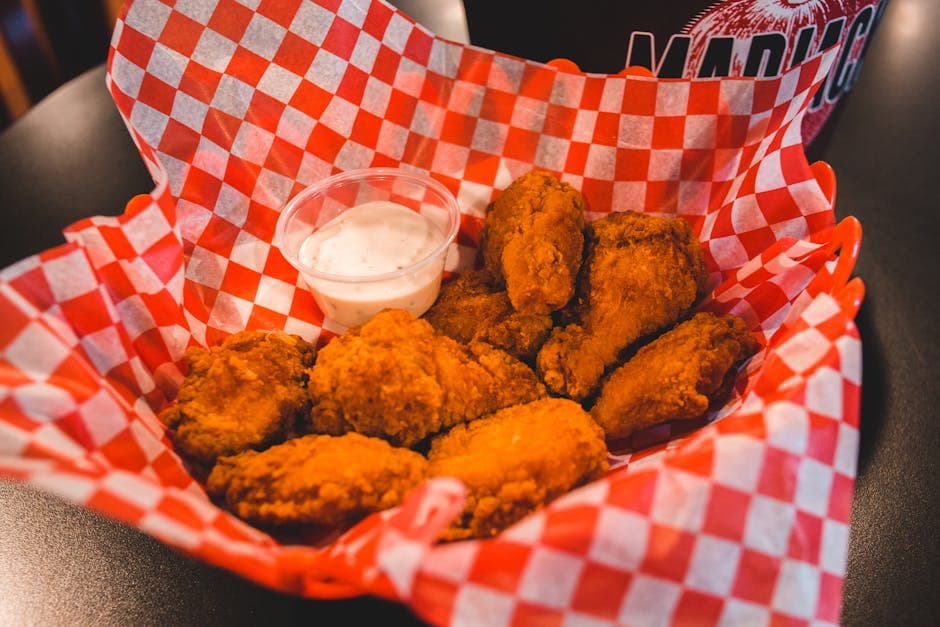
Buffalo Wings (Anchor Bar-Style Classic)
Deep-fried unbreaded chicken wings tossed in a sauce of Frank's hot sauce and melted butter — the original 1964 Buffalo, New York recipe.
About This Recipe
Buffalo wings are the most influential American snack food invented in the second half of the 20th century, and they have a precise origin: the Anchor Bar on Main Street in Buffalo, New York, in 1964, where co-owner Teressa Bellissimo deep-fried a tray of chicken wings late one night for her son's friends and tossed them in a quickly improvised sauce of melted butter and Frank's RedHot. Within a decade, wings had spread from Buffalo across the country and become the official bar food of American sports television. The original recipe is shockingly simple — and that simplicity is the point. Wings (the whole wing split into drumettes and flats, tips discarded or saved for stock) are deep-fried twice or fried hot, undressed, with no breading. The sauce is just hot sauce, butter, and a touch of vinegar — Frank's RedHot specifically, because the original recipe used what was on the shelf and the flavor profile (cayenne pepper, vinegar, garlic powder) is now locked in. Wings are tossed in the sauce while still hot from the fryer so the butter clings, served on a plain plate with celery sticks and blue cheese dressing for cooling. Eat with hands, expect wet napkins, and follow the original protocol: drumette first because it's the cleaner bite.
Ingredients
Serves 4
- 1.4 kgwhole chicken wings, separated into drumettes and flats (tips removed)
- 1.5 Lneutral oil for frying (peanut, canola or vegetable)
- 1 tspkosher salt
- 1 tspgarlic powder (optional)
- 180 mlFrank's RedHot Original cayenne sauce (no substitutes for authenticity)
- 115 gunsalted butter
- 1 tbspwhite vinegar
- 1 tspWorcestershire sauce (optional)
- 0.5 tspgarlic powder (for sauce)
- 0.25 tspcayenne pepper (for extra heat)
- 1 bunchcelery, cut into sticks
- 240 mlchunky blue cheese dressing (Marie's or homemade)
Instructions
- 1
Dry the wings thoroughly
Pat wings completely dry with paper towels — moisture is the enemy of crisp skin. Toss with the salt and (optional) garlic powder and let sit uncovered on a rack in the fridge for at least 1 hour, ideally overnight. The dry surface is what produces shatter-crisp skin without breading.
- 2
Heat the oil
In a heavy 6-quart Dutch oven or deep fryer, heat oil to 150°C / 300°F (the low temperature for the first fry). Use a candy thermometer — guessing leads to soggy wings. The oil should be at least 8 cm deep but no more than half-full in the pot.
- 3
First fry — low and slow
Working in 2 batches to avoid crowding, fry wings 8 minutes at 150°C / 300°F. They will look pale and floppy — that's correct. This first fry renders fat from beneath the skin so the second fry can crisp it. Lift to a rack to drain and cool 5+ minutes between fries.
Skip this step and the wings will be greasy. The double-fry is the secret to restaurant-quality crisp.
- 4
Make the sauce
While the wings rest, melt the butter in a small saucepan over low heat. Whisk in Frank's RedHot, vinegar, Worcestershire, garlic powder and extra cayenne. Bring to a bare simmer, whisk to emulsify, and pull off the heat. Keep warm. The ratio should be roughly 2:1 hot sauce to butter — adjust upward in butter for milder, in hot sauce for hotter.
- 5
Second fry — hot and fast
Crank the oil to 190°C / 375°F. Working in batches again, fry wings 3–4 minutes until deep golden and the skin shatters when you tap with tongs. Drain on a fresh rack — never on paper, which steams them limp.
- 6
Toss immediately
Transfer hot wings to a large stainless steel bowl. Pour the warm Buffalo sauce over and toss vigorously by lifting the bowl and tumbling — this coats every surface without dislodging crisp skin. Toss for a full 30 seconds; the butter clings only while hot.
- 7
Plate without delay
Pile onto a serving plate (do not let wings sit in residual sauce — they'll go soggy). Serve immediately with celery sticks and a small bowl of blue cheese dressing. Provide a stack of napkins; there is no clean way to eat Buffalo wings.
- 8
Repeat the ritual
For multiple batches, fry and sauce in waves so each plate goes out hot. Buffalo wings wait for no one — even 5 minutes off the line is the difference between glory and disappointment.
Did you make this?
Rate it and help other cooks find the recipes that actually work.
One tap to sign in, and we'll save the rating you just picked.
Everything you need to plan your week — free
- Meal calendar
- Grocery list
- AI recipe ideas
Track what you eat
Snap your meal to log calories and macros, run fasting timers and track water in the free SnapCal app.
Pro Tips
- →
Frank's RedHot is non-negotiable for the original flavor — Tabasco is too thin and vinegar-forward, Crystal too mild. The Buffalo profile is built on Frank's specific cayenne and garlic blend.
- →
Don't bread the wings. Real Buffalo wings have no flour, no batter, no cornstarch — just well-dried skin. Restaurant chains break this rule, but the original doesn't.
- →
Blue cheese, not ranch. Buffalo, NY, considers ranch a Midwestern compromise; chunky blue cheese is the only correct dip.
- →
If you don't want to deep-fry, air-fry at 200°C / 400°F for 25 minutes, flipping halfway. Not identical, but very close. Oven-bake at 230°C / 450°F on a rack for 45 minutes flipping once.
Variations
- •
Mild: increase butter to 170 g and decrease Frank's to 120 ml.
- •
Suicide hot: add 2 tablespoons of habanero hot sauce or 1 tsp ghost pepper sauce to the standard sauce.
- •
Honey BBQ: substitute equal parts honey BBQ sauce for the Frank's-and-butter, for kids and the heat-averse.
- •
Garlic Parmesan: skip the hot sauce, toss wings in melted butter, minced raw garlic, parsley and grated Parmesan — a popular non-spicy alternative.
Storage
Buffalo wings are best the moment they come out of the sauce. Leftover wings refrigerate 2 days; re-crisp in a 220°C / 425°F oven for 8 minutes, then re-toss in fresh warm sauce. Never microwave — they turn rubbery and the sauce separates.
History & Origin
Buffalo wings were invented at the Anchor Bar in Buffalo, NY, in 1964 by Teressa Bellissimo as a late-night snack for her son Dominic's friends. The dish was unknown outside Buffalo until the 1980s, when it spread nationally and became the defining American bar food.
Frequently Asked Questions
Why don't they have breading?
Because the original 1964 version didn't. Breading is a regional and chain-restaurant adaptation that produces a heavier, less crisp result. Real Buffalo wings rely on dry skin and a double fry for crispness.
Can I make Buffalo wings ahead?
Fry the wings up to 4 hours ahead and keep them at room temperature on a rack. Re-crisp in a 220°C / 425°F oven for 6 minutes just before tossing in fresh sauce. Saucing too early always leads to sogginess.
What's the difference between Buffalo and hot wings?
Buffalo wings are a specific recipe (Frank's + butter from Anchor Bar 1964). 'Hot wings' is a generic category that can mean anything from breaded chains' versions to dry-rubbed Memphis wings. All Buffalo wings are hot wings; not all hot wings are Buffalo.
Is ranch dressing wrong?
Culturally, yes — Buffalo natives serve blue cheese only. The ranch-with-wings convention spread from Midwest pizza chains in the 1980s and is now widespread but considered an outsider habit in western New York.
Nutrition Facts
Per serving (280g / 9.9 oz) · 4 servings total
Time Summary
Have Questions?
Ask our AI cooking assistant anything about this recipe — substitutions, techniques, scaling.
Chat with AI Chef →Featured in Guides
This recipe is featured in the following curated guides:
More American Recipes
You Might Also Like
Similar dishes from other cuisines around the world.
Browse by Ingredient
More recipes built around the same core ingredients.
Free Kitchen Tools
Calculators and converters that pair with this page — no signup needed.
Put This Into a Plan
Schedule it, shop for it, and track what you already have.
Read Next
Longer reads that go deeper on the ideas behind this dish.
Community
Join the conversation
Sign in to leave a comment and save your favourite recipes