
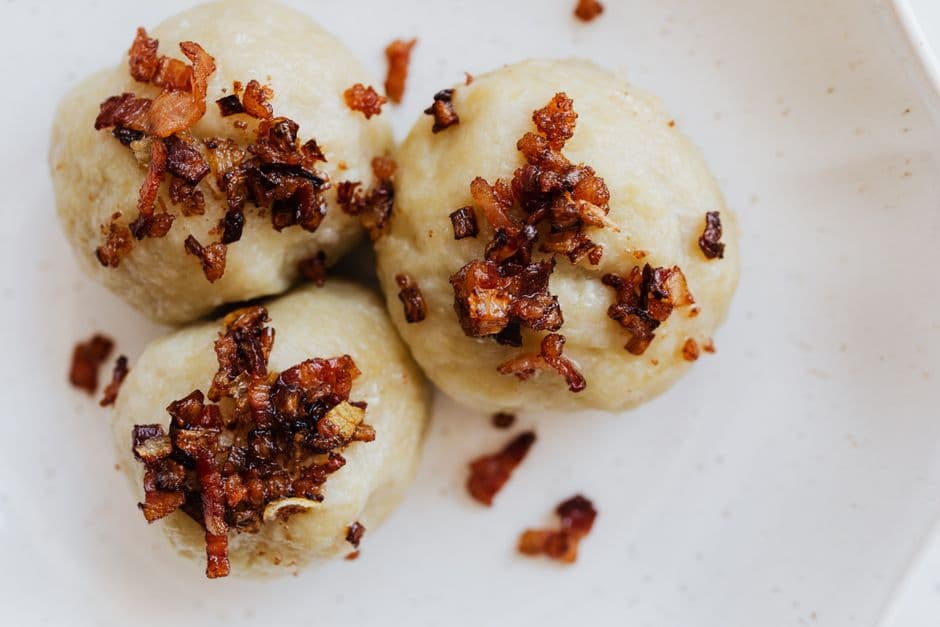
Cepelinai (Lithuanian Potato Dumplings Stuffed with Pork)
Lithuania's beloved 'zeppelin' dumplings — large potato dumplings stuffed with seasoned ground pork, boiled gently and served with crispy bacon-onion sauce and sour cream.
About This Recipe
Cepelinai are the national dish of Lithuania and arguably the heaviest, most satisfying dumplings in Europe — large, oval potato dumplings, each about the size of a fist and the shape of a small zeppelin (hence the name, from the German aircraft), filled with seasoned ground pork and poached gently in salted water until the potato shell turns translucent and glossy. The technique is genuinely unusual: half the potatoes are grated raw and squeezed almost dry, the other half are cooked and mashed, and the two are combined with a little potato starch to create a stretchy, almost gluten-like dough capable of wrapping around the meat without tearing during the long poach. The result is a dumpling with a texture unlike anything else in European cooking — outside almost rubbery and elastic, inside a juicy pocket of pork seasoned with marjoram, onion and pepper. Served two or three to a plate (one is dinner enough for most), they are drowned in spirgučiai — a sauce of cubed smoked bacon rendered crispy with caramelized onions in its own fat — and topped with a heroic dollop of cold sour cream that melts into the hot dumpling. This is the food of Lithuanian Sunday lunch, of grandmother's kitchens, and of winter dinners that justify several hours in the kitchen and a long nap afterward.
Ingredients
Serves 4
- 1.5 kgstarchy potatoes (Russet), peeled — half for grating, half for boiling
- 1 smallonion, grated (to prevent oxidation)
- 30 gpotato starch, plus 1 tsp salt for the dough
- 400 gground pork (50% shoulder, 50% belly for proper fat content)
- 1 mediumonion, finely diced (for the filling)
- 2 tspdried marjoram (essential — non-negotiable for cepelinai flavor)
- 1 tspsalt and 1/2 tsp pepper for the filling
- 200 gsmoked bacon, cut into 5 mm cubes (for spirgučiai sauce)
- 2 largeonions, finely chopped (for the sauce)
- 200 gthick sour cream (smetana), cold, to serve
Instructions
- 1
Make the filling
In a skillet, sweat the diced onion in 1 tbsp oil over medium heat 5 minutes until translucent. Cool completely. Combine with the ground pork, marjoram, salt, pepper, and 3 tbsp ice-cold water in a bowl. Mix well with hands until tacky. Form into 8 walnut-sized balls and refrigerate while you make the dough.
- 2
Boil half the potatoes
Cut 750 g of the peeled potatoes into chunks. Boil in salted water 18 minutes until very soft. Drain thoroughly and let steam off for 3 minutes, then mash smooth with a ricer (not a masher — you need ricer-fine texture). Cool until just warm.
- 3
Grate the raw potatoes
On the smallest holes of a box grater, grate the remaining 750 g raw potatoes into a bowl with the grated small onion. Transfer to a clean kitchen towel and squeeze hard over a bowl to extract all the liquid — you should get about 250 ml of starchy water. Let it settle 5 minutes; carefully pour off the clear water, leaving the thick white starch at the bottom. Scrape that starch back into the grated potatoes.
- 4
Combine the dough
In a large bowl, combine the squeezed raw potatoes, the riced cooked potatoes, the potato starch, and 1 tsp salt. Knead by hand for 2–3 minutes until you have a soft, slightly tacky dough that holds together when squeezed. If too wet, add 1–2 more tbsp potato starch; if too dry, a splash of cold water.
- 5
Form the cepelinai
Bring a large wide pot of generously salted water to a gentle boil (not a roar — they'll burst). Divide the dough into 8 portions. Wet your hands. Flatten one portion into a circle in your palm, place a pork ball in the centre, and carefully bring the dough up and around the meat, sealing completely. Smooth into an oval zeppelin shape. Place on a damp tray. Repeat with all 8.
Seal carefully — any hole and the filling escapes during cooking. Pinch firmly and smooth with wet fingers.
- 6
Poach the cepelinai
Carefully lower the cepelinai into the gently simmering water with a slotted spoon — work in batches of 4 to avoid crowding. Once they float (about 2 minutes), reduce heat to barely simmering and cook 25–30 minutes uncovered. The dough should turn glossy-translucent. Do not let the water boil hard or they'll burst.
- 7
Make the spirgučiai sauce
While the cepelinai poach, render the bacon cubes in a dry skillet over medium-low heat 8 minutes until crisp and the fat has rendered out. Add the chopped onions and a pinch of salt. Cook 10–12 minutes more until onions are deeply golden and tender. The sauce should be a generous pool of bacon-onion fat with crisp bits suspended throughout.
- 8
Serve
Lift the cepelinai out with a slotted spoon, draining well. Place 2 on each warm plate. Spoon a generous quantity of the hot spirgučiai sauce over each. Top with a heroic dollop of cold sour cream — it will melt into a stream of dairy down the dumpling. Serve immediately, with cold beer and pickles on the side. One is plenty for most diners; two is the traditional portion.
Did you make this?
Rate it and help other cooks find the recipes that actually work.
One tap to sign in, and we'll save the rating you just picked.
Everything you need to plan your week — free
- Meal calendar
- Grocery list
- AI recipe ideas
Cook this hands-free
Get AI meal plans, step-by-step cooking mode, and your saved recipes in the free Bento app.
Pro Tips
- →
The proportion of raw-grated to cooked-mashed potato (1:1) is the secret — too much raw means rubber, too much cooked means dumplings that fall apart.
- →
Don't boil hard — gentle simmer only. Boiling water tears the delicate dough.
- →
Don't skip marjoram in the pork — it's the herb that makes cepelinai taste Lithuanian rather than just generic European dumplings.
- →
Sour cream MUST be cold and thick — the contrast with the hot dumpling and salty bacon sauce is the heart of the dish.
Variations
- •
Vegetarian cepelinai — fill with mashed curd cheese (varškė) and onion for a Friday/Lent version called varškinai cepelinai.
- •
Wild mushroom filling — porcini and onion braised in butter for a deeply earthy autumn version.
- •
Serve with mushroom-sour-cream gravy instead of bacon sauce for a richer dinner-party version.
- •
Smaller cepelinai (half the size) cook in 15 minutes and are friendlier to less hardy appetites.
Storage
Best eaten fresh. Leftovers refrigerate 3 days; reheat in simmering water 8 minutes or in a covered skillet with a splash of water. Freeze uncooked cepelinai on a tray, then bag — cook from frozen, adding 10 minutes to poach time. Do not microwave.
History & Origin
Cepelinai entered Lithuanian cuisine in the 19th century after the potato had spread across Eastern Europe, gaining their distinctive name during the early 20th century when zeppelin airships fascinated the public imagination. They quickly became the symbol of Lithuanian rural cuisine and were officially designated the national dish in modern times.
Frequently Asked Questions
Why did my cepelinai burst?
Either the water boiled too hard, or the seal wasn't tight. Use very gentle simmer and pinch the dough firmly, smoothing with wet fingers to close any tiny gaps.
Are cepelinai really that heavy?
Yes. They are dense, satisfying, and very filling. One large cepelinas is usually enough for a single meal — Lithuanians treat them as the main event, not a side.
Can I substitute regular flour for potato starch?
Not well — potato starch gives the dough its signature stretchy, almost gluten-free elasticity. Cornstarch is the closest substitute; regular flour makes them more like pierogi.
What if I don't have a ricer?
A food mill works. A masher is acceptable but you'll have lumps. Avoid food processors — they make potato glue.
Nutrition Facts
Per serving (540g / 19.0 oz) · 4 servings total
Time Summary
Have Questions?
Ask our AI cooking assistant anything about this recipe — substitutions, techniques, scaling.
Chat with AI Chef →Featured in Guides
This recipe is featured in the following curated guides:
More Lithuanian Recipes
You Might Also Like
Similar dishes from other cuisines around the world.
Free Kitchen Tools
Calculators and converters that pair with this page — no signup needed.
Put This Into a Plan
Schedule it, shop for it, and track what you already have.
Read Next
Longer reads that go deeper on the ideas behind this dish.
Community
Join the conversation
Sign in to leave a comment and save your favourite recipes