
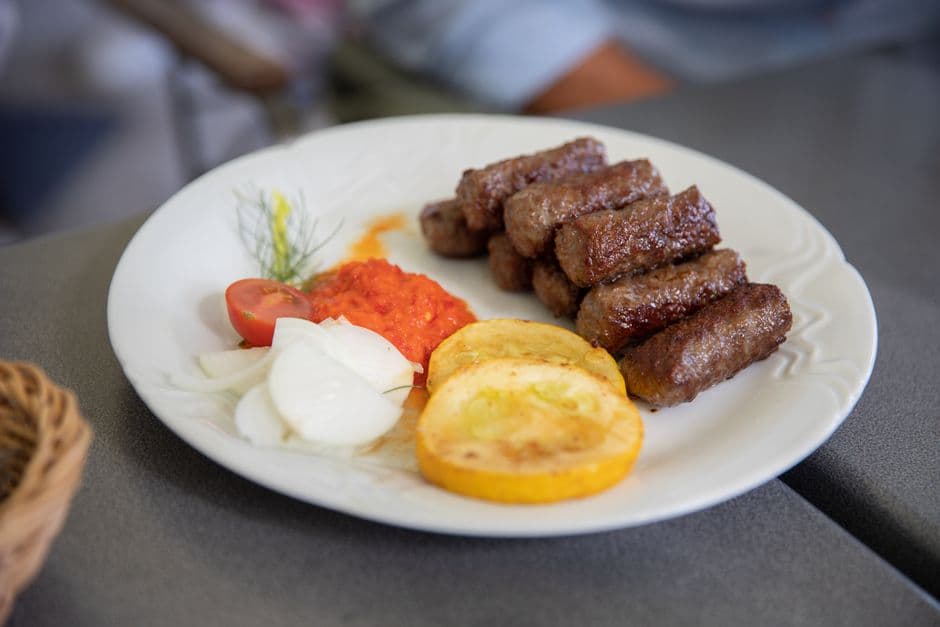
Ćevapi (Bosnian Grilled Beef Sausages with Somun and Onion)
Small skinless minced-beef sausages, kneaded with garlic and bicarbonate of soda, grilled hard over charcoal until smoky and tender, served in warm somun flatbread with raw onion and kajmak — Sarajevo's most famous food.
About This Recipe
Ćevapi (or ćevapčići, the diminutive) are the most iconic street food of Bosnia and Herzegovina, beloved across the entire former Yugoslavia but most fiercely defended in Sarajevo, where every dedicated ćevabdžinica has its own secret recipe and devotees who insist no other version comes close. The principle is deceptively simple: very fresh minced beef (sometimes with a touch of lamb), seasoned only with salt, garlic water and a small pinch of bicarbonate of soda, kneaded until the meat becomes elastic and tacky, then rested overnight to develop flavour and texture. The mixture is shaped by hand into small skinless sausages — about the thickness of a finger and 7 cm long, not pencil-thin and not bratwurst-thick — and grilled hard over white-hot charcoal so the outside chars and gets smoky while the inside stays juicy. The classic serving is uncompromising: 5 to 10 ćevapi tucked into a warm split somun (a soft round Bosnian flatbread that absorbs the meat juices), with a heap of raw chopped onion alongside, and a spoonful of kajmak — the cultured clotted cream of the western Balkans, somewhere between butter and cream cheese, that melts gloriously over the hot meat. Add ajvar (red pepper relish) if you wish, but Sarajevans will tell you the holy trinity is meat, bread and onion. Eaten with a cold dark beer or a glass of šljivovica plum brandy, ćevapi are the meal that defines Sarajevo's Baščaršija old town and that Bosnian families abroad miss most fiercely.
Ingredients
Serves 4
- 700 gfreshly ground beef chuck (20% fat)(best ground twice through a coarse plate)
- 200 gfreshly ground lamb shoulder (optional but traditional in some recipes)
- 4garlic cloves, crushed to a paste with a pinch of salt
- 100 mlvery cold sparkling water (or plain ice water)
- 1 tspbicarbonate of soda (baking soda)(the secret that gives the bouncy tender texture)
- 1 tspfine sea salt plus 1 tsp freshly ground black pepper
- 4fresh somun flatbreads, or 4 thick warm pitas split open
- 2 largewhite onions, very finely chopped (raw)
- 100 gkajmak (or thick crème fraîche/mascarpone mixed with feta)(Balkan groceries; the right kajmak transforms the dish)
- ajvar (red pepper relish), pickled chillies, and cold beer to serve
Instructions
- 1
Make garlic water
Whisk the crushed garlic paste into the cold sparkling water in a small jug. Let sit 10 minutes — the garlic infuses the water and the sparkling bubbles add lightness to the meat later.
- 2
Mix the meat
In a large bowl, combine both ground meats. Add the bicarbonate of soda, salt and pepper. Pour over the garlic water, straining out the garlic solids (or leaving them in if you like a stronger garlic note). Knead hard with your hands for 4–5 minutes — the mixture should become smooth, elastic, tacky and slightly lighter in colour as it incorporates air. This kneading develops the bouncy texture.
Wet your hands with cold water to prevent sticking; the soda starts working immediately.
- 3
Rest overnight
Cover the bowl tightly and refrigerate at minimum 8 hours, ideally 24. The rest is non-negotiable — the bicarbonate of soda works on the meat proteins to tenderise and give that characteristic bouncy bite, and the flavours develop substantially.
Some Sarajevo masters rest the mix 48 hours and use even older meat — the flavour is markedly deeper.
- 4
Shape the ćevapi
Wet your hands with cold water. Take a heaped tablespoon of mixture (about 35 g) and roll between your palms into a smooth sausage shape — about 7 cm long, the thickness of a finger, rounded at both ends. Lay on a tray as you go. Aim for 25–30 ćevapi. Keep cold until grilling.
- 5
Heat the grill hard
Light a charcoal grill and let the coals burn down to white-hot — they should make you instinctively pull your hand away after 2 seconds at grill height. A gas grill should be on its highest setting for 10 minutes. The ćevapi need fierce heat to char outside before the inside dries out.
- 6
Grill quick and hot
Brush grill grates lightly with oil. Lay ćevapi across the grates and grill 2–3 minutes per side, turning once or twice, until they have deep mahogany char marks all around and feel firm but yielding when pressed. Total cook time 6–8 minutes — much longer and they go dry. The inside should be juicy and just-cooked, not pink, not grey.
If using a stovetop grill pan, do it with the kitchen extractor on full — they smoke beautifully.
- 7
Warm the somun
While the ćevapi rest 2 minutes, warm the somun directly on the grill 30 seconds per side until just toasted and pliable. Split each open to make a pocket — but the bread should still be soft, not crisp.
- 8
Assemble and serve
Place 5–7 ćevapi in each warm somun pocket. Top with a generous handful of raw chopped onion and a spoonful of kajmak laid directly on the hot meat so it begins to melt. Set on a plate with a side of ajvar, pickled chillies, and another mound of raw onion on the side. Eat immediately with the hands, with cold dark beer or chilled šljivovica.
Did you make this?
Rate it and help other cooks find the recipes that actually work.
One tap to sign in, and we'll save the rating you just picked.
Everything you need to plan your week — free
- Meal calendar
- Grocery list
- AI recipe ideas
Cook this hands-free
Get AI meal plans, step-by-step cooking mode, and your saved recipes in the free Bento app.
Pro Tips
- →
Resting the meat 24 hours after kneading is the single most important step — never skip it. The bicarbonate of soda needs time to work.
- →
Real kajmak is hard to find outside the Balkans; mix mascarpone with crumbled feta and a tiny splash of cream for a passable substitute.
- →
Don't be tempted to season with paprika, cumin or anything else — ćevapi are fundamentally about meat, salt, garlic and char.
- →
Charcoal makes a massive difference; gas grill works but ćevapi without smoke flavour are like espresso without crema.
Variations
- •
Banja Luka ćevapi — northern Bosnian version where 4 ćevapi are joined together as small grids (rather than separate sausages) and served as one piece per portion.
- •
Lamb ćevapi — 100% lamb shoulder for a richer, gamier version popular in Serbia.
- •
Pljeskavica — the same meat mixture pressed into a single large flat patty (Balkan burger) and grilled.
- •
Vegetarian ćevapi — made with mushrooms, walnuts, breadcrumbs and beans; surprisingly good when grilled hard.
Storage
Uncooked shaped ćevapi keep refrigerated 24 hours, or freeze on a tray then bag — grill from frozen, adding 3 minutes. Cooked ćevapi keep refrigerated 3 days and are excellent reheated in a hot pan with a splash of water. The meat mixture itself, unshaped, can be made up to 48 hours ahead.
History & Origin
Ćevapi descend from the Turkish kebabs that arrived with Ottoman rule in the 15th and 16th centuries and gradually evolved into the small skinless beef sausage form across the central Balkans. Sarajevo's old-town ćevabdžinica restaurants formalized the dish in the 19th century, and Sarajevo-style ćevapi served in somun with onion remain the most celebrated version, with famous shops like Petica and Željo open since the 1950s.
Frequently Asked Questions
Can I make these without bicarbonate of soda?
You can but the texture will be denser and less tender. The soda raises pH and helps the meat retain moisture during high-heat grilling — it's a small amount and you can't taste it.
What's somun? Can I substitute?
Somun is a soft round Bosnian flatbread similar to a thick, slightly puffier pita. Warm pita is a workable substitute; warm naan is too oily. Frozen Bosnian somun is sold at Balkan groceries.
How spicy are ćevapi?
Not at all — they're seasoned only with salt, pepper and garlic. The heat comes from optional pickled chillies and the punch from raw onion. Spicy ćevapi is not a real thing.
Can I cook these in the oven or pan?
Pan-frying in a smoking-hot cast-iron skillet gives 80% of the experience. Oven-broiling at full heat works for large batches. But the charcoal smoke really is part of the dish.
Nutrition Facts
Per serving (360g / 12.7 oz) · 4 servings total
Time Summary
Have Questions?
Ask our AI cooking assistant anything about this recipe — substitutions, techniques, scaling.
Chat with AI Chef →Featured in Guides
This recipe is featured in the following curated guides:
More Bosnian Recipes
You Might Also Like
Similar dishes from other cuisines around the world.
Free Kitchen Tools
Calculators and converters that pair with this page — no signup needed.
Put This Into a Plan
Schedule it, shop for it, and track what you already have.
Read Next
Longer reads that go deeper on the ideas behind this dish.
Community
Join the conversation
Sign in to leave a comment and save your favourite recipes