
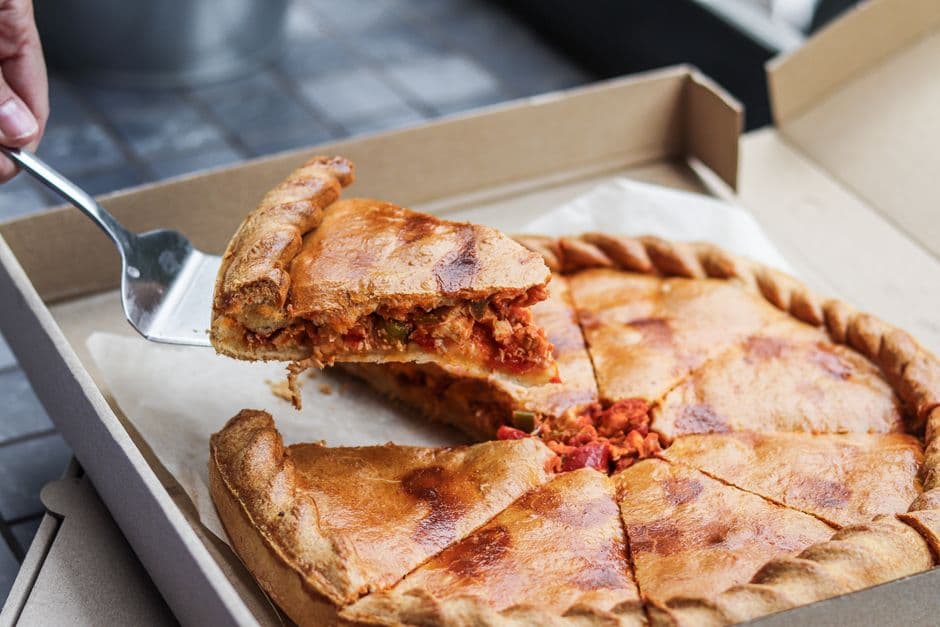
Chicago Deep-Dish Pizza
A buttery, cornmeal-laced pan pizza with a 5-cm wall of crust, layers of low-moisture mozzarella, Italian sausage, and chunky San Marzano tomato sauce on top — the iconic Chicago invention.
About This Recipe
Chicago deep-dish pizza is its own creature — closer to a savory pie than the Neapolitan-derived flatbread most of the world calls pizza. Invented in 1943 at Pizzeria Uno on Ohio Street by Ike Sewell and Ric Riccardo, it was conceived as a hearty, knife-and-fork Italian dish that could serve as a substantial dinner rather than a snack. The defining geometry is the high-walled crust: a buttery, slightly flaky dough made with cornmeal and oil (sometimes shortening), pressed into a deep, well-oiled round steel pan and built up 4–5 cm at the edges. Construction is inverted from any other pizza: mozzarella goes directly on the dough as an insulating moisture barrier; toppings (most classically loose Italian sausage flattened into a single uninterrupted disc) come next; and a thick, almost chunky San Marzano tomato sauce — barely cooked, herb-flecked — is ladled on top, finished with grated Parmigiano. It bakes for nearly 40 minutes at 220°C, emerging deep brown and bubbling, requiring a 10-minute rest before slicing or the molten cheese will collapse. Chicagoans distinguish it sharply from 'stuffed pizza' (Giordano's, Edwardo's), which adds a second sheet of dough sealing in the cheese. Deep-dish is divisive — New Yorkers love to mock it — but executed properly, with hand-stretched dough and quality canned tomatoes, it is one of America's great regional inventions.
Ingredients
Serves 6
- 375 gall-purpose flour (or bread flour for chewier crust)
- 60 gfine yellow cornmeal
- 1 tspfine sea salt
- 2 tspgranulated sugar
- 7 ginstant yeast (1 packet)
- 240 mlwarm water (40°C)
- 60 mlneutral oil (corn or canola)
- 45 gunsalted butter, melted, plus more for pan
- 400 glow-moisture whole-milk mozzarella, sliced 5 mm thick
- 400 gbulk Italian sausage (mild or hot), uncooked
- 1 can (800 g)whole San Marzano tomatoes, hand-crushed and drained briefly
- 2 clovesgarlic, finely grated
- 1 tspdried oregano
- 1/2 tspred pepper flakes
- 1 tbspolive oil
- 50 gfreshly grated Parmigiano-Reggiano
- 10 leavesfresh basil, torn (optional)
Instructions
- 1
Mix the dough
In a stand mixer with the paddle attachment, combine flour, cornmeal, salt, sugar and yeast. Add warm water, oil and melted butter. Mix on low 2 minutes until shaggy, then switch to the dough hook and knead on medium-low 6 minutes. The dough should be soft, slightly oily, and elastic but not dry.
- 2
First rise
Transfer the dough to a lightly oiled bowl, cover with plastic wrap, and let rise at room temperature 90 minutes — it should nearly double. The cornmeal and high fat content slow the rise compared to standard pizza dough, which is normal.
- 3
Make the sauce
Hand-crush the San Marzanos in a bowl into rough chunks (a deep-dish sauce should look like crushed tomatoes, not puree). Drain off about a third of the liquid. Stir in the grated garlic, oregano, red pepper flakes, olive oil, and a heavy pinch of salt. Do not cook the sauce — it cooks on the pizza.
- 4
Press into the pan
Generously butter a 30 cm (12-inch) deep-dish pizza pan or 5 cm-tall cake pan. Press the dough into the pan, working it up the sides to 5 cm of wall thickness, fully covering the bottom and walls. The dough should be slightly thicker on the bottom than the walls. Let rest 15 minutes uncovered.
- 5
Layer the cheese
Heat the oven to 220°C / 425°F with a rack in the lower third. Lay the sliced mozzarella over the entire bottom of the dough, overlapping pieces and going right up to the wall. The cheese acts as a moisture barrier protecting the crust from the sauce.
- 6
Layer the sausage
Press the raw sausage between your palms into thin patties and arrange in a single flat layer on top of the cheese, covering as much of the surface as possible. There should be almost no gaps — Chicagoans call this a 'sausage carpet'.
Press the sausage as thin as you can; it cooks and shrinks in the oven.
- 7
Top with sauce and Parmigiano
Ladle the chunky tomato sauce over the sausage in a thick, uneven layer (use it all). Sprinkle the grated Parmigiano evenly over the top — this forms a savory, slightly crispy crust as it bakes.
- 8
Bake
Bake on the lower rack 40–45 minutes until the crust edge is deep golden-brown and the sauce on top has set with patches of bubbling. If the top browns too fast, tent loosely with foil at minute 25.
- 9
Rest and slice
Let the pizza rest in the pan 10 minutes — this is critical or the cheese will run when you cut. Run a knife around the edge to release the crust, then carefully lift the whole pie onto a board with a long offset spatula. Slice into 6 wedges with a sharp knife or wheel, scatter basil over the top, and serve immediately.
Did you make this?
Rate it and help other cooks find the recipes that actually work.
One tap to sign in, and we'll save the rating you just picked.
Everything you need to plan your week — free
- Meal calendar
- Grocery list
- AI recipe ideas
Track what you eat
Snap your meal to log calories and macros, run fasting timers and track water in the free SnapCal app.
Pro Tips
- →
A genuine round steel deep-dish pan from Lloyd Pans or American Metalcraft is the single biggest upgrade — they conduct heat better than cake pans and give the signature golden crust.
- →
Low-moisture mozzarella (not fresh) is mandatory; fresh mozzarella releases too much water and turns the crust soggy.
- →
Use a brand of Italian sausage with fennel seed — its anise note is the secret to authentic Chicago flavor.
- →
Do not skip the 10-minute rest after baking — sliced too early, the molten cheese will run out of the pie.
Variations
- •
Stuffed pizza (Giordano's style): roll out a second thin disc of dough; lay it over the sausage; pinch the edges to the wall; cut a few steam vents; then sauce on top. Bake 5 minutes longer.
- •
Spinach deep-dish: substitute the sausage with 300 g sautéed spinach squeezed dry plus 100 g ricotta dolloped throughout — the Lou Malnati's classic.
- •
Pepperoni-and-mushroom: use 200 g sliced cremini under the cheese and 150 g pepperoni layered with the sauce.
- •
Cast-iron version: an oiled 30 cm cast-iron skillet is an acceptable alternative to a deep-dish pan; bake at 230°C for slightly less time (35–38 minutes).
Storage
Refrigerate leftovers up to 4 days wrapped tightly. Reheat in a 200°C / 400°F oven 15 minutes on a sheet pan — the crust recrisps beautifully. Freeze whole pizzas (uncooked) up to 2 months; bake from frozen, adding 12 minutes. Microwave reheating is acceptable but the crust softens.
History & Origin
Chicago deep-dish was invented in 1943 at Pizzeria Uno by Ike Sewell, a former football star, and his partner Ric Riccardo, who envisioned a substantial Italian dish to anchor a sit-down restaurant rather than a casual snack. The recipe likely involved Riccardo's chef Rudy Malnati Sr., whose son Lou later opened the famous Lou Malnati's chain in 1971.
Frequently Asked Questions
Is deep-dish actually pizza?
New Yorkers say no; Chicagoans say absolutely. Technically it has all pizza components (dough, cheese, sauce, toppings) but is closer to a savory tart in form. It's pizza if Pizzeria Uno calls it pizza.
Why do you put cheese under the sauce?
The cheese forms a moisture barrier protecting the crust from the wet sauce during the long 40-minute bake. A bottom layer of sauce on a deep-dish crust would produce a sodden bottom.
Can I use store-bought dough?
You can, but it won't have the buttery, cornmeal-rich character of a true deep-dish crust. Pillsbury makes a refrigerated 'pizza crust' that's better than nothing; supermarket pizza dough is too lean.
Why does the recipe say to drain the tomatoes?
Excess tomato liquid bakes into the cheese layer and makes the bottom crust soggy. You want a thick, almost crushed-tomato consistency on top — not a soup.
Nutrition Facts
Per serving (380g / 13.4 oz) · 6 servings total
Time Summary
Have Questions?
Ask our AI cooking assistant anything about this recipe — substitutions, techniques, scaling.
Chat with AI Chef →Featured in Guides
This recipe is featured in the following curated guides:
More American Recipes
You Might Also Like
Similar dishes from other cuisines around the world.
Browse by Ingredient
More recipes built around the same core ingredients.
Free Kitchen Tools
Calculators and converters that pair with this page — no signup needed.
Put This Into a Plan
Schedule it, shop for it, and track what you already have.
Read Next
Longer reads that go deeper on the ideas behind this dish.
Community
Join the conversation
Sign in to leave a comment and save your favourite recipes