
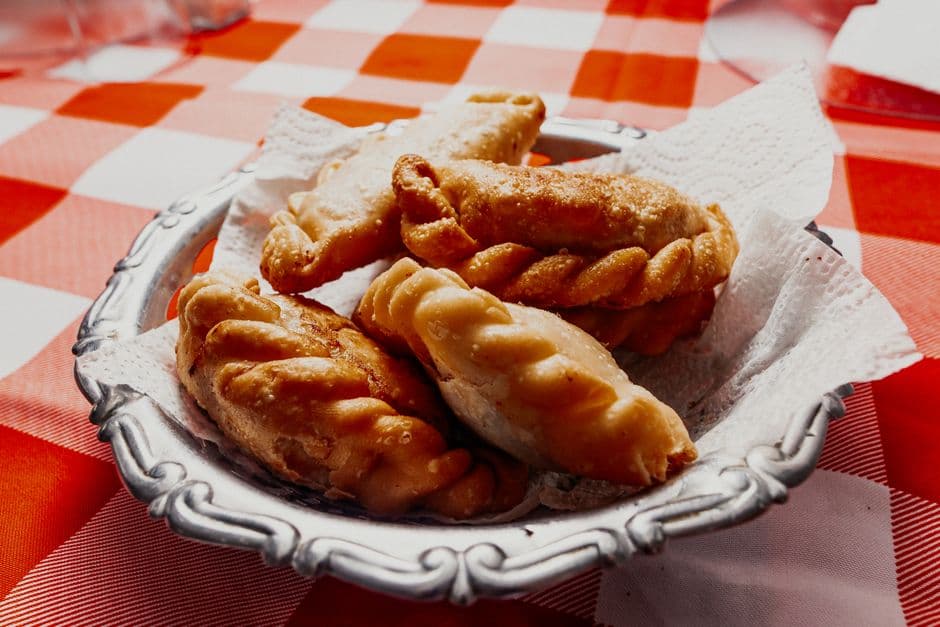
Chilean Empanadas de Pino
Chile's national empanada — a large baked half-moon stuffed with minced beef, sautéed onion, hard-boiled egg, black olive and a single raisin, brushed with egg wash.
About This Recipe
Empanadas de pino are the most beloved empanadas in Chile — a baked, palm-sized half-moon of buttery wheat dough filled with a rich, savory mixture called 'pino': finely minced beef, plenty of slowly sautéed yellow onion, ground cumin, paprika, oregano, a piece of hard-boiled egg, a single black olive (pit-in, traditionally, as a warning), and one fat raisin. The name 'pino' likely comes from the Mapuche (indigenous Chilean) word 'pirru,' meaning chopped beef and onion. Empanadas de pino are the unmissable centerpiece of Fiestas Patrias (Chilean Independence Day, September 18), eaten by the millions, paired with a glass of pipeño wine or a chicha de uva. The dough is unique: enriched with butter or lard and a splash of warm wine or stock, then rolled thick and brushed with egg yolk before baking, producing a deep gold, slightly sweet, almost shortcake-like crust. Each empanada is large (15–18 cm) and quite filling — two are a full lunch. The technique of folding the dough involves three signature folds that create the empanada's distinctive crimped edge. Made well, you bite through the burnished crust into a juicy, beefy filling with a sudden hit of salty olive and sweet raisin in the same mouthful — Chile's defining flavor.
Ingredients
Serves 6
- 500 gall-purpose flour
- 1 tspfine salt
- 150 gunsalted butter or pork lard, cold and cubed
- 180 mlwarm beef stock or warm water
- 60 mlwarm white wine
- 1egg yolk (plus 1 whole egg for egg wash)
- 500 gbeef chuck, very finely hand-chopped (not ground) — or ground beef as compromise
- 3 largeyellow onions, very fine dice (about 800 g)
- 60 mlneutral oil or beef tallow
- 2 clovesgarlic, minced
- 2 tspground cumin
- 2 tspsweet paprika
- 1 tspMediterranean oregano
- 1/2 tspají de color or chile powder (optional)
- 200 mlwarm beef stock
- 2 tbspall-purpose flour (for thickening)
- salt and black pepper
- 3hard-boiled eggs, peeled and quartered lengthwise
- 12black olives (pit-in is traditional)
- 12fat raisins
Instructions
- 1
Make the pino filling (day before)
Heat the oil in a heavy skillet over medium heat. Add the diced onions and cook 15–20 minutes, stirring often, until very soft and translucent but not brown — Chilean pino has more onion than beef by volume. The slow cook is essential for the silky texture.
- 2
Brown the beef and bloom spices
Push the onions aside, add the chopped beef and cook 5 minutes over high heat, breaking up the chunks. Stir in the garlic, cumin, paprika, oregano and ají de color. Cook 60 seconds until intensely fragrant. Season heavily with salt and pepper.
- 3
Build the sauce
Sprinkle the flour over the meat-onion mixture and stir to coat — this thickens the filling. Pour in the warm beef stock and simmer 10 minutes until the liquid thickens to a glossy, slightly loose sauce. Taste — should be deeply savory, slightly spicy. Cool completely, then refrigerate at least 4 hours, ideally overnight.
- 4
Make the dough
In a large bowl, mix flour and salt. Cut in the cold butter with a pastry cutter or fingertips until the mixture resembles coarse meal. Whisk the warm stock, wine and egg yolk together; pour into the flour and stir with a wooden spoon until a shaggy dough forms. Knead on a floured surface 3 minutes until smooth and elastic. Rest in plastic wrap 30 minutes at room temperature.
- 5
Roll the discs
Divide the dough into 12 equal balls (about 70 g each). Roll each into a 15 cm circle about 3 mm thick on a lightly floured surface. The dough should be soft but not sticky. Stack with parchment between to prevent drying.
- 6
Fill the empanadas
Place 2 heaping tablespoons of cold pino filling slightly off-center on each disc. Top each with 2 quarters of hard-boiled egg, 1 olive and 1 raisin — these are the defining add-ins.
Cold filling is essential; warm filling melts the dough and causes leaks during baking.
- 7
Fold the signature Chilean shape
Brush the edge of the disc with a little water. Fold in half over the filling. Press the edge to seal. Now make the three classic folds: fold the right corner over onto itself (about 2 cm), fold the bottom left corner over, then fold the top left corner. This creates the characteristic Chilean empanada shape with a thick crimped edge.
- 8
Egg wash and vent
Place the empanadas on a parchment-lined sheet pan, leaving 4 cm between them. Brush each generously with beaten whole egg. Prick the top of each empanada once with a fork to vent steam — this prevents bursting.
- 9
Bake until deeply golden
Bake at 220°C / 425°F for 25–30 minutes until the empanadas are deep gold-brown with a glossy crust. Rotate the pan halfway through for even color. Rest 5 minutes before serving — the filling is volcanically hot.
- 10
Serve traditionally
Serve hot or warm with a glass of pipeño or chilled rosé wine. The traditional Chilean accompaniment is pebre — a salsa of finely chopped onion, cilantro, tomato, ají and olive oil — spooned alongside each empanada. Always bite carefully on the first bite; the olive may still have a pit.
Did you make this?
Rate it and help other cooks find the recipes that actually work.
One tap to sign in, and we'll save the rating you just picked.
Everything you need to plan your week — free
- Meal calendar
- Grocery list
- AI recipe ideas
Cook this hands-free
Get AI meal plans, step-by-step cooking mode, and your saved recipes in the free Bento app.
Pro Tips
- →
The filling MUST be made and chilled at least 4 hours, ideally overnight — warm filling makes the empanadas burst and the dough soggy.
- →
Hand-chopped beef chuck is the Chilean tradition (not ground beef); the irregular pieces give the proper texture. Use ground only as compromise.
- →
Onions equal in weight or greater than the meat — this is the secret to Chilean pino's silky, melting texture. Don't skimp.
- →
Don't overfill; 2 tablespoons of filling plus add-ins is the right amount. Overfilled empanadas burst and leak in the oven.
Variations
- •
Empanadas fritas: deep-fry in 180°C oil 3 minutes per side instead of baking — crispier, served at street stalls.
- •
Empanadas de mariscos: replace beef with chopped shrimp, scallops and cheese — a coastal Chilean version.
- •
Empanadas de queso: filled with melting Chilean string cheese only, smaller (8 cm) and deep-fried — the cheese variant.
- •
Chicken pino: substitute very finely chopped chicken thigh for the beef — a Chilean home variation, especially good with green olives.
Storage
Refrigerate baked empanadas up to 3 days. Reheat in a 180°C / 350°F oven 8 minutes to recrisp the crust — never microwave. Freeze raw assembled empanadas on a tray, then bag once solid; bake from frozen at 200°C / 400°F for 35 minutes. Filling alone refrigerates 4 days.
History & Origin
Empanadas arrived in Chile via Spanish colonists in the 16th century, themselves a Moorish-influenced tradition from Galicia and Andalusia. The Chilean pino filling — heavy on onion, with characteristic add-ins of egg, olive and raisin — developed in the 18th and 19th centuries and became a Fiestas Patrias tradition that today consumes over 100 million empanadas every September 18.
Frequently Asked Questions
Why a single raisin?
Tradition. The single sweet raisin among savory ingredients creates a moment of surprise and is considered the signature of a properly made Chilean pino. Some families use 2; never more.
Why pit-in olives?
Tradition again — Chilean grandmothers say it's a warning to eat carefully and remember the dish is real food, not pureed. Pitted olives are increasingly accepted; tell guests either way.
Can I freeze them before baking?
Yes — freeze raw assembled empanadas on a sheet pan, then bag once solid. Bake from frozen at 200°C / 400°F for about 35 minutes. The crust stays crisper than reheating baked ones.
Why does my dough crack when I fold?
Either too dry (add 1 tbsp warm water to remaining dough) or too cold (let rest at room temperature 15 minutes longer). Chilean dough should be soft and stretchy, not stiff like pastry dough.
Nutrition Facts
Per serving (200g / 7.1 oz) · 6 servings total
Time Summary
Have Questions?
Ask our AI cooking assistant anything about this recipe — substitutions, techniques, scaling.
Chat with AI Chef →Featured in Guides
This recipe is featured in the following curated guides:
More Chilean Recipes
You Might Also Like
Similar dishes from other cuisines around the world.
Free Kitchen Tools
Calculators and converters that pair with this page — no signup needed.
Put This Into a Plan
Schedule it, shop for it, and track what you already have.
Read Next
Longer reads that go deeper on the ideas behind this dish.
Community
Join the conversation
Sign in to leave a comment and save your favourite recipes