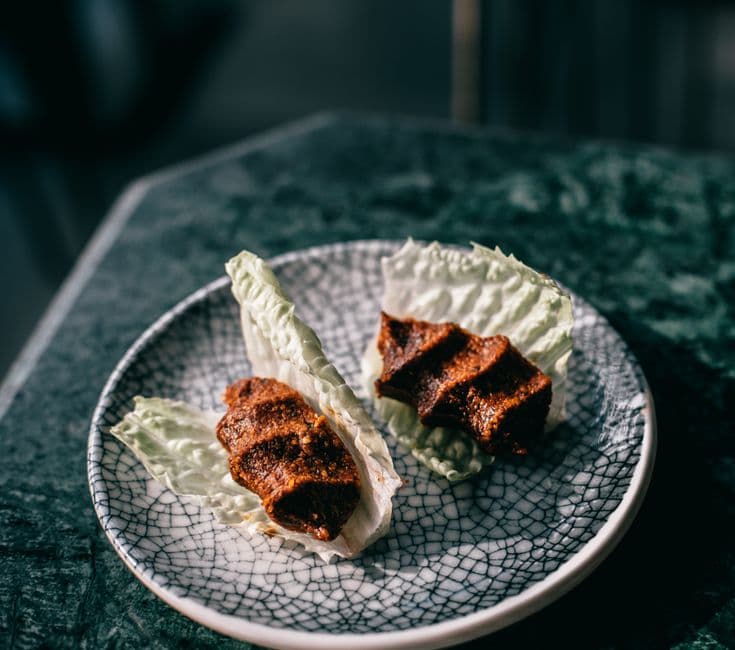
Fiery, herb-packed raw bulgur patties kneaded with tomato paste, pomegranate molasses, and spices — Turkey's most popular street food and a completely vegan delight.
Çiğ köfte (pronounced 'chee KUF-teh', literally 'raw meatball') is one of the most fascinating dishes in Turkish culinary history — a preparation that has evolved from a raw-meat original to a completely vegan street food beloved by tens of millions. Traditionally made in southeastern Turkey (particularly Şanlıurfa) from very finely pounded raw lamb mixed with fine bulgur and spices, health regulations in modern Turkey led to the complete removal of meat from commercial versions. The result is arguably better: a vibrant, deeply spiced mixture of fine bulgur, tomato paste, red pepper paste (isot biber), pomegranate molasses, and an extensive spice blend, kneaded vigorously for 30-40 minutes until the bulgur softens through friction and moisture alone — no cooking required. The kneading process is the heart of the dish: without sustained physical work, the bulgur remains grainy; with proper kneading the mixture becomes cohesive, paste-like, and slightly warm from the friction. Spring onions, parsley, and a squeeze of lemon are mixed in at the end to add freshness. The finished mixture is shaped into small oval patties, roughly resembling the original meat köfte. They are traditionally served wrapped in lettuce leaves or thin lavash bread with a squeeze of pomegranate molasses and a sprinkle of dried mint — a combination of textures and flavors (spicy, sour, cooling, herby) that is intensely addictive. Çiğ köfte carts are now ubiquitous on Turkish streets, and the snack is a powerful example of how culinary constraints can produce cultural innovation.
Serves 6
Place the fine bulgur in a large bowl. Add the tomato paste, red pepper paste, pomegranate molasses, olive oil, and all dry spices. Mix together with your hands until the bulgur is completely coated in the pastes and the mixture looks uniformly orange-red.
Use fine bulgur (ince bulgur), not coarse — coarse bulgur will never soften enough without cooking.
Begin kneading the mixture, adding warm water gradually — about 50ml at a time — as the bulgur starts to absorb the moisture. Knead firmly for 15-20 minutes, squeezing and pressing the mixture through your fingers. The mixture should become progressively smoother and start to hold together.
Keep kneading for another 10-15 minutes — you'll feel the mixture warm slightly from friction and the bulgur will lose its grainy texture, becoming cohesive and pliable like very thick hummus. The total kneading time should be 25-35 minutes. Squeeze a small amount in your fist — if it holds the shape of your fingers clearly, it's ready.
The more thoroughly you knead, the smoother and more professional the result. Short-cutting the kneading produces a gritty texture.
Fold in the sliced spring onions and chopped parsley. Taste and adjust seasoning — çiğ köfte should be well-seasoned, with a clear spicy-sour-herby balance.
Take a golf-ball-sized portion and roll between your palms to form a small oval, then press the four fingers of one hand into the surface to create parallel ridges — the traditional çiğ köfte shape. Arrange on a serving plate. Squeeze a little extra pomegranate molasses over the top before serving.
Fine bulgur is mandatory — it softens through kneading. Coarse bulgur requires cooking and cannot be used in this recipe.
Isot pepper (Urfa biber) is a smoky, dark chili flake from Şanlıurfa that is central to authentic çiğ köfte flavor — find it at Turkish grocers.
The kneading process is the whole point — there are no shortcuts. Aim for at least 25 minutes of active kneading for smooth texture.
Serve wrapped in a lettuce leaf with extra pomegranate molasses and a squeeze of lemon — the combination of spicy, sour, and cooling is what makes it special.
Resting the shaped patties in the refrigerator for 30 minutes helps them firm up and the flavors deepen.
Mercimekli çiğ köfte: add 100g finely ground cooked red lentils to the bulgur for extra protein and binding.
Mild version: reduce the hot pepper paste to 1 tsp and increase the tomato paste — suitable for children.
Wrap style: serve inside thin lavash bread with diced tomato, parsley, and pomegranate molasses instead of shaping into patties.
Çiğ köfte can be refrigerated in an airtight container for up to 2 days — the flavor actually improves overnight as the spices meld. The mixture may firm up in the fridge; bring to room temperature for 15 minutes before serving. Do not freeze.
The original çiğ köfte was a dish from Şanlıurfa in southeastern Turkey where very fresh, finely minced raw lamb was pounded together with fine bulgur and spices — a preparation related to kibbeh nayyeh of the Levant. Food safety regulations implemented in the 2000s banned the sale of raw meat preparations in Turkey, prompting vendors to develop the now-dominant vegan version. Rather than disappearing, the dish became a national phenomenon: çiğ köfte chains now operate across Turkey and in Europe, serving millions of portions daily.
Yes and no. The bulgur in çiğ köfte is pre-cooked during the bulgur-making process (bulgur is parboiled wheat), so technically nothing is truly raw. The dish is completely vegan and safe to eat without any additional cooking.
Traditional çiğ köfte is quite spicy — the large amount of hot red pepper paste is part of its identity. You can reduce the hot pepper paste and increase tomato paste for a milder version, or use sweet paprika instead of isot pepper.
Pomegranate molasses gives çiğ köfte its characteristic sweet-sour punch. A substitute is lemon juice mixed with a teaspoon of honey or grape molasses. Pure lemon juice also works but produces a sharper, less complex sourness.
Yes — use the dough hook attachment on medium-low speed for 20-25 minutes instead of kneading by hand. This is physically easier but produces the same result.
Per serving (120g / 4.2 oz) · 6 servings total
Ask our AI cooking assistant anything about this recipe — substitutions, techniques, scaling.
Chat with AI Chef →Join the conversation
Sign in to leave a comment and save your favourite recipes
Have feedback or need help?
We read every email and reply within 1–2 business days.
© 2026 MyCookingCalendar. All rights reserved.