
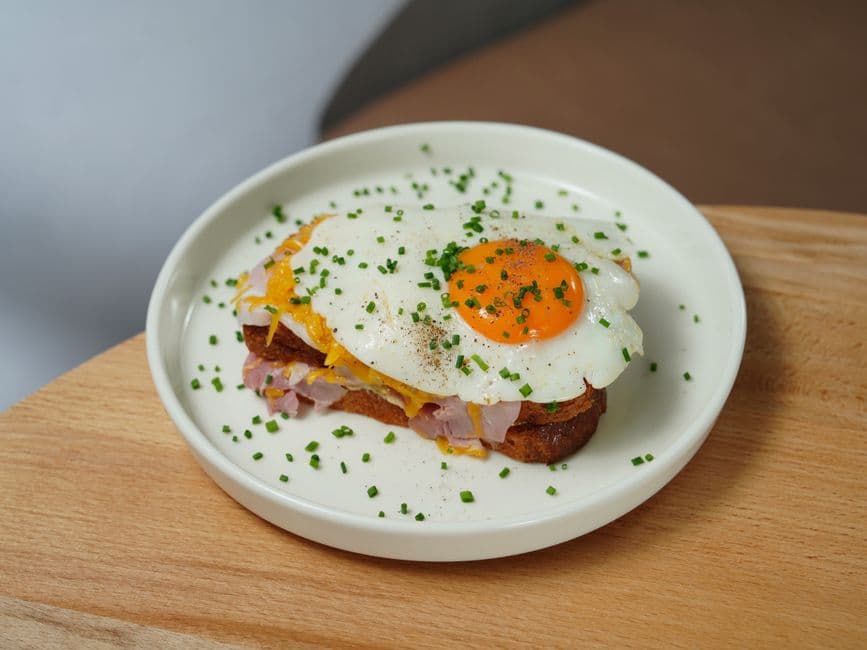
Croque Madame (French Ham, Cheese & Béchamel Toast with Fried Egg)
The grand dame of Parisian café lunches — buttery toast layered with ham and Gruyère, smothered in béchamel and Gruyère again, broiled until bubbling, and crowned with a sunny fried egg.
About This Recipe
The croque madame is the croque monsieur with a hat — the addition of a fried egg perched on top of the broiled, béchamel-smothered ham-and-cheese sandwich, and according to most Parisian café conventions, the hat is what transforms 'monsieur' into 'madame.' This is not a sandwich in the American sense of two slices of bread closed around a filling; it is an open-faced or barely-closed creation eaten with a knife and fork, sitting at a bistro table with a glass of Sancerre or a coupe of Champagne. The version that defines the dish — and that you will find at any worthy Paris café from Café de Flore to a corner bistro in the 11th — uses thick slices of pain de mie (a buttery, fine-crumbed white pullman loaf), generous slices of jambon de Paris (cooked pressed ham, never smoked), and aged Comté or Gruyère as the cheese. The béchamel must be thick enough to cling like a custard but loose enough to brown and bubble under the salamander. The egg is fried in butter just until the white sets and the yolk is still runny; when you cut into it, the yolk pools across the bubbling cheese in a way that elevates the whole thing into something closer to gastronomy than a sandwich. The croque madame is a dish that rewards quality ingredients and good technique disproportionately: with the right ham, cheese, bread and a properly silky béchamel, it is one of the great lunches of Western cuisine.
Ingredients
Serves 2
- 4 thick slicespain de mie or good white pullman bread, 2 cm thick
- 30 gsoftened salted butter, for the bread
- 200 gjambon de Paris (good cooked ham, sliced 2 mm)
- 180 gaged Comté or Gruyère, finely grated, divided
- 2 tspDijon mustard
- 2 largeeggs, room temperature
- 30 gunsalted butter, for the béchamel
- 30 gall-purpose flour
- 350 mlwhole milk, warmed
- 0.25 tspfreshly grated nutmeg
- salt, white pepper, and a small piece of butter for the egg pan
Instructions
- 1
Make the béchamel
Melt the 30 g unsalted butter in a small saucepan over medium heat. Whisk in the flour and cook 90 seconds, stirring constantly, until the roux is pale and smells nutty but has taken no color. Pour in the warm milk in a steady stream, whisking continuously to prevent lumps. Bring to a gentle simmer and cook 4 to 5 minutes until the béchamel is thick enough to coat the back of a spoon. Season with salt, white pepper and the grated nutmeg. Off heat, whisk in 60 g of the grated cheese until smooth. Cover with a piece of butter or plastic film pressed to the surface to prevent a skin.
- 2
Toast the bread
Spread softened butter on one side of each bread slice. Toast in a dry skillet or under a broiler for 90 seconds per side until lightly golden but still soft in the center. The toast must be sturdy enough to support the wet béchamel without going soggy, but not so dry that it cracks under a knife.
- 3
Build the sandwich
Spread the unbuttered side of two slices with a thin layer of Dijon mustard. Top with half the ham (folded into ribbons for texture) and 40 g of grated cheese per slice. Cover with the second bread slices, buttered side facing up.
- 4
Preheat the broiler
Set the broiler/grill to high and position the rack 15 cm below the heat. Line a baking tray with parchment or foil to catch any cheese drips.
- 5
Top with béchamel and cheese
Place the assembled sandwiches on the baking tray. Spoon a generous mound — about 4 tablespoons each — of béchamel over the top of each sandwich. Use the back of the spoon to spread it to the edges so the entire top surface is covered. Sprinkle the remaining grated cheese over the béchamel.
- 6
Broil to deep gold
Slide the tray under the broiler. Watch closely; the béchamel and cheese should bubble vigorously and turn deep golden brown in 4 to 6 minutes. If your broiler runs hot, cover loosely with foil for the first 3 minutes to prevent burning before the inside warms through.
- 7
Fry the eggs
While the sandwiches broil, melt a small piece of butter in a non-stick skillet over medium heat. Crack the eggs gently into the pan — they should sizzle. Fry sunny-side up 2 to 3 minutes until the whites are set and opaque but the yolks are still bright and liquid. Season the whites lightly with salt and pepper.
- 8
Crown and serve
Transfer each croque to a warm plate. Slide a fried egg directly onto the bubbling top of each sandwich, yolk-up. Serve immediately with a small dressed salad of frisée and walnuts on the side, plus a glass of dry white wine. Eat with knife and fork, breaking the yolk over the cheese on the first cut.
Did you make this?
Rate it and help other cooks find the recipes that actually work.
One tap to sign in, and we'll save the rating you just picked.
Everything you need to plan your week — free
- Meal calendar
- Grocery list
- AI recipe ideas
Track what you eat
Snap your meal to log calories and macros, run fasting timers and track water in the free SnapCal app.
Pro Tips
- →
The cheese matters enormously. Real aged Comté (24-month) or Swiss Gruyère gives the right melt and nutty depth; a mild supermarket Swiss will produce a flat-tasting croque.
- →
Make the béchamel thicker than you'd want for pasta — it should mound on a spoon. A loose béchamel runs off the toast and burns on the tray.
- →
Use good cooked ham. Jambon de Paris is delicate, pressed and slightly sweet; smoked deli ham overwhelms the dish.
- →
Don't skip the mustard. The thin layer of Dijon under the cheese is what cuts the richness and gives the croque its characteristic bistro bite.
Variations
- •
Croque monsieur: the un-hatted original, no egg on top — equally classic, eaten with one hand instead of two.
- •
Croque provençal: add a layer of sliced ripe tomato under the cheese and finish with fresh basil after broiling.
- •
Croque forestière: replace ham with sautéed mushrooms, deglazed with a splash of white wine, for a vegetarian-leaning version.
- •
Croque norvégien: substitute thin slices of smoked salmon for the ham and add a spoon of crème fraîche to the béchamel — popular in Parisian brasseries for Sunday brunch.
Storage
Croques are absolutely a freshly-made dish — refrigerated leftovers reheat as soggy disappointment. Béchamel can be made up to 2 days ahead and stored in the fridge; reheat gently with a splash of milk before assembling. The sandwich itself takes 20 minutes start to finish; just make it fresh.
History & Origin
The croque monsieur first appeared on a Parisian café menu in 1910, reportedly at Le Bel Age boulevard des Capucines, where a chef ran out of baguette for jambon-beurre sandwiches and used pain de mie instead, broiling it with cheese to disguise the substitution. Marcel Proust mentions it in À la recherche du temps perdu by 1918. The croque madame — with the fried-egg topping — emerged in the 1960s, the name a teasing reference to women's hats of the era. Both have remained fixtures of French café culture ever since, equally beloved at sit-down brasseries and quick lunch stops.
Frequently Asked Questions
Can I use sourdough or a different bread?
Sourdough and country breads work but change the character — they're chewier and tangier where pain de mie is soft, sweet and buttery. For an authentic croque, hunt down a good pullman loaf or brioche; for a more rustic version, a sturdy white sourdough is fine.
Why does mine go soggy?
Either the toast was undercooked or the béchamel was too thin. The bread needs enough initial toast to form a barrier against the sauce, and the béchamel should be thick enough that it doesn't soak through during broiling.
Can I make the béchamel ahead?
Yes — make it up to 2 days ahead, press butter or plastic film directly onto the surface, and refrigerate. Reheat gently in a saucepan with a splash of milk, whisking until smooth, before topping the sandwiches.
What's the right wine?
Classic café pairings: a glass of dry white from the Loire (Sancerre, Pouilly-Fumé), a young Chablis, or for breakfast/brunch a coupe of Champagne. A light Beaujolais also works beautifully against the rich cheese and yolk.
Nutrition Facts
Per serving (380g / 13.4 oz) · 2 servings total
Time Summary
Have Questions?
Ask our AI cooking assistant anything about this recipe — substitutions, techniques, scaling.
Chat with AI Chef →Featured in Guides
This recipe is featured in the following curated guides:
More French Recipes
You Might Also Like
Similar dishes from other cuisines around the world.
Browse by Ingredient
More recipes built around the same core ingredients.
Free Kitchen Tools
Calculators and converters that pair with this page — no signup needed.
Put This Into a Plan
Schedule it, shop for it, and track what you already have.
Read Next
Longer reads that go deeper on the ideas behind this dish.
Community
Join the conversation
Sign in to leave a comment and save your favourite recipes