
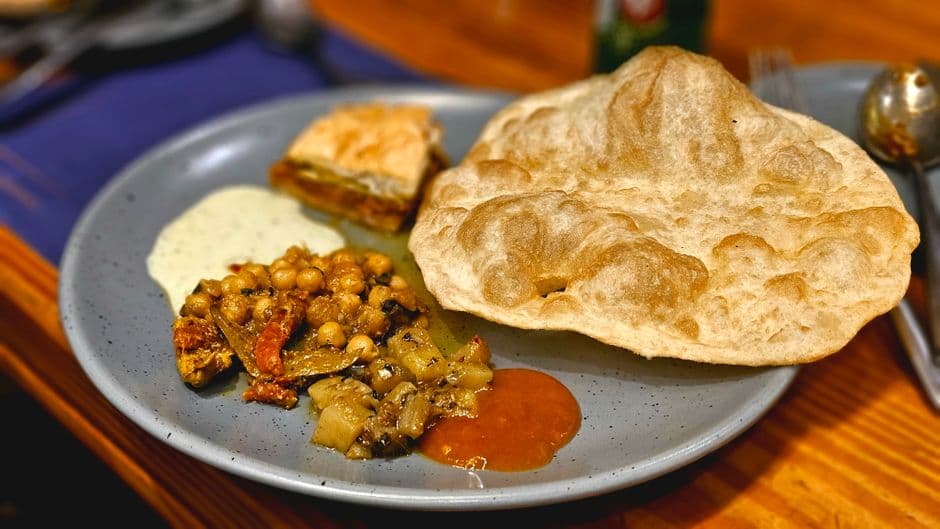
Doubles (Trinidadian Curried Chickpeas in Fried Bara Flatbreads)
Trinidad's beloved street breakfast — two soft turmeric-stained fried flatbreads sandwiching a generous scoop of curried chickpeas, topped with cucumber chutney, pepper sauce and tamarind.
About This Recipe
Doubles is Trinidad's national street food and the iconic breakfast of the island — a humble construction of two soft fried flatbreads (called bara, stained yellow with turmeric and almost spongy in texture) sandwiching a generous scoop of channa (curried chickpeas), then dressed with a choreographed array of condiments: cool cucumber chutney, sweet tamarind sauce, intensely spicy Scotch-bonnet pepper sauce, fresh cilantro, and sometimes a flurry of grated coconut or a swipe of mango chutney. Eaten standing at street corners and breakfast carts from Port of Spain to San Fernando, doubles is so quick and so satisfying that some Trinis eat three or four at a sitting. The dish traces directly to the Indian indentured laborers brought to Trinidad in the 19th century after the abolition of slavery — they brought with them North Indian channa preparations and chapati-style flatbreads, which evolved on the island into the distinctly Trinidadian bara: softer, slightly sweeter, and built on turmeric and ground cumin. The name 'doubles' comes from the way customers always order them in pairs ('gimme two doubles, slight pepper'), since one flatbread alone is called a 'single' and is considered ungenerous. Eaten by hand, with the juicy channa inevitably leaking down your wrists, doubles is one of the great democratic breakfasts of the Caribbean.
Ingredients
Serves 6
- 350 gall-purpose flour (for the bara)
- 2 tspinstant yeast, plus 1 tsp sugar and 1 tsp salt
- 1 tbspground turmeric (gives bara their distinctive yellow color)
- 1 tspground cumin (for the bara dough)
- 200 mlwarm water (for the bara dough)
- 500 gcooked chickpeas (one and a half 400 g cans, drained), or 200 g dried, soaked overnight and simmered tender
- 1 mediumonion, finely chopped, plus 4 garlic cloves and 1 Scotch bonnet (deseeded) all minced
- 2 tbspCaribbean curry powder (Madras-style, sold at Caribbean grocers)
- 1 tspground geera (cumin) and 1 tsp ground turmeric (for the channa)
- neutral oil for frying, cilantro (chadon beni if available), tamarind sauce, Scotch-bonnet pepper sauce, and cucumber chutney to serve
Instructions
- 1
Make the bara dough
In a large bowl, whisk together flour, yeast, sugar, salt, turmeric, and cumin. Add the warm water and 1 tbsp oil and mix into a soft, slightly sticky dough — knead 5 minutes until smooth and elastic. Cover with a damp towel and let rise in a warm spot 60–90 minutes until doubled.
- 2
Cook the channa
In a wide saucepan, heat 3 tbsp oil over medium heat. Add the chopped onion and cook 6 minutes until softened. Add the garlic and Scotch bonnet and cook 60 seconds. Stir in the curry powder, geera, and turmeric and toast 60 seconds until aromatic — add 2 tbsp water if it threatens to burn.
Toasting the curry powder is essential; raw curry powder tastes dusty and one-dimensional.
- 3
Simmer the chickpeas
Add the cooked chickpeas, 400 ml water, and 1 tsp salt. Bring to a simmer, cover, and cook 30 minutes over low heat. As they simmer, use the back of a spoon to crush about a quarter of the chickpeas against the side of the pan — this creates the thick, almost gravy-like consistency that defines proper channa.
- 4
Adjust the channa
The channa should be thick but soupy — not dry, not watery. Add more water if needed; reduce uncovered if too wet. Taste for salt and adjust. Some cooks add 1 tsp brown sugar at this stage for a hint of sweetness. Keep warm.
- 5
Shape the bara
Punch down the risen dough and divide into 12 equal balls (each about 50 g). Roll each into a tight ball, then flatten between oiled palms into thin disks about 10 cm across and 3 mm thick. Cover with a towel as you work; don't let them dry out.
- 6
Fry the bara
Heat 3 cm of neutral oil in a deep skillet to 175°C / 350°F. Fry the bara one or two at a time, 30 seconds per side, until puffed, golden-yellow, and just cooked through. They should be soft and pliable, NOT crisp — overcooked bara is one of the most common mistakes. Lift onto paper towel; they'll deflate a little, which is correct.
- 7
Make the cucumber chutney
Quickly: grate half a peeled cucumber, mix with a pinch of salt, 1 tsp lime juice, and a tiny pinch of Scotch bonnet. Set aside. If using tamarind sauce, thin store-bought tamarind concentrate with a little warm water, sugar, salt and a pinch of cumin.
- 8
Assemble the doubles
For each portion, lay 2 bara on a piece of foil or wax paper (open the doubles open-faced like a book). Spoon a generous 2 tbsp of warm channa across one bara, then top with cucumber chutney, a small drizzle of tamarind sauce, a small spoon of Scotch bonnet pepper sauce (ask 'plenty pepper or slight pepper?'), and a scatter of chopped cilantro. Lay the second bara on top, fold the foil around the base, and eat by hand. Repeat — most Trinis eat 2–3 doubles per meal.
Did you make this?
Rate it and help other cooks find the recipes that actually work.
One tap to sign in, and we'll save the rating you just picked.
Everything you need to plan your week — free
- Meal calendar
- Grocery list
- AI recipe ideas
Cook this hands-free
Get AI meal plans, step-by-step cooking mode, and your saved recipes in the free Bento app.
Pro Tips
- →
Bara should be soft and pliable, not crisp. If yours come out hard, your oil was too hot or you fried too long — 30 seconds per side maximum.
- →
Use Caribbean curry powder (Indi or Chief brand) — Indian curry powders work but have different spice ratios and taste subtly off.
- →
The channa MUST be saucy, almost gravy-like — partially mashed chickpeas create the thick texture. Whole-bean channa is wrong.
- →
Tamarind sauce and Scotch-bonnet sauce are non-negotiable condiments. Don't substitute generic hot sauce; the smoky-fruity Scotch bonnet flavor is essential.
Variations
- •
Aloo pies — same channa, stuffed inside a fried dough turnover with curried potato.
- •
Aloo doubles — adds curried potato chunks to the channa for a heartier version.
- •
Add a tablespoon of mango chutney (kuchela) for sweet-spicy contrast popular in Tobago.
- •
Vegan-friendly already — no modifications needed.
Storage
Bara are best fresh — they go rubbery in hours. Channa keeps refrigerated 4 days (flavor improves overnight). To revive bara, wrap in damp paper towel and microwave 15 seconds, or warm in a hot skillet 20 seconds per side. Assemble fresh each time.
History & Origin
Doubles was invented in Trinidad in the 1930s by Emamool Deen and his wife Rasulan Ali, who began selling curried chickpeas in single fried flatbreads (called 'singles') at the corner of Charlotte and Park Streets in Port of Spain. Customers kept asking for two breads at once ('a double, please'), and the name stuck. It is now Trinidad's most famous street food, eaten daily by hundreds of thousands of Trinis.
Frequently Asked Questions
What is chadon beni?
Trinidad's version of culantro — a sharper, more pungent cousin of cilantro. If you can find it (at Caribbean grocers), use it; otherwise cilantro is the best substitute.
Can I bake the bara?
Not really — bara is defined by its quick-fried texture. Baking gives you a different bread, not bara. If you must avoid frying, shallow-fry in just 1 cm of oil.
How spicy should doubles be?
Trini street vendors ask 'plenty pepper or slight pepper?' Plenty means a serious dose of Scotch bonnet; slight means a small drizzle. Adjust to your tolerance — Scotch bonnet is genuinely fiery.
Can I make the bara dough ahead?
Yes — make and refrigerate up to 24 hours; bring to room temperature before shaping. The slow fermentation actually improves the flavor.
Nutrition Facts
Per serving (260g / 9.2 oz) · 6 servings total
Time Summary
Have Questions?
Ask our AI cooking assistant anything about this recipe — substitutions, techniques, scaling.
Chat with AI Chef →Featured in Guides
This recipe is featured in the following curated guides:
More Trinidadian Recipes
You Might Also Like
Similar dishes from other cuisines around the world.
Free Kitchen Tools
Calculators and converters that pair with this page — no signup needed.
Put This Into a Plan
Schedule it, shop for it, and track what you already have.
Read Next
Longer reads that go deeper on the ideas behind this dish.
Community
Join the conversation
Sign in to leave a comment and save your favourite recipes