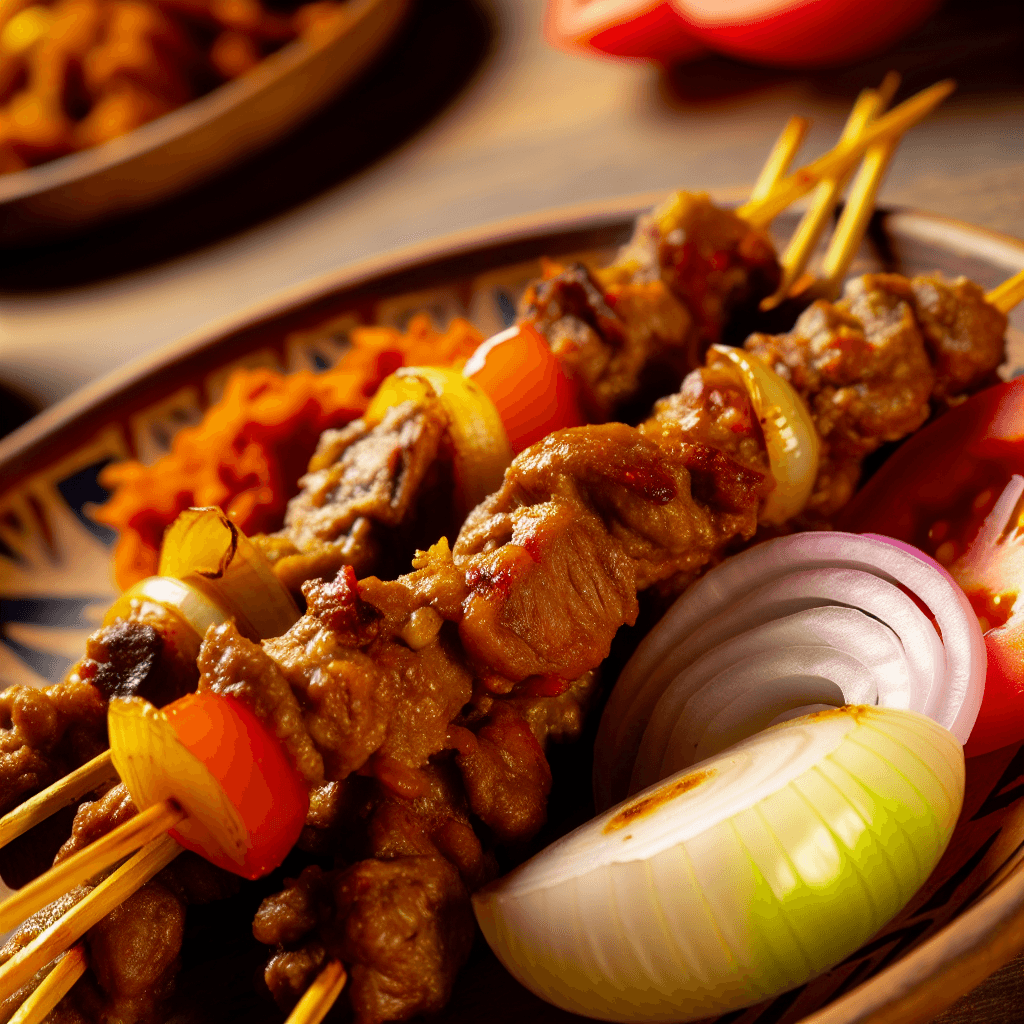
Fakoye are Malian lamb skewers grilled over a wood-charcoal fire until the exterior is charred and fragrant, while the interior stays juicy and just pink. The marinade is built on a backbone of fresh garlic, ground ginger, and cumin — spices that arrived in the Sahel via trans-Saharan trade centuries ago and became fully embedded in local cooking long before the colonial period. A light coating of oil in the marinade helps both to adhere the spices to the meat and to create the caramelised crust that is the skewer's defining characteristic. In Bamako and other Malian cities, fakoye vendors set up at dusk around 'grillade' stalls — low tables positioned next to braziers of glowing hardwood charcoal. Skewers are arranged in rows, fanned periodically to control the fire, and the smell drifts through entire neighbourhoods, drawing a crowd. They are sold by the skewer, wrapped in a scrap of paper, and eaten standing up with a pinch of salt, raw onion rings, and a fierce house-made pepper sauce. The experience is as much about the theatre of the charcoal fire as it is about the food itself. At home, fakoye can be replicated on a charcoal grill, gas barbecue, or even a screaming-hot cast-iron grill pan. The key variable is high direct heat — the lamb needs to sear quickly on contact to develop the Maillard crust that gives it flavour. Overcrowding the grill, or placing skewers on medium heat, produces stewed rather than grilled meat and misses the point entirely.
Serves 4
In a medium bowl, combine the minced garlic, ground ginger, ground cumin, salt, and vegetable oil. Mix until a uniform paste forms. If you have time, add 1/2 teaspoon of black pepper and a pinch of coriander to round out the spice profile — both are common in Malian grillade seasonings.
For deeper flavour, use freshly grated ginger root (1 teaspoon fresh = 1/2 teaspoon ground) — the volatile oils in fresh ginger are considerably more aromatic than the dried powder.
Add the lamb cubes to the marinade and turn to coat every surface thoroughly. Cover and refrigerate for at least 30 minutes — though 4–8 hours in the fridge produces significantly more flavourful results. Remove the lamb from the refrigerator 20 minutes before grilling so it comes up to room temperature, which ensures even cooking.
If using wooden skewers, soak them in cold water for at least 30 minutes before threading to prevent them from scorching on the grill. Thread the marinated lamb cubes onto the skewers, leaving a small gap (about 5 mm) between each piece so the heat can circulate evenly around the meat rather than steaming it.
Prepare a charcoal grill for direct high heat — the coals should be glowing white-hot with no visible flames, or a gas grill should be preheated on high for 10 minutes. For a grill pan, heat over high heat for at least 3 minutes until a drop of water evaporates immediately on contact. Brush the grill grates with oil just before cooking to prevent sticking.
The grill must be scorching hot before the lamb goes on — this is not optional. A lukewarm surface produces grey, steamed meat without the crucial charred crust.
Lay the skewers on the grill perpendicular to the grates. Do not touch them for the first 2 minutes — the lamb needs time to develop a seared crust before it will release naturally from the grill surface. After 2 minutes, you should see clear char marks when you peek underneath. Turn the skewers 90 degrees and grill for another 2–3 minutes, then turn once more for the final 1–2 minutes. Total cooking time is 5–7 minutes for medium (slightly pink centre) or 7–9 minutes for well done.
Transfer skewers to a plate and rest for 3 minutes before serving — this allows the muscle fibres to relax and the juices to redistribute throughout the meat rather than running out when cut. Serve immediately with thinly sliced raw onion rings, sliced tomatoes, and a spoonful of spicy pepper sauce on the side.
Lamb shoulder is the traditional and best cut for fakoye — it has enough fat to stay juicy over high direct heat without drying out, unlike the leaner leg.
Let the grill get completely white-hot before placing skewers — the first contact between cold meat and a hot surface is what creates the Maillard-reaction crust that distinguishes grilled from baked lamb.
Do not press or push skewers against the grill after placing them; pressing squeezes out the juices and produces dry, flavourless meat.
If you see flare-ups (flames from dripping fat), move the skewers temporarily to a cooler zone and let the flames die down rather than dousing with water, which drops the grill temperature and steams the meat.
A light squeeze of fresh lime juice immediately after coming off the grill brightens all the spice flavours and adds a Sahelian freshness that finishes the dish perfectly.
Beef fakoye: use beef sirloin or chuck cut into 3 cm cubes — increase cumin to 1.5 teaspoons for a more robust spice profile to match beef's stronger flavour.
Goat fakoye: the most traditional substitute in rural Mali — goat shoulder works identically to lamb and has a more assertive, slightly gamey flavour that many prefer.
Chicken fakoye: use boneless thigh pieces, reduce marinating time to 30 minutes, and cook for only 4–5 minutes per side since poultry dries out faster than red meat.
Market-style pepper sauce: blend roasted scotch bonnets, tomato, onion, and salt into a rough sauce to serve alongside — this is the canonical accompaniment at Malian grillade stalls.
Cooked fakoye keep refrigerated for up to 3 days. Reheat on a very hot dry cast-iron pan for 2–3 minutes per side to restore the char and crust — microwave reheating makes the meat rubbery and steams away the caramelised flavour. The uncooked marinated lamb can be refrigerated for up to 24 hours before grilling.
Grilled meat skewers — known generically as 'brochettes' in Francophone West Africa — are one of the region's most enduring culinary traditions, with roots in the nomadic herding cultures of the Sahel where lamb and goat have been the primary livestock for millennia. In Mali, the grillade stall culture is particularly vibrant in Bamako's neighbourhoods of Hamdallaye and Djélibougou, where vendors set up every evening. The spice profile of fakoye — ginger, cumin, and garlic — reflects the Saharan and Maghrebi trade influences that shaped Malian cooking over centuries of trans-Saharan commerce.
Yes — a heavy cast-iron grill pan heated on high for at least 3 minutes produces very good results. Open a window as it will smoke. The main difference is that you miss the wood-smoke flavour of charcoal; to partially compensate, add a pinch of smoked paprika to the marinade.
For medium doneness (slightly pink, juicy centre), the internal temperature should read 63 °C on a meat thermometer. For well done, cook to 71 °C. Visually, medium lamb will have clear grill marks and will feel firm but spring back slightly when pressed; well-done lamb feels firm with no give.
Up to 24 hours is fine and improves flavour. Beyond that, the acid from garlic starts to denature the proteins on the surface, giving the outer layer a slightly mealy texture. For the best results, 4–8 hours in the refrigerator is the sweet spot.
The most common accompaniment is a rough sauce of roasted scotch bonnet chillies blended with tomato, onion, salt, and a splash of vegetable oil — very similar to a rough harissa. Some vendors add a little vinegar for acidity. It should be fiercely hot, applied sparingly to the side of the plate.
Per serving (180g / 6.3 oz) · 4 servings total
Ask our AI cooking assistant anything about this recipe — substitutions, techniques, scaling.
Chat with AI Chef →Join the conversation
Sign in to leave a comment and save your favourite recipes
Have feedback or need help?
We read every email and reply within 1–2 business days.
© 2026 MyCookingCalendar. All rights reserved.