
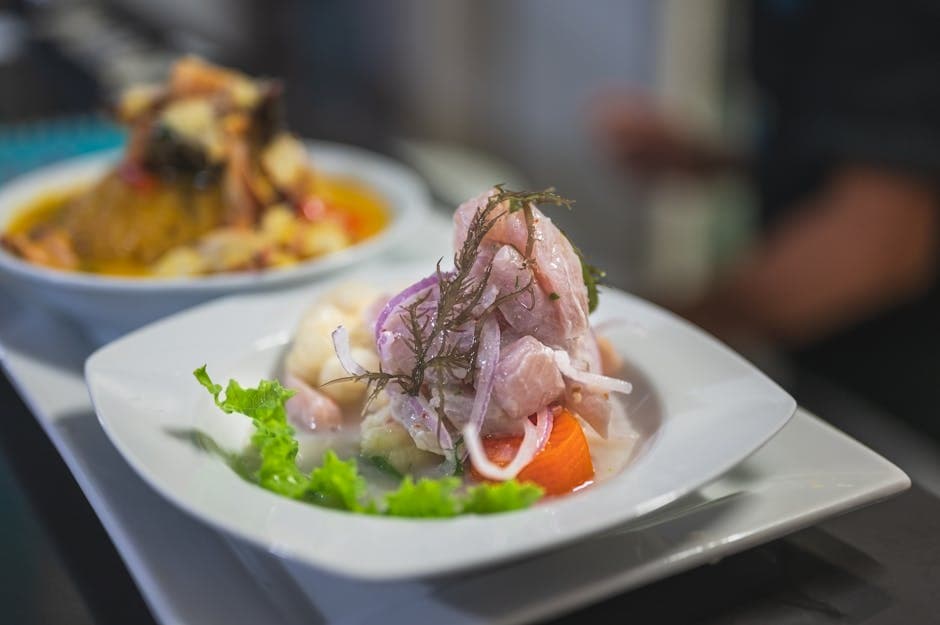
Kokoda (Fijian Coconut-Lime Fish Ceviche)
Fiji's national raw-fish dish: cubes of fresh white fish cured in lime, then bathed in cold coconut cream with chili, onion, and tomato.
About This Recipe
Kokoda (pronounced ko-KON-da) is Fiji's signature dish and the Pacific's most elegant ceviche. Cubes of the freshest possible white-fleshed fish — traditionally walu (Spanish mackerel) or mahi-mahi — are cured in fresh lime juice until just opaque, drained, and then dressed in cold thick coconut cream with finely diced red onion, tomato, cucumber, chili, and coriander. It is served chilled in coconut-shell halves or small bowls at almost every Fijian celebration, from village feasts to resort restaurants. The technique is similar to Peruvian ceviche or Tahitian poisson cru, but the heavy coconut cream is what sets Fijian kokoda apart — it tames the citrus heat and gives the dish its signature creamy-tart Pacific profile.
Ingredients
Serves 4
- 500 gvery fresh sashimi-grade white fish (mahi-mahi, walu, snapper, or sea bass), skin and bones removed
- 180 mlfreshly squeezed lime juice (about 6 limes)
- 300 mlthick coconut cream, cold
- 1 smallred onion, finely diced
- 1 mediumtomato, seeded and finely diced
- 0.5cucumber, seeded and finely diced
- 1red bird's-eye chili, very finely minced (or to taste)
- 1 tspfine sea salt
- 2 tbspfresh coriander, chopped
- 1spring onion, thinly sliced (optional)
Instructions
- 1
Cube the fish
Trim away any dark bloodline and pin-bones, then cut the fish into clean 1.5 cm cubes. Uniform size is important so they cure evenly.
Use only fish that smells like the sea, not fishy — freshness is non-negotiable for any ceviche.
- 2
Cure
Place the cubes in a non-reactive glass or ceramic bowl. Pour over the lime juice — it must fully cover the fish. Cover and refrigerate 25–30 minutes, stirring once at the halfway mark.
- 3
Drain firmly
When the fish has turned opaque on the outside but still has a faint translucent center, tip it into a fine sieve and drain very well. Press gently to remove excess lime; over-cured kokoda becomes chalky.
- 4
Dress
Return the drained fish to a clean bowl. Add the coconut cream, onion, tomato, cucumber, chili, salt, coriander, and spring onion. Fold gently to coat — the cream should pool around the cubes, not be absorbed.
- 5
Chill and serve
Refrigerate 15 minutes for the flavors to marry. Taste, adjust salt and lime, and serve very cold in coconut-shell halves, small glass bowls, or scallop shells.
Did you make this?
Rate it and help other cooks find the recipes that actually work.
One tap to sign in, and we'll save the rating you just picked.
Everything you need to plan your week — free
- Meal calendar
- Grocery list
- AI recipe ideas
Cook this hands-free
Get AI meal plans, step-by-step cooking mode, and your saved recipes in the free Bento app.
Pro Tips
- →
Squeeze the limes only at the moment of use — bottled lime juice has cooked flavors that ruin the dish.
- →
Drain the fish well after curing; coconut cream will not adhere to wet fish and you'll end up with a watery dressing.
- →
If your coconut cream is solid from the fridge, whisk it smooth in a separate bowl before adding to the fish.
Variations
- •
Kokoda vakaviti: the village-style version, made with more lime and chili and a splash of grated fresh coconut.
- •
With prawns: substitute half the fish with quickly blanched, chopped raw prawns for a richer mix.
- •
Smoked walu kokoda: a modern resort version using cold-smoked fish instead of cured raw — drop the lime cure entirely and use only as a finishing squeeze.
Storage
Kokoda is at its peak within an hour of dressing. It will keep refrigerated for 12 hours but the coconut cream loosens and the fish toughens. Do not freeze.
History & Origin
Kokoda has been part of Fijian coastal cooking for centuries; the technique of lime-curing fish in coconut cream spread across the South Pacific via intermarriage between Fijian, Tongan, and Samoan island communities. Its modern form, with tomato and onion, reflects 19th-century Indian-laborer influence on the Fijian table.
Frequently Asked Questions
Is the fish raw?
Technically yes — but the lime juice 'cooks' it chemically by denaturing the proteins, the same way ceviche is prepared in Peru or Mexico. Use only sashimi-grade fish from a trusted source.
How long should I cure the fish?
25–30 minutes is the sweet spot for 1.5 cm cubes. Less and the center is too raw and slippery; more and the fish goes chalky and tight.
Can I make kokoda ahead?
You can do the cure and the dice up to 4 hours ahead, but combine with the coconut cream no more than 30 minutes before serving — the cream loosens quickly in contact with the lime.
What if I can't find fresh coconut cream?
Use the thick top layer from a refrigerated can of full-fat coconut milk (Aroy-D, Chaokoh). Avoid 'light' coconut milk — it splits and turns watery.
Nutrition Facts
Per serving (280g / 9.9 oz) · 4 servings total
Time Summary
Have Questions?
Ask our AI cooking assistant anything about this recipe — substitutions, techniques, scaling.
Chat with AI Chef →More Fijian Recipes
You Might Also Like
Similar dishes from other cuisines around the world.
Free Kitchen Tools
Calculators and converters that pair with this page — no signup needed.
Put This Into a Plan
Schedule it, shop for it, and track what you already have.
Read Next
Longer reads that go deeper on the ideas behind this dish.
Community
Join the conversation
Sign in to leave a comment and save your favourite recipes