
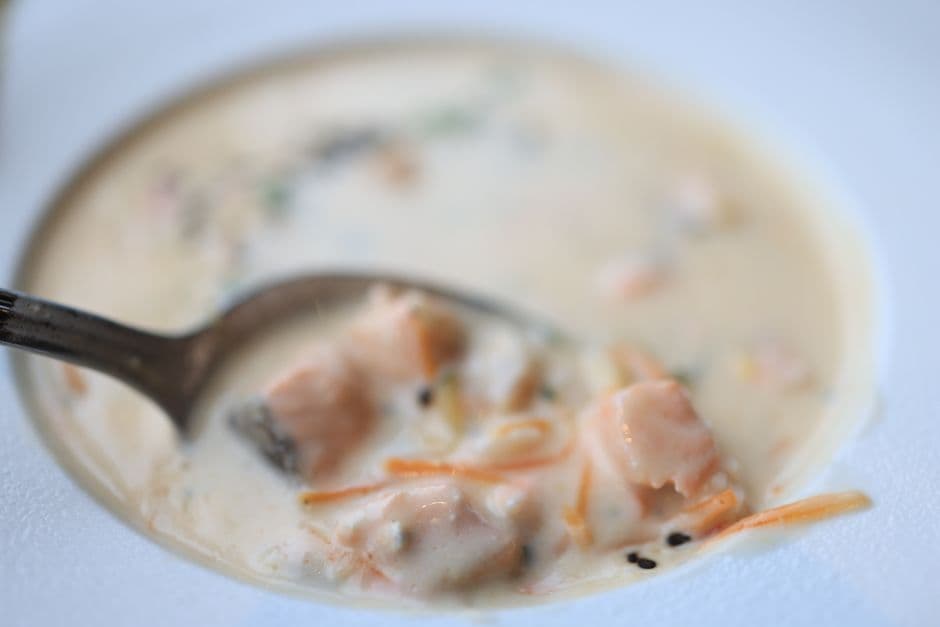
Fiskesuppe (Norwegian Creamy Fish Soup)
Chunks of cod, salmon and shrimp poached in a silken cream-and-fish-stock broth perfumed with leek, carrot and dill — Bergen's elegant answer to chowder.
About This Recipe
Fiskesuppe is Norway's great fish soup and one of the defining dishes of the western fjord coast, particularly Bergen, where centuries of fishing-trade wealth turned even everyday fishermen's food into something polished and refined. Unlike the dense, potato-thickened chowders of New England or the rustic bouillabaisse of Provence, fiskesuppe is built around a delicate fish stock made from white-fish bones — cod, haddock, halibut — gently simmered with leek tops, carrot, parsley stems, white peppercorns and a splash of white wine, then strained until perfectly clear. The stock is enriched with cream (lots of it — Norwegians don't economize on dairy in fish soup), thickened only lightly with a flour-butter roux, and brought to a silken texture that coats the spoon without ever feeling heavy. Into this golden cream broth go batons of carrot and leek (the only vegetables — never potato, in true Bergen style), and at the very end, gently poached chunks of two or three white fish — usually cod for sweetness, salmon for richness, and a handful of small cold-water shrimp for sweetness and pink colour. The garnish is a flurry of dill, a few chive scrolls, and a single lemon wedge on the side. Eaten with hunks of dark Norwegian rye and a glass of cold lager, it is a soup that tastes of the cold Atlantic sea distilled into cream — clean, sweet, faintly briny, deeply comforting, and unmistakably of the Bergen quayside.
Ingredients
Serves 6
- 1.2 lgood fish stock (homemade from white fish bones, or quality bought)
- 300 mlheavy cream plus 100 ml whole milk
- 40 gunsalted butter plus 30 g plain flour (for the roux)
- 2large leeks, white and pale green only, sliced into 5 mm rings
- 2carrots, peeled and cut into thin batons
- 350 gskinless boneless cod fillet, cut into 3 cm chunks
- 250 gskinless boneless salmon fillet, cut into 3 cm chunks
- 150 gsmall cooked cold-water shrimp, peeled
- 150 mldry white wine, plus 1 bay leaf and 6 white peppercorns
- fresh dill, chives, fine sea salt, white pepper, and lemon wedges to serve
Instructions
- 1
Sweat the vegetables
Melt the butter in a heavy soup pot over medium-low heat. Add the sliced leek rings and carrot batons with a pinch of salt and sweat gently 8 minutes, stirring, until softened but not coloured. They should be tender and translucent.
Browning the vegetables is wrong for fiskesuppe — the broth must stay pale and clean.
- 2
Build the roux
Sprinkle the flour over the vegetables and stir to coat. Cook 90 seconds, stirring constantly, until the flour smell is gone and a pale paste forms. Do not let it colour.
- 3
Add wine and stock
Pour in the white wine and whisk hard to dissolve the roux completely. Let bubble 60 seconds. Add the fish stock in a steady stream, whisking constantly to prevent lumps. Add the bay leaf and white peppercorns. Bring to a gentle simmer, then reduce heat low and cook 15 minutes — the stock will thicken slightly and the vegetables will become very tender.
- 4
Enrich with cream
Stir in the heavy cream and milk. Bring back to a bare simmer — do not boil hard or the cream may split. Cook gently 5 minutes for flavours to marry. Taste — should be silken, lightly thickened, sweet from cream and fish stock. Adjust with salt and white pepper.
- 5
Poach the white fish first
Reduce heat to its lowest setting — the soup must barely tremble, not bubble. Add the cod chunks and cook 3 minutes, just until they turn opaque at the edges. White fish overcooks instantly in residual heat — be conservative.
- 6
Add salmon and shrimp
Add the salmon chunks and cook another 2 minutes — salmon should be just translucent in the centre, not opaque all the way through. Turn off the heat completely and stir in the cooked shrimp. Residual heat will warm them through in 60 seconds. Fish out the bay leaf.
- 7
Rest and garnish
Let the soup rest 3 minutes off the heat — the fish finishes cooking gently and the flavours settle. Stir in a generous handful of chopped fresh dill. Ladle into wide warmed bowls, making sure each portion gets some of each fish, some shrimp, and some vegetables.
- 8
Serve with rye
Garnish each bowl with a tuft of dill, a sprinkle of chive, and a tiny crack of white pepper. Set a lemon wedge on each bowl rim — a small squeeze brightens the cream but is optional. Serve with thick slices of dark Norwegian rye bread and salted butter, with a cold lager or chilled Alsatian Riesling alongside.
Did you make this?
Rate it and help other cooks find the recipes that actually work.
One tap to sign in, and we'll save the rating you just picked.
Everything you need to plan your week — free
- Meal calendar
- Grocery list
- AI recipe ideas
Cook this hands-free
Get AI meal plans, step-by-step cooking mode, and your saved recipes in the free Bento app.
Pro Tips
- →
Use real homemade fish stock if you possibly can — it transforms the soup from good to extraordinary. Bones from one whole white fish, simmered 30 minutes with vegetables, are enough.
- →
Never let the cream-enriched soup boil hard — cream above a bare simmer can break into oily droplets.
- →
Add fish in the precise order given (cod first, salmon second, shrimp last) — each has different ideal cooking times.
- →
Bergen tradition adds no potato; the soup is built around cream and fish, not starch. Don't be tempted.
Variations
- •
Add 200 g of halibut or monkfish chunks for an even more luxurious version.
- •
Mussels and clams — steam 500 g of either separately, then add along with their strained broth in the final step.
- •
Curry fiskesuppe — add 1 tsp mild curry powder with the roux for a popular modern Oslo twist.
- •
Smoked salmon finish — top each bowl with thin slices of cold-smoked salmon as garnish for a Swedish-Norwegian fusion.
Storage
Best the day it's made; cream-based fish soups don't reheat well. Refrigerate gently up to 24 hours and reheat over very low heat without boiling. Does not freeze — cream splits and fish becomes mushy. If making ahead, prepare the cream base without fish, refrigerate, and add fresh fish at serving.
History & Origin
Fiskesuppe evolved in the wealthy fishing port of Bergen during the Hanseatic League period (14th–17th centuries), when German merchants and Norwegian fishermen mingled and dairy-rich fish soups became a hallmark of the western fjord coast. By the 19th century it was the showcase Sunday lunch dish of Bergen's bourgeois homes, and remains the most ordered tourist dish at the famous Fisketorget (fish market) restaurants.
Frequently Asked Questions
Can I use frozen fish?
Yes — thaw slowly in the fridge overnight and pat very dry before adding to the soup. Frozen cod from northern waters is often excellent quality.
What if my soup splits?
If the cream breaks, whisk 1 tbsp cold cream into 1 tbsp cornflour and stir into the soup off the heat — it will pull back together. Prevention is better: never boil hard.
Can I add potato?
Some Norwegian regions do (Trondheim style), but Bergen-style fiskesuppe specifically does not. Adding potato changes the dish into something closer to American chowder.
Substitute for cod?
Any firm white fish — haddock, pollock, halibut, hake, or even monkfish. Avoid oily fish like mackerel or sardines, which would dominate the cream.
Nutrition Facts
Per serving (400g / 14.1 oz) · 6 servings total
Time Summary
Have Questions?
Ask our AI cooking assistant anything about this recipe — substitutions, techniques, scaling.
Chat with AI Chef →Featured in Guides
This recipe is featured in the following curated guides:
More Norwegian Recipes
You Might Also Like
Similar dishes from other cuisines around the world.
Free Kitchen Tools
Calculators and converters that pair with this page — no signup needed.
Put This Into a Plan
Schedule it, shop for it, and track what you already have.
Read Next
Longer reads that go deeper on the ideas behind this dish.
Community
Join the conversation
Sign in to leave a comment and save your favourite recipes