
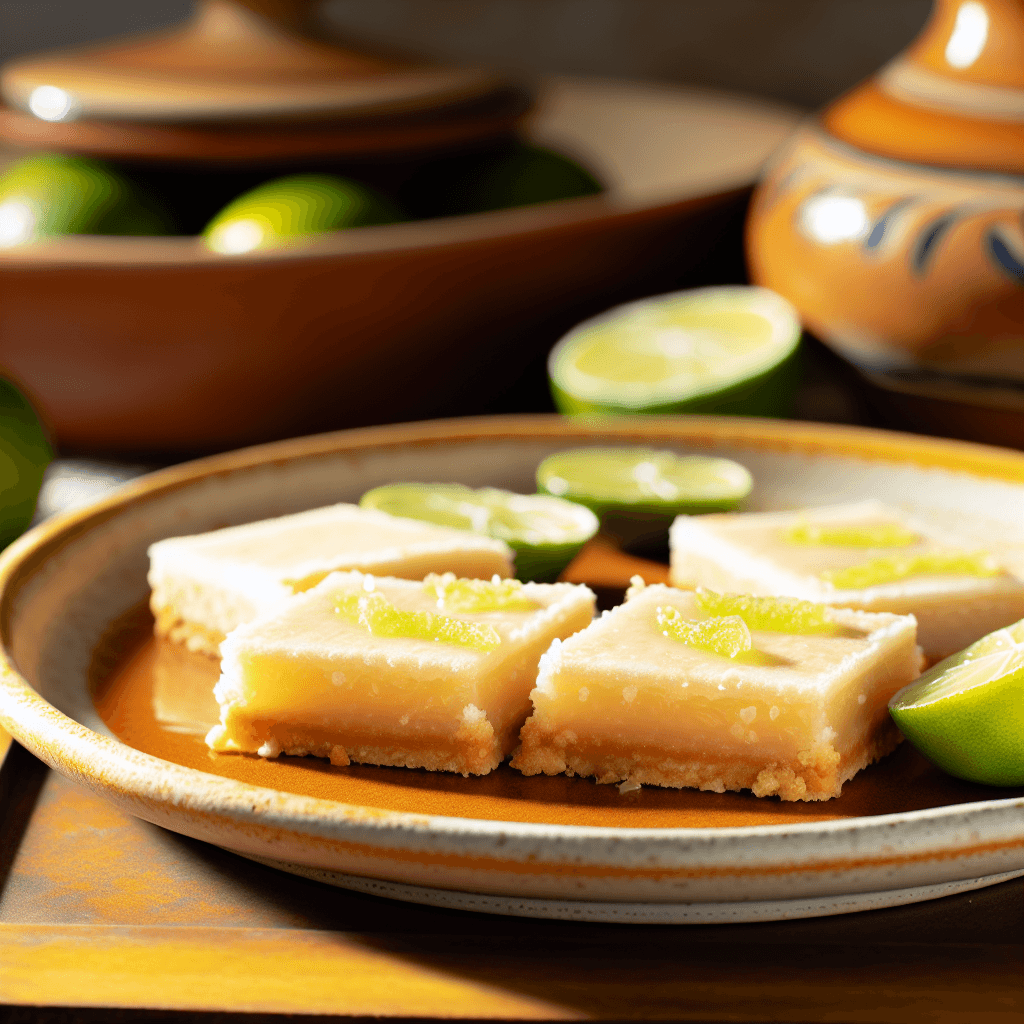
Key Lime Bars
Tart key lime custard on buttery shortbread crust.
About This Recipe
Key limes (Citrus aurantifolia) are smaller, rounder, and considerably more aromatic than the Persian limes sold in most grocery stores — and in the Florida Keys, where they grew abundantly before a 1926 hurricane wiped out most of the crop, they were the only citrus available. Local cooks, working with sweetened condensed milk (which required no refrigeration before electricity reached the Keys), egg yolks, and those intensely tart, floral little limes, created a filling that set to a silky, slightly wobbly custard through the chemical reaction between the lime's acid and the milk's proteins — no oven required in the original recipe. The bars format translates this iconic Florida pie tradition into something more practical for picnics, potlucks, and bake sales: a firmly pressed graham cracker crust, the same three-ingredient custard filling, and a brief bake that sets the top without losing the jiggly, bright tang underneath. The tasting notes of real key lime filling are distinct and irreducible: intensely tart with a floral bitterness on the finish that regular lime juice — sharper, more one-dimensional — cannot replicate. The sweetened condensed milk is not mere convenience; its concentrated sugar and milk solids create a creaminess and richness that no combination of cream and sugar can match. The egg yolks provide lecithin for emulsification and contribute a golden tint that signals richness. Cut into squares after a thorough chill, dusted with powdered sugar or topped with a drift of lightly sweetened whipped cream, these bars deliver the flavour of a Florida summer afternoon in every bite.
Ingredients
Serves 16
- 200 ggraham cracker crumbs
- 100 gmelted butter
- 2 tbspsugar
- 1 cansweetened condensed milk
- 3egg yolks
- 100 mlkey lime juice
- 1 tbsplime zest
- powdered sugarfor dusting
Instructions
- 1
Build and bake the crust
Combine the graham cracker crumbs, melted butter, and sugar in a bowl and mix until the crumbs are evenly moistened and clump together when pressed between your fingers. Tip into a 20 cm square baking pan and press firmly and evenly into the bottom using the bottom of a measuring cup or flat glass. Bake at 175°C (350°F) for 10 minutes until the crust smells toasty and feels set at the edges.
Press the crust firmly and evenly — a loosely packed crust crumbles when you cut the bars. Run the measuring cup around the edges to form a slight raised rim that holds the filling.
- 2
Make the filling
Whisk together the sweetened condensed milk, egg yolks, key lime juice, and lime zest in a bowl until completely smooth and uniformly pale yellow — about 1 minute of brisk whisking. The filling thickens slightly from the acid-protein reaction even before baking. Do not whip aggressively or you will incorporate air bubbles that mar the surface.
- 3
Bake the filling
Pour the filling over the hot crust, smoothing to the edges with a spatula. Return to the oven and bake at 175°C (350°F) for 14–16 minutes until the edges are fully set and the centre has only a faint wobble when you gently shake the pan — like set Jell-O, not liquid.
Don't overbake — the filling firms further as it chills and overbaked key lime custard turns dry and slightly grainy.
- 4
Cool and chill
Cool in the pan on a wire rack for 30 minutes at room temperature, then cover with cling film and refrigerate for at least 3 hours, or overnight. The filling must be fully cold to slice cleanly — warm bars collapse and smear.
- 5
Cut and serve
Run a sharp knife around the edge of the pan, then cut into 16 squares using a long knife dipped in hot water and wiped dry between cuts. Arrange on a platter, dust lightly with powdered sugar, and serve cold — these bars are at their best straight from the refrigerator.
Did you make this?
Rate it and help other cooks find the recipes that actually work.
One tap to sign in, and we'll save the rating you just picked.
Everything you need to plan your week — free
- Meal calendar
- Grocery list
- AI recipe ideas
Track what you eat
Snap your meal to log calories and macros, run fasting timers and track water in the free SnapCal app.
Pro Tips
- →
Use bottled Nellie & Joe's Famous Key West Lime Juice if you can't find fresh key limes — it is genuinely superior to fresh Persian lime juice for this recipe and widely available in specialty stores.
- →
Zest your limes before juicing them; the essential oils in the zest are what give key lime desserts their signature floral aroma.
- →
The crust must be baked hot before the filling goes on — pouring filling onto a raw or cooled crust results in a soggy, crumbly base that won't hold together when sliced.
- →
A sharp knife is essential for clean cuts; a dull knife drags through the custard and tears the crust. Hot-water-dipped knife, wiped dry, every single cut.
- →
Bars keep their flavour and texture much better than pie — the increased surface area of the crust-to-filling ratio means they stay crisp longer in the refrigerator.
Variations
- •
Coconut key lime bars: replace half the graham cracker crumbs with toasted shredded coconut in the crust, and add 2 tablespoons of cream of coconut to the filling for a tropical double note.
- •
Chocolate key lime: use crushed chocolate wafer cookies (like Oreos, filling removed) in place of graham crackers for a dark crust that plays dramatically against the bright filling.
- •
Meringue-topped: immediately after baking, top with a stiff Italian meringue made from 2 egg whites and 100 g of sugar, then torch the meringue peaks until golden — a bar version of the classic key lime meringue pie.
- •
No-bake cream cheese version: beat 8 oz softened cream cheese with the condensed milk and lime juice until smooth, skip the eggs, pour over unbaked crust, and refrigerate 4 hours — safe for those avoiding cooked eggs.
Storage
Refrigerate key lime bars covered with cling film or in an airtight container for up to 4 days — they actually improve on day two as the flavors meld and the crust softens slightly to a shortbread texture. Do not freeze assembled bars, as the custard filling weeps and turns grainy on thawing.
History & Origin
Key lime pie — the template for these bars — is believed to have originated in the Florida Keys in the late 19th century, where sweetened condensed milk was a pantry staple before refrigeration and Key limes grew prolifically on every property. The recipe was first published in the 1930s, and Borden's condensed milk was promoting it by the 1940s. Florida officially declared Key lime pie the state pie in 2006. The bar format emerged as home bakers adapted the recipe to be more portable and easier to serve at gatherings, with the first published key lime bar recipes appearing in American home cooking magazines in the 1980s.
Frequently Asked Questions
Can I use regular Persian lime juice instead of key lime juice?
You can, but the result is noticeably different. Persian limes are larger, less aromatic, and sharper-tasting than key limes, which have a distinct floral bitterness and complexity. The filling will still taste good with regular limes, but it won't have the characteristic tropical aroma that defines authentic key lime desserts. Bottled key lime juice (Nellie & Joe's is the standard) is widely available and a much better substitute than fresh Persian lime.
Why won't my filling set?
Two likely causes: you used evaporated milk instead of sweetened condensed milk (they look similar but behave completely differently — condensed milk is thick and very sweet, evaporated milk is thin), or you under-baked the filling. The centre should have only a very slight wobble when it comes out of the oven; it firms completely only after thorough chilling. If still liquid after chilling overnight, the eggs may have been omitted or the juice-to-milk ratio was off.
Do the egg yolks stay raw?
No — the oven bake cooks the eggs to a safe temperature. The filling reaches well above 70°C (160°F) during baking, which pasteurises the yolks. If you prefer to avoid any uncertainty, use pasteurised egg yolks sold in cartons at most grocery stores.
How do I get clean cuts without the filling sticking?
The bars must be thoroughly cold — at least 3 hours in the refrigerator, ideally overnight. Use a long, sharp knife dipped in very hot water and wiped completely dry before each cut. This prevents the custard from dragging and smearing. Cutting 16 squares requires 6 total cuts, so dip and wipe 6 times.
Nutrition Facts
Per serving (60g / 2.1 oz) · 16 servings total
Time Summary
Have Questions?
Ask our AI cooking assistant anything about this recipe — substitutions, techniques, scaling.
Chat with AI Chef →Featured in Guides
This recipe is featured in the following curated guides:
More American Recipes
You Might Also Like
Similar dishes from other cuisines around the world.
Free Kitchen Tools
Calculators and converters that pair with this page — no signup needed.
Put This Into a Plan
Schedule it, shop for it, and track what you already have.
Read Next
Longer reads that go deeper on the ideas behind this dish.
Community
Join the conversation
Sign in to leave a comment and save your favourite recipes