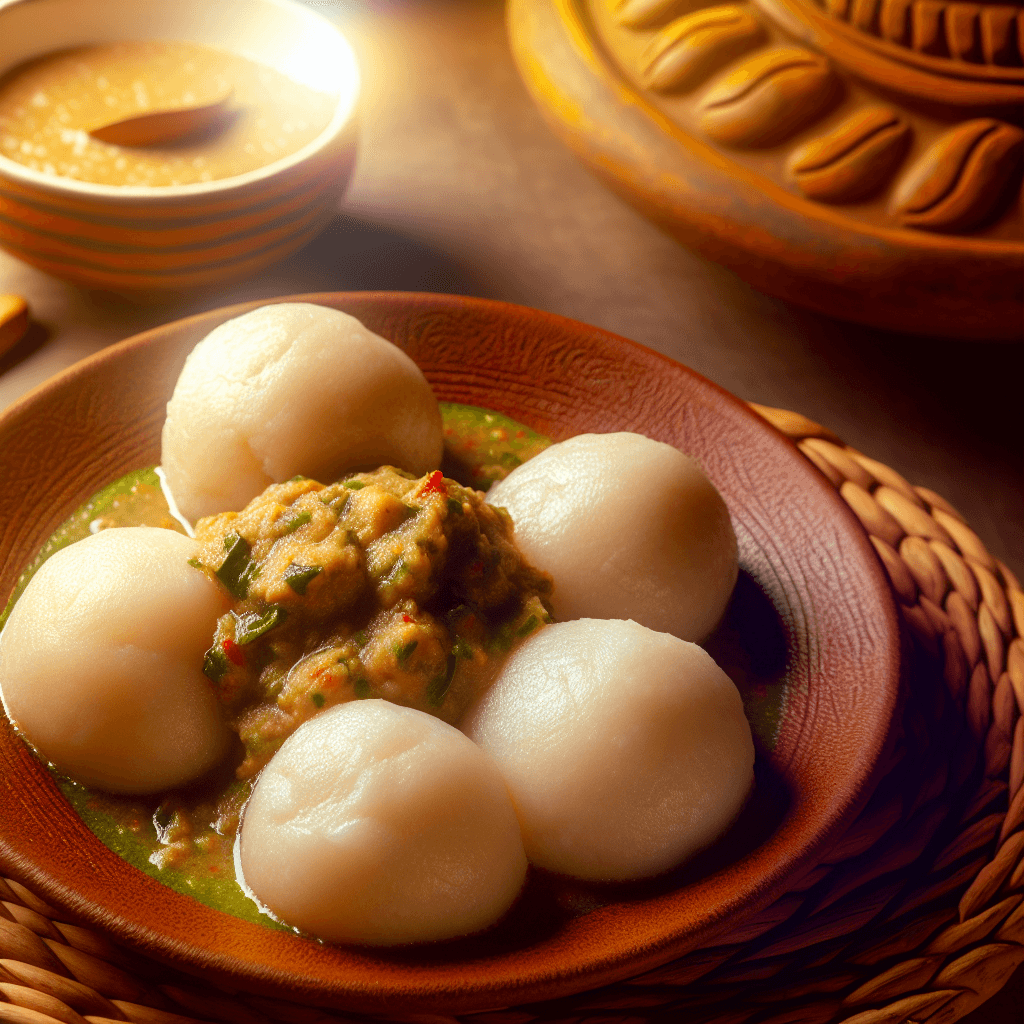
Fufu is the foundation upon which the entire cuisine of Togo — and much of West and Central Africa — is built. It is not a side dish; it is the meal itself, the vehicle through which soups, stews, and sauces are consumed. In Togo, fufu is most commonly made from white yam (Dioscorea rotundata), which is peeled, boiled until completely tender, then transferred to a large wooden mortar and pounded rhythmically with a heavy pestle until it transforms from individual pieces of cooked yam into a single, unified, glossy-smooth elastic mass. The pounding process is both a physical technique and a social ritual: in households across Togo, the pounding is traditionally done by two people — one turning the fufu in the mortar, one striking with the pestle in alternating beats — creating a rhythmic percussion that accompanies the sound of daily life. The quality of fufu depends almost entirely on two variables: the starch content of the yam and the vigour and consistency of the pounding. High-starch white yam from West Africa — available at African grocery stores outside the continent — produces the stretchiest, most elastic fufu. Cassava fufu is slightly less elastic but more widely available in diaspora communities. During the pounding, small amounts of hot water are added incrementally to keep the mass from drying out and sticking to the pestle, but the goal is always to keep the fufu as dry as possible while achieving smoothness — too much water makes it gummy and weak. The finished fufu should be smooth enough to roll into a ball with wet hands, elastic enough to stretch slightly without tearing, and dense enough to hold its shape when pressed against the rim of a soup bowl. It is eaten by tearing off a small piece with the right hand, pressing a thumb indentation into it, and using it as a spoon to scoop the accompanying soup.
Serves 4
Peel the white yam, removing all the rough brown skin, and cut into even cubes of roughly 5–6cm. Place in a large pot, cover with cold water, add the salt, and bring to a boil over high heat. Cook for 25–30 minutes until a fork slides through each piece with zero resistance — the yam must be fully, completely tender with no hard centre.
Cut pieces as evenly as possible so they all finish cooking at the same time. Undercooked yam in the mortar produces lumpy, grainy fufu that won't smooth out no matter how long you pound.
Drain the cooked yam thoroughly in a colander, shaking out all excess water. Let it steam-dry in the colander for 2–3 minutes — residual water on the surface makes the early pounding stage slippery and slows the process. Transfer immediately to the mortar while still piping hot.
Start pounding the yam with firm, downward strikes of the pestle, rotating the pestle slightly with each strike to break up the pieces. At this stage the yam will break apart into rough chunks — continue pounding for 3–4 minutes until no separate pieces remain and the mass begins to come together as a sticky, uniform dough.
Pound while the yam is as hot as you can handle — the starch is most pliable at high temperature and becomes increasingly difficult to smooth as it cools.
Once the yam has unified into a rough mass, dip the pestle in a bowl of warm water and continue pounding. The small amount of water transferred from the wet pestle is enough to keep the fufu smooth and prevent sticking. Pound for another 8–10 minutes, rotating the fufu in the mortar after every 10–12 strikes, until the surface is completely smooth and the mass stretches slightly when pulled.
Press a wet thumb firmly into the surface of the fufu — it should indent cleanly and the sides should be smooth with no visible granularity. Stretch a small piece between two wet fingers — it should extend slightly before tearing, indicating adequate gluten-like cohesion from the starch. If still grainy, continue pounding with additional strikes from a wet pestle.
Wet both hands with warm water. Take portions of fufu from the mortar, roll into smooth balls or half-sphere mounds, and plate immediately. Serve alongside gboma dessi, groundnut soup (tiga dege na), or palm nut soup — ladle the soup into a bowl and place the fufu on the side or in the centre.
Pound while the yam is still very hot — the hotter the yam, the more quickly the starch activates and becomes silky. Working with cooled yam takes twice as long and produces a less smooth result.
Keep a bowl of warm (not cold) water beside the mortar throughout pounding; cold water shocks the starch and tightens it, while warm water keeps it pliable.
If using a stand mixer as a substitute for the mortar, use the dough hook attachment at the lowest speed and process for 10–12 minutes, adding warm water one tablespoon at a time. Stop when the dough pulls cleanly from the sides of the bowl.
White yam from West Africa (sold as 'yam' in African grocery stores) produces the best fufu — it has a higher starch content than yellow Caribbean yam or sweet potato, both of which produce a sweeter, less elastic result.
The correct consistency is firm enough to hold its shape when rolled into a ball but soft enough that you can make a thumb impression without cracking the surface. If it cracks, add a few more drops of warm water and pound briefly.
Cassava fufu: substitute white yam with peeled fresh cassava — boil 20–25 minutes until tender and pound the same way. Cassava fufu is slightly whiter, denser, and less elastic but widely eaten across Togo.
Plantain-yam hybrid: boil equal parts white yam and ripe plantain together, then pound together for a fufu that is slightly sweeter and softer than pure yam fufu.
Instant fufu: instant fufu flour (cassava or yam based) is available at African grocery stores — mix with boiling water according to package directions and knead to the correct consistency in about 5 minutes, used widely in the diaspora.
Cocoyam fufu: use taro root (cocoyam) instead of yam for a denser, slightly stickier fufu common in forest-zone communities of Togo.
Fufu is best eaten immediately after making — it loses its silky, warm texture quickly as it cools and the starch retrogrades. If you must store it, wrap tightly in cling film and refrigerate up to 2 days. To reheat, unwrap and steam over boiling water for 8–10 minutes until warmed through and pliable, or microwave wrapped in a damp paper towel on medium power for 2–3 minutes. Do not reheat in a dry pan, which causes the exterior to dry and crack.
Fufu has been made across West and Central Africa for at least several centuries, its origins tied to the cultivation of yam (Dioscorea species) that archaeological evidence places in West Africa as far back as 50,000 years ago. The specific pounding technique using a wooden mortar and pestle is documented in accounts by European traders visiting the West African coast from the 15th century onward, and the word 'fufu' itself is thought to derive from the Twi language of the Akan people of Ghana and Ivory Coast. In Togo, the dish is central to Ewe, Kabiyé, and Kotokoli food cultures, each with minor regional variations in starch base.
Yes — a stand mixer with a dough hook is the best substitute. Process the hot boiled yam on the lowest speed for 10–12 minutes, adding warm water one tablespoon at a time until smooth. A food processor set to pulse works but can over-aerate the mixture, making it light and less cohesive than mortar-pounded fufu.
Lumpiness usually means the yam wasn't cooked long enough — it must be completely tender with no resistance to a fork anywhere in the piece. Alternatively, you may have let the yam cool too much before pounding. Starch is most responsive to pounding when hot; once it cools below 60°C, it tightens and resists smoothing.
Break off a small piece (about the size of a golf ball) with the right hand, roll it briefly between your palm and fingers to smooth the surface, press your thumb into the centre to create a small bowl shape, and use it to scoop a mouthful of soup from the bowl. Fufu is traditionally swallowed with minimal chewing — its role is as a vehicle for the soup rather than a food to be chewed independently.
Yes — yam-based fufu contains no gluten whatsoever. It is entirely safe for people with celiac disease or gluten intolerance. Cassava fufu is also gluten-free. The starch that gives fufu its elastic quality is entirely from yam or cassava starches, not from wheat.
The most traditional pairings in Togo are gboma dessi (smoked fish and eggplant stew), palm nut soup (a rich, deep orange soup made from pounded fresh palm nuts), groundnut soup (tiga dege na), and light soup with goat or chicken. Any thick, intensely flavoured stew works well — the fufu's neutral flavour is its strength, allowing it to complement without competing.
Per serving (250g / 8.8 oz) · 4 servings total
Ask our AI cooking assistant anything about this recipe — substitutions, techniques, scaling.
Chat with AI Chef →Join the conversation
Sign in to leave a comment and save your favourite recipes
Have feedback or need help?
We read every email and reply within 1–2 business days.
© 2026 MyCookingCalendar. All rights reserved.