
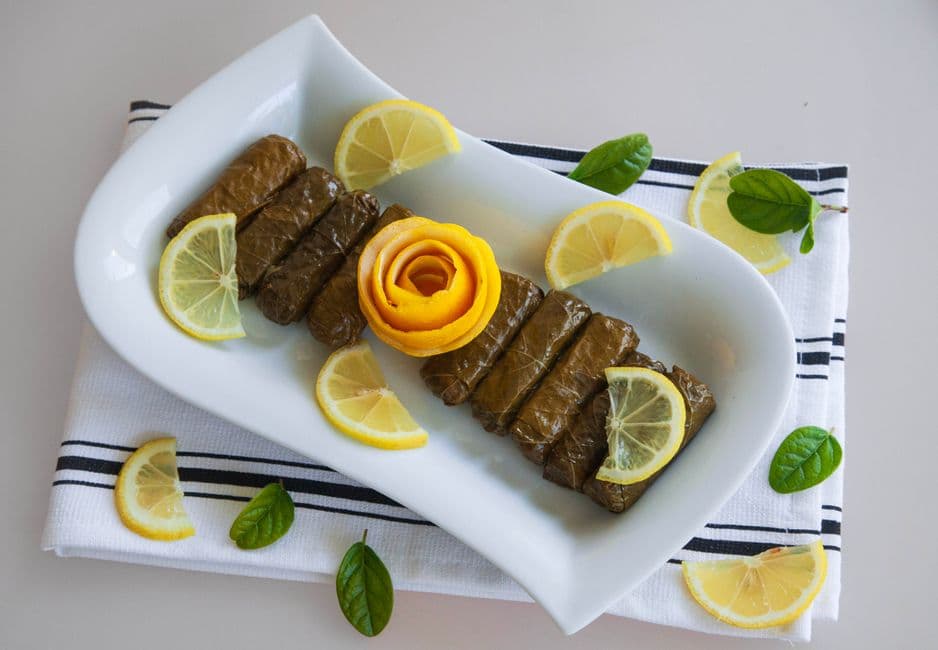
Zeytinyağlı Yaprak Sarma (Stuffed Grape Leaves in Olive Oil)
Delicate vine leaves stuffed with herb-scented rice, pine nuts, and currants, cooked in olive oil and lemon — the jewel of the Turkish zeytinyağlı (olive-oil) tradition.
About This Recipe
Yaprak sarma is one of the most cherished and labor-intensive dishes in Turkish cuisine — thin vine leaves rolled around a fragrant rice filling and cooked long and slow until the leaves become silky and the filling absorbs all the cooking liquid's flavor. The zeytinyağlı (olive oil) version, served at room temperature rather than hot, is the classic: this cold preparation allows the flavors to deepen and integrate in a way that hot service cannot match. Freshly made yaprak sarma left to rest overnight before serving is a completely different and superior experience to freshly made-and-eaten. The filling is a masterpiece of seasoning balance: long-grain rice mixed with finely diced onion sautéed in good olive oil, pine nuts toasted to golden, dried currants or sultanas that swell during cooking to provide pockets of sweetness, and a quartet of fresh and dried herbs — fresh dill, mint, parsley, and dried mint — that give the filling its distinctive aromatic complexity. A pinch of cinnamon and allspice adds warm depth without being detectable as distinct flavors. Each leaf is laid flat, ribs trimmed, filling placed in a neat cylinder, and rolled tightly into a small torpedo. The sarma are packed snugly in a pot, covered with a plate to prevent unrolling, and cooked in a mixture of olive oil, water, and lemon juice for 35-40 minutes until the rice is perfectly cooked and the leaves silky.
Ingredients
Serves 6
- 40-50 leavesbrined grape/vine leaves(rinsed and blanched)
- 300 glong-grain rice(rinsed and drained)
- 2 largeonions(very finely diced)
- 3 tbsppine nuts
- 2 tbspdried currants or sultanas
- 100 mlextra-virgin olive oil(divided)
- 1/4 cupfresh dill(finely chopped)
- 1/4 cupfresh flat-leaf parsley(finely chopped)
- 2 tbspfresh mint leaves(finely chopped)
- 1 tspdried mint (kuru nane)
- 1/4 tspcinnamon
- 1/4 tspallspice
- 1.5 tspsalt
- 1/2 tspblack pepper
- 2 tbsplemon juice
- 300 mlhot water
Instructions
- 1
Prepare the Leaves
Separate the brined vine leaves and rinse under cold water. Blanch in boiling water for 2 minutes to soften and remove excess salt. Drain and spread on a towel. Any torn leaves should be used to line the base of the pot.
- 2
Make the Filling
Heat 3 tbsp olive oil in a skillet over medium heat. Sauté the onion for 8-10 minutes until very soft and translucent. Add pine nuts and toast for 2 minutes. Add the rice and stir for 1 minute. Remove from heat. Mix in currants, all fresh and dried herbs, cinnamon, allspice, salt, pepper, and 1 tbsp lemon juice. The filling will be partially cooked — it finishes cooking inside the rolled leaves.
The rice should be barely cooked at this stage — it will absorb all the cooking liquid inside the rolled sarma.
- 3
Roll the Sarma
Place a leaf vein-side up on the work surface. Place 1 teaspoon of filling (for small leaves) or 1.5 tsp (for larger leaves) in a horizontal line near the stem end. Fold the bottom of the leaf up over the filling, fold in the sides, then roll tightly upward into a compact cylinder. The roll should be firm but not so tight that it bursts when the rice expands.
- 4
Pack and Cook
Line the base of a wide saucepan with any torn leaves. Pack the sarma tightly in layers, seam-side down. Mix remaining olive oil with hot water and lemon juice; pour over the sarma. Place an inverted plate on top of the sarma to hold them down. Cover with a lid and cook on medium-low heat for 35-40 minutes until the liquid is absorbed and a rice grain is completely tender.
The inverted plate prevents the sarma from unrolling and keeps them uniformly submerged in the cooking liquid.
- 5
Cool and Serve
Remove from heat and let cool completely in the pot — at least 1 hour. Transfer to a serving plate and drizzle with a little extra olive oil and lemon juice. Serve at room temperature with yogurt or lemon wedges alongside.
Did you make this?
Rate it and help other cooks find the recipes that actually work.
One tap to sign in, and we'll save the rating you just picked.
Everything you need to plan your week — free
- Meal calendar
- Grocery list
- AI recipe ideas
Track what you eat
Snap your meal to log calories and macros, run fasting timers and track water in the free SnapCal app.
Pro Tips
- →
Make sarma a day ahead — the flavor improves dramatically after a night in the refrigerator as the olive oil and lemon infuse throughout.
- →
Roll tightly but not extremely tight — the rice needs room to expand. A roll that's too tight will burst; too loose will fall apart.
- →
Using brined grape leaves from a jar (already softened) is fine — just rinse well and blanch briefly to reduce saltiness.
- →
Line the bottom of the pan with several layers of leaves to prevent sticking and protect the bottom sarma from direct heat.
Variations
- •
With meat: replace the vegan filling with a mixture of rice and ground lamb, serve hot rather than at room temperature, and skip the currants.
- •
Fresh grape leaves: in spring, use fresh tender young vine leaves picked from the garden — blanch for only 30 seconds.
- •
Chard version (pazı sarma): substitute Swiss chard leaves for grape leaves — larger and easier to roll for beginners.
Storage
Yaprak sarma keeps in the refrigerator for up to 4 days and improves with time. Store with the cooking juices to keep moist. Serve at room temperature — do not microwave. Freeze for up to 2 months; thaw in the refrigerator overnight.
History & Origin
Stuffed vine leaves appear in ancient texts from the Levant, Greece, and Turkey and are documented in Byzantine cooking records. The zeytinyağlı (olive oil, cold) version of yaprak sarma is considered a distinctly Turkish contribution — hot stuffed leaves with meat are found throughout the Levant, but the cold, herb-and-currant-scented olive oil version is particularly associated with the Aegean Turkish tradition. The dish appears in 17th and 18th century Ottoman cookbooks as both a palace and popular food.
Frequently Asked Questions
Why do my sarma fall apart during cooking?
Rolling too loosely is the main cause. The roll must be firm and tight enough to hold during the cooking, and they must be packed tightly in the pot (they support each other). Using the inverted plate method is essential — without it, the rolls can unravel as the liquid bubbles.
Can I freeze stuffed grape leaves?
Yes — freeze after cooking and cooling. Thaw overnight in the refrigerator. They may be slightly less firm after freezing but the flavor is excellent. You can also freeze them raw (uncooked) — add 10 minutes to the cooking time from frozen.
What do I serve with yaprak sarma?
The zeytinyağlı version is served at room temperature as a meze with a wedge of lemon and sometimes a dollop of yogurt on the side. It pairs beautifully with other cold meze dishes like cacık, hummus, and eggplant dip as part of a Turkish mezze spread.
Nutrition Facts
Per serving (180g / 6.3 oz) · 6 servings total
Time Summary
Have Questions?
Ask our AI cooking assistant anything about this recipe — substitutions, techniques, scaling.
Chat with AI Chef →Featured in Guides
This recipe is featured in the following curated guides:
More Turkish Recipes
You Might Also Like
Similar dishes from other cuisines around the world.
Browse by Ingredient
More recipes built around the same core ingredients.
Free Kitchen Tools
Calculators and converters that pair with this page — no signup needed.
Put This Into a Plan
Schedule it, shop for it, and track what you already have.
Read Next
Longer reads that go deeper on the ideas behind this dish.
Community
Join the conversation
Sign in to leave a comment and save your favourite recipes