
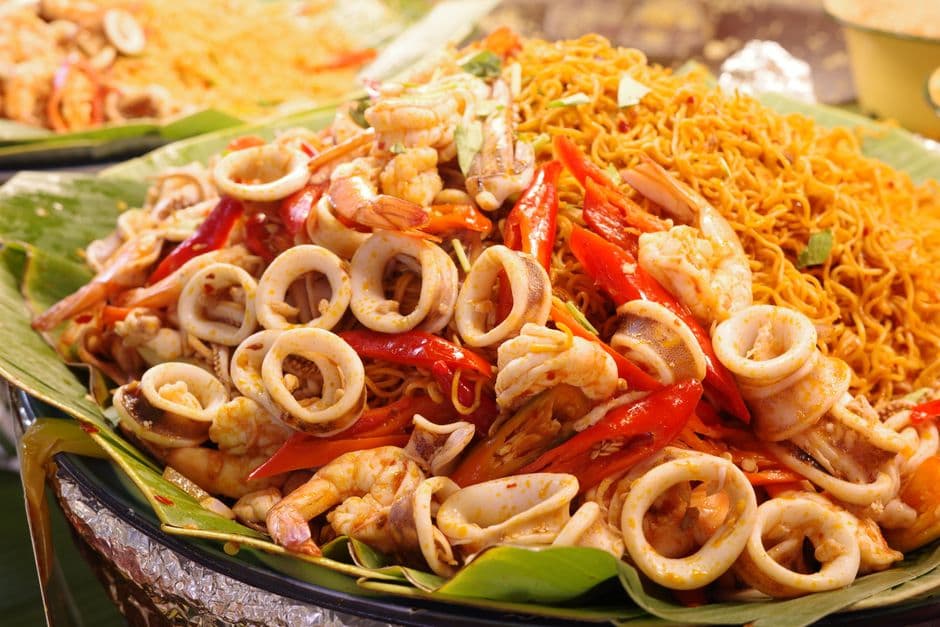
Singapore Hokkien Mee (Wok-Fried Prawn and Pork Noodles)
Wok-charred yellow noodles and rice vermicelli braised in a deep prawn-and-pork stock with squid, prawns and a squeeze of calamansi — Singapore hawker classic.
About This Recipe
Singapore Hokkien mee (often spelled Hokkien prawn mee) is one of the city's defining hawker dishes — a wok-braised tangle of thick yellow egg noodles and thin rice vermicelli, glossed with a deep amber prawn-and-pork stock and topped with succulent prawns, squid rings, pork belly, fried lard cubes and a wedge of fragrant calamansi lime. It bears no resemblance to Malaysian Hokkien mee (a thick black-soy stir-fry) or the soup-based prawn mee — Singapore's version is its own creature, defined by the long-simmered stock and the wok hei char that only a 200,000 BTU hawker burner can produce. The technique is a kind of controlled chaos: noodles, stock and protein hit the wok in sequence, the cook tosses constantly so nothing burns while the stock reduces and the noodles absorb it, and at the last second a final ladle of fresh stock is added so the dish is just-wet, neither soupy nor dry. Eaten with a squeeze of calamansi and a spoonful of fiery sambal chile, it is the rare dish where simple ingredients become greater than the sum of their parts through technique alone. The legendary versions — Hong Heng at Tiong Bahru, Nam Sing at Old Airport Road — have queues that stretch around the block, and every Singaporean has a favorite stall they will defend with religious fervor.
Ingredients
Serves 4
- 400 gfresh thick yellow egg noodles (Hokkien mee)
- 200 gdried rice vermicelli (bihun), soaked 10 minutes
- 12large prawns, peeled (reserve shells and heads for stock)
- 200 gpork belly, sliced 5 mm thick
- 200 gsquid, cleaned and sliced into rings
- 100 gpork lard, diced into 5 mm cubes (for rendering)
- 4garlic cloves, minced
- 3eggs, beaten
- 1 small handfulbean sprouts
- 2 stalksyellow garlic chives (kuchai), cut into 5 cm lengths
- 3 tbsplight soy sauce; 1 tbsp dark soy sauce; 1 tsp white pepper
- 1 tbspfish sauce
- to serve: calamansi or lime wedges, sambal belacan
Instructions
- 1
Make the prawn-pork stock (essential)
Render lard cubes in a heavy pot over low heat 15 minutes until golden — reserve the cracklings for garnish. In the rendered fat, fry the prawn shells and heads over medium-high 5 minutes, crushing with a spatula until deep red-orange. Add the pork belly cut-offs (or extra pork bones) and 1.5 L water. Simmer 40 minutes, skimming foam. Strain — you should have about 1 L of intensely flavored amber stock.
- 2
Prep all ingredients
Slice pork belly, peel prawns (cut along back to butterfly), slice squid into rings, beat eggs, blanch bean sprouts 15 seconds and chop chives. Soak vermicelli in cool water 10 minutes then drain. Loosen the fresh yellow noodles with your hands. Wok stir-fry takes 5 minutes — you cannot pause.
- 3
Heat the wok aggressively
Set a carbon-steel wok over your hottest flame for 2 minutes until just smoking. Add 2 tbsp rendered lard and swirl. The wok should smoke instantly when oil hits it — this is the only way to get wok hei.
Cook in two batches if your home stove can't deliver enough heat; doubling the recipe in one wok will give you steamed gloop.
- 4
Sear the proteins
Drop pork belly into the smoking oil and stir-fry 90 seconds until edges crisp. Add prawns and squid, toss 60 seconds until just opaque (they'll finish cooking later). Push everything to the wok's side. Add garlic to the center and stir 10 seconds.
- 5
Add the eggs and noodles
Pour the beaten eggs into the cleared center, let set 15 seconds, then push and scramble loosely. Add yellow noodles and vermicelli together, toss to combine with the egg, pork and seafood. Drizzle light soy, dark soy and fish sauce around the edges of the wok where they'll caramelize.
- 6
Add stock and braise
Ladle in 500 ml of the hot prawn-pork stock and toss vigorously. The noodles should absorb the stock greedily over 90 seconds — keep tossing so the bottom doesn't scorch. Add another ladle of stock if the noodles look dry, but stop before it becomes soupy. The final dish is just-wet, not swimming.
- 7
Finish and plate
Throw in bean sprouts and chives and toss twice. Slide onto a plate, top with the reserved lard cracklings, a wedge of calamansi and a generous spoonful of sambal belacan on the side. Diners squeeze the calamansi and stir the sambal in to taste — that single squeeze of citrus is what cuts the richness and makes the dish sing.
Did you make this?
Rate it and help other cooks find the recipes that actually work.
One tap to sign in, and we'll save the rating you just picked.
Everything you need to plan your week — free
- Meal calendar
- Grocery list
- AI recipe ideas
Track what you eat
Snap your meal to log calories and macros, run fasting timers and track water in the free SnapCal app.
Pro Tips
- →
The stock is everything — don't skip it or substitute store-bought. Even 30 minutes of homemade prawn-shell stock gives a depth no shortcut matches.
- →
Lard is non-negotiable in real Hokkien mee — vegetable oil works but you lose the porky richness that defines the dish. Buy pork fat at a butcher and render it yourself.
- →
Calamansi is the authentic finishing citrus — substitute with a mix of lime and orange juice (3:1) if needed. Plain lime alone is too one-dimensional.
- →
Sambal belacan should be served on the side, not stirred in — each diner adds their own. Make it fresh by pounding 6 red chiles with 1 tsp toasted belacan and a pinch of salt.
Variations
- •
White Hokkien mee — skip the dark soy entirely for a paler, more delicate version (the Nam Sing house style).
- •
Black Hokkien mee — double the dark soy for a sweeter, darker dish closer to the Malaysian style.
- •
Crispy noodle version — fry half the yellow noodles until crispy first, then add to the wet noodles at the end for textural contrast.
- •
Vegetarian — omit all seafood and pork; make stock from kombu, dried mushrooms and soy bean paste; use fried tofu and king oyster mushrooms.
Storage
Best eaten immediately — Hokkien mee does not store well as the noodles continue to absorb stock and turn pasty. Leftover stock can be refrigerated 4 days or frozen 2 months; reuse it as a base for other noodle soups. Refrigerated leftovers reheat poorly; eat within 24 hours if you must save them.
History & Origin
Singapore Hokkien mee was created in the 1920s by Hokkien sailors in Rochor Road who used leftover noodles from nearby factories and free prawn-head stock from kitchens to feed themselves cheaply. The dish was refined into its modern form in the postwar hawker-stall culture of the 1950s and 1960s, and is now formally recognized by the Singapore Tourism Board as one of the nation's heritage hawker dishes.
Frequently Asked Questions
Can I use chicken stock instead?
It works in a pinch but loses the dish's defining seafood depth. If you must, simmer chicken stock with 250 g of prawn shells for 20 minutes to approximate the flavor.
Why are my noodles gummy?
Either your wok wasn't hot enough or you added too much stock at once. Add stock in two ladles and toss aggressively between additions so the noodles absorb gradually.
What's the difference from Malaysian Hokkien mee?
Malaysian (KL) Hokkien mee is a thick, dark, black-soy-glazed stir-fry with no soup element; Singapore Hokkien mee is light amber, just-wet with stock, and finished with calamansi. Completely different dishes despite the shared name.
Can I make the lard cracklings ahead?
Yes — they keep crisp 1 week in an airtight container at room temperature. Render a big batch and use them as a garnish on rice, noodles or soups.
Nutrition Facts
Per serving (480g / 16.9 oz) · 4 servings total
Time Summary
Have Questions?
Ask our AI cooking assistant anything about this recipe — substitutions, techniques, scaling.
Chat with AI Chef →Featured in Guides
This recipe is featured in the following curated guides:
More Singaporean Recipes
You Might Also Like
Similar dishes from other cuisines around the world.
Free Kitchen Tools
Calculators and converters that pair with this page — no signup needed.
Put This Into a Plan
Schedule it, shop for it, and track what you already have.
Read Next
Longer reads that go deeper on the ideas behind this dish.
Community
Join the conversation
Sign in to leave a comment and save your favourite recipes