
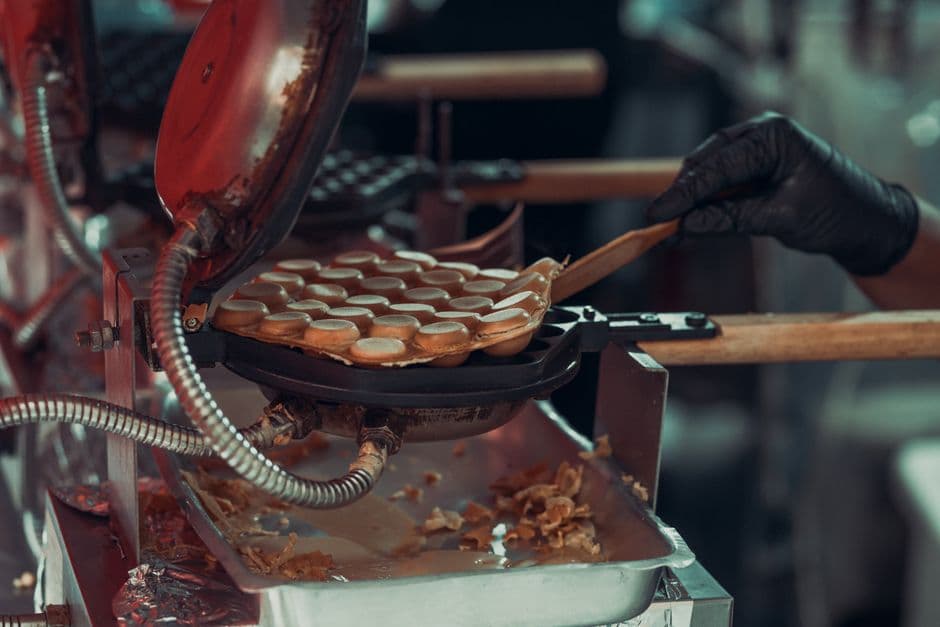
Hong Kong Egg Waffles (Gai Daan Jai)
Hong Kong's iconic street snack — egg-rich batter cooked in a hinged honeycomb mold until crisp, bubbly, and golden, eaten warm straight from the paper cone.
About This Recipe
Gai daan jai, literally 'little chicken eggs,' are the most beloved street snack in Hong Kong, sold from MTR-station stalls and Mong Kok side alleys for over sixty years. The batter — eggs, sugar, evaporated milk, flour, custard powder, and a touch of baking powder — is poured into a hinged cast-iron mold studded with hemispherical wells, then clamped shut and flipped over an open gas flame. Three minutes later, the cook prises the mold open to reveal a sheet of golden bubbles, crisp on the outer shell and soft, almost custard-like in the center. The texture is the whole point: each bubble shatters between your teeth then yields to a vanilla-egg interior that tastes like the love child of a waffle and a sponge cake. Vendors fold the warm sheet into a paper cone so you can pull off bubbles one by one as you walk. Modern shops have added flavors — chocolate, matcha, sea salt cheese, Oreo — but the original plain version remains untouchable: warm, eggy, faintly sweet, and gone before you reach the next tram stop. Making them at home requires the dedicated egg waffle iron (cheap on Taobao or Amazon), but once you own one the batter takes ten minutes and the technique is forgiving.
Ingredients
Serves 4
- 3 largeeggs, at room temperature for maximum lift
- 150 gcaster sugar
- 120 mlevaporated milk (Carnation), gives the signature flavor — do not substitute fresh milk
- 60 mlwater
- 2 tbspneutral oil (sunflower or peanut)
- 200 gplain flour
- 2 tbspcustard powder (Bird's), critical for color and aroma
- 1 tspbaking powder
- 0.25 tspfine salt
- 1 tspvanilla extract
Instructions
- 1
Whisk wet ingredients
In a large bowl whisk eggs and sugar for 2 minutes until pale, thick, and ribbon-stage. Add evaporated milk, water, oil, and vanilla and whisk until uniform. The aeration here builds the bubble structure.
- 2
Combine dry, then fold together
Sift flour, custard powder, baking powder, and salt into a second bowl. Add to the wet in three additions, whisking smooth between each. The finished batter should pour like single cream — thicker batter gives dense waffles, too thin and bubbles collapse.
Strain through a fine sieve to remove lumps — Hong Kong masters always strain.
- 3
Rest the batter
Cover and rest 30 minutes at room temperature. This hydrates the flour and relaxes gluten so the bubbles puff evenly. Skipping the rest gives a tough, chewy waffle instead of crisp-tender.
- 4
Heat the iron
Preheat your egg-waffle iron on high until a drop of water dances and evaporates instantly (about 4 minutes on a gas flame). Brush both plates lightly with oil before the first waffle only — non-stick coating handles the rest.
- 5
Pour and clamp
Pour about 150 ml batter onto the bottom plate to just cover the wells. Close immediately and flip the iron upside down — gravity helps batter fill every bubble cavity for that classic 3D shape.
- 6
Cook over flame
Cook 90 seconds, flip back, cook 90 more, then flip once more for 30 seconds. Total 3.5 minutes. You'll see steam slow and smell vanilla-egg toasting — that's done.
- 7
Release and cool briefly
Open the iron carefully (steam burns). Lift the waffle with a wooden skewer — it releases cleanly when ready. Cool 30 seconds on a rack so the outside crisps, then roll into a cone shape while still warm and pliable.
- 8
Eat immediately
Eat within 5 minutes — that's when the contrast between crackly shell and soft bubble interior peaks. Tear off bubbles one at a time straight from the cone.
Did you make this?
Rate it and help other cooks find the recipes that actually work.
One tap to sign in, and we'll save the rating you just picked.
Everything you need to plan your week — free
- Meal calendar
- Grocery list
- AI recipe ideas
Cook this hands-free
Get AI meal plans, step-by-step cooking mode, and your saved recipes in the free Bento app.
Pro Tips
- →
Evaporated milk and custard powder are non-negotiable — they're what makes it taste like Hong Kong and not like a generic waffle. Both keep for years in the pantry.
- →
The iron must be very hot when you pour or the bubbles will not puff. Test with a water drop every batch.
- →
Do not overfill — batter should just cover the wells. Overfilled waffles become thick discs instead of hollow bubbles.
- →
If your bubbles collapse, the batter is too thin or the iron not hot enough. Add a tablespoon of flour and reheat the iron 1 minute.
Variations
- •
Chocolate: replace 30 g flour with 30 g cocoa powder and add 50 g chopped dark chocolate to the batter.
- •
Matcha: replace custard powder with 2 tbsp ceremonial matcha for a Tokyo-Hong Kong fusion popular since 2015.
- •
Sea salt cheese: brush the warm waffle with melted unsalted butter, sprinkle flaky salt and shaved Parmesan — a Causeway Bay night-market favorite.
- •
Stuffed: wrap the warm waffle around a scoop of mango ice cream and condensed milk drizzle for a dessert-shop classic.
Storage
Best eaten immediately. Leftover waffles lose crispness within an hour; revive by 3 minutes in a 180°C oven (never microwave — turns rubbery). Batter keeps refrigerated 24 hours; whisk before using.
History & Origin
Gai daan jai originated in 1950s Hong Kong when a grocer with broken eggs supposedly poured them into a hot waffle iron to avoid waste, producing the first bubble-textured sheet. The snack was named for its resemblance to clusters of small chicken eggs and spread rapidly through Sham Shui Po street stalls in the 1960s.
Frequently Asked Questions
Can I use a Belgian waffle iron?
No — a regular waffle iron produces a flat grid pattern. The hemispherical bubble shape requires the dedicated egg-waffle iron (sometimes sold as 'puffle' or 'bubble waffle' iron). They cost £20–40 online.
Why is my waffle tough?
Overmixing develops gluten. Whisk only until smooth, then rest 30 minutes. Also check that your custard powder is fresh — old baking powder gives flat, tough waffles.
Can I make these on an electric iron instead of a gas flame?
Yes — most home cooks use electric bubble-waffle makers. Cook 4 minutes per waffle, no flipping needed. Texture is 95 percent as good as gas-flame original.
Why evaporated milk and not regular milk?
Evaporated milk has concentrated milk solids and a slight caramel note from its heat processing — that's the signature Hong Kong flavor. Fresh milk gives a flat, generic taste.
Nutrition Facts
Per serving (150g / 5.3 oz) · 4 servings total
Time Summary
Have Questions?
Ask our AI cooking assistant anything about this recipe — substitutions, techniques, scaling.
Chat with AI Chef →Featured in Guides
This recipe is featured in the following curated guides:
More Hong-kong Recipes
You Might Also Like
Similar dishes from other cuisines around the world.
Free Kitchen Tools
Calculators and converters that pair with this page — no signup needed.
Put This Into a Plan
Schedule it, shop for it, and track what you already have.
Read Next
Longer reads that go deeper on the ideas behind this dish.
Community
Join the conversation
Sign in to leave a comment and save your favourite recipes