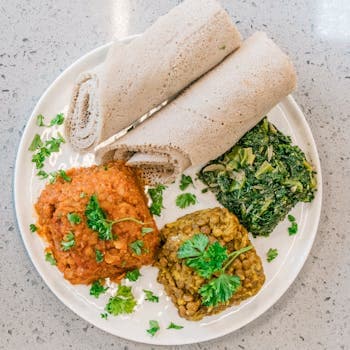
Injera is not a side dish — it is the plate, the utensil, and the staple of every Ethiopian meal. A thin, spongy crepe of fermented teff batter, it is draped across a wide platter and topped with wats, tibs, and vegetables; diners tear pieces from the edge and pinch up each bite, and feeding the choicest morsel to a companion (gursha) is a cherished gesture of love. The days-long wild fermentation gives injera its gentle sourness and the lacy 'eyes' that soak up sauce, while teff — the tiny iron-rich grain domesticated in Ethiopia thousands of years ago — makes it naturally gluten-free. Mastering it takes patience, but few breads reward the effort so completely.
Serves 8
Whisk the teff flour with the water in a large non-reactive bowl until completely smooth, working out every lump with your hands or a whisk — the batter should be the consistency of thin pancake batter. Hold the salt back for later, as it slows fermentation. Cover loosely with a cloth or cracked lid so wild yeasts can enter while dust stays out.
Leave the bowl at room temperature for 3–5 days. Within a day or two a thin, darker liquid (absit watering) will pool on top — this is normal; stir it back in once daily. The batter is ready when it smells distinctly sour and tangy, like yogurt with a yeasty edge, and shows small bubbles when stirred.
Warm kitchens ferment in 3 days, cool ones may need 5; taste a drop — pleasant sourness means ready, while a flat floury taste means wait longer.
Stir in the salt and check consistency: the batter should pour in a thin, steady ribbon, so thin it seems too watery for a pancake — add water if needed. Heat a large non-stick pan or injera mitad over medium-high until a drop of water skitters. Pour the batter in a thin spiral from the outside edge toward the center, tilting to fill gaps.
Never grease the pan — injera must steam-set on a dry surface, and oil prevents the eyes from forming.
As soon as bubbles ('eyes') open across the entire surface, cover with a tight lid and steam for 1–2 minutes. Injera is cooked from one side only: the top should be set, matte, and dry to the touch, while the bottom stays pale and pliable with no browning. Slide it out rather than flipping.
Lay each finished injera on a clean cloth-lined plate and let it cool for a minute before stacking the next on top — stacking hot traps steam and glues them together. Once cool, the rounds stay flexible and can be rolled for serving.
Everything you need to plan your week — free
Cook this hands-free
Get AI meal plans, step-by-step cooking mode, and your saved recipes in the free Bento app.
The eyes are the test: a properly fermented, properly thin batter erupts in hundreds of small holes within seconds of hitting the pan. No eyes means the batter is too thick or under-fermented.
Save a cup of fermented batter as a starter (ersho) for your next batch — it cuts fermentation to 1–2 days and gives more reliable sourness.
Cook on one side only and never flip; the pale, soft underside is what makes injera pliable enough to fold and tear.
Fermentation time tracks temperature: 3 days in a warm kitchen, up to 5 in a cold one. Sour smell and bubbles matter more than the calendar.
Ivory teff gives a milder, lighter injera; brown teff is earthier and more traditional — a 50/50 blend is a good starting point.
Quick injera: replace half the teff with all-purpose flour and add a pinch of instant yeast plus a squeeze of lemon, fermenting just overnight — less authentic but very forgiving (not gluten-free).
Absit method for extra-soft injera: cook a ladle of the fermented batter with water into a thin porridge, cool, and stir it back in before cooking — the traditional Ethiopian technique for elasticity.
Sorghum or barley injera: common regional variants in Ethiopia where teff is expensive; ferment and cook identically.
Firfir: tear day-old injera into pieces and toss with berbere sauce and niter kibbeh — the classic way to use leftovers, eaten with fresh injera.
Cool completely, then wrap stacks in a clean cloth and plastic; keep at room temperature 1–2 days or refrigerate up to 3 days (bring back to room temperature before serving, as cold injera turns stiff). Freeze with parchment between rounds for up to a month.
Teff was domesticated in the Ethiopian highlands several thousand years ago and remains cultivated almost nowhere else, making injera one of the world's most geographically distinctive staples. The bread is cooked on a clay griddle called a mitad, a tool found in archaeological sites centuries old; today electric mitads are a fixture of Ethiopian and Eritrean households worldwide. Injera's role as shared plate and utensil shapes the entire communal character of Ethiopian dining.
Ethiopian and Eritrean groceries are the best and cheapest source, and most health-food stores and online retailers now stock it as teff has gained popularity as a gluten-free grain. Both ivory and brown teff work; brown is the more traditional, earthier choice for injera.
Three usual culprits: the batter is too thick (it should pour like thin crepe batter), the fermentation is too short (no gas, no bubbles), or the pan is too cool when the batter lands. Fix thickness first — most beginners make the batter far too heavy — then give fermentation another day.
Pure teff injera is naturally gluten-free, since teff contains no gluten — one reason the grain has surged in international popularity. But beware: many restaurants and quick recipes stretch teff with wheat or barley flour to cut cost, so coeliacs should always confirm it's 100% teff.
That darker, watery layer is a normal byproduct of wild fermentation, similar to the hooch on a sourdough starter. Simply stir it back into the batter once a day. Only discard the batch if you see pink or fuzzy mold, which means contamination — a clean sour smell is exactly what you want.
Per serving (130g / 4.6 oz) · 8 servings total
Ask our AI cooking assistant anything about this recipe — substitutions, techniques, scaling.
Chat with AI Chef →This recipe is featured in the following curated guides:
Join the conversation
Sign in to leave a comment and save your favourite recipes
Everything you need to plan your week — free
Have feedback or need help?
We read every email and reply within 1–2 business days.
© 2026 MyCookingCalendar. All rights reserved.