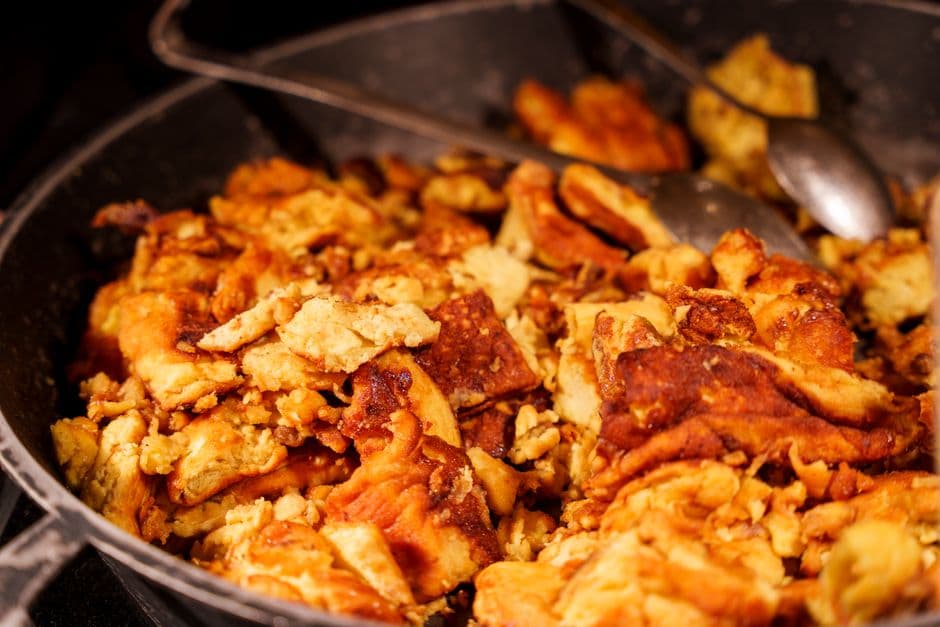
Austria's torn caramelised pancake — fluffy whisked batter with rum-plumped raisins, cooked in butter, ripped into ragged pieces, dusted with icing sugar and served with plum compote.
Kaiserschmarrn — literally 'the Emperor's mess' — is the dessert that became Austria's national pride after Emperor Franz Joseph I supposedly ordered a sweet pancake from his court chef in the 1850s and was served a pillowy, broken-up version that he loved more than the original. The dish is a study in deliberate imperfection: a thick, slightly sweet batter of flour, milk, egg yolks, sugar and rum-soaked raisins, lightened with stiff-peaked egg whites, is poured into hot butter in a heavy pan, cooked until set on the bottom, flipped once, and then deliberately torn into ragged 4 cm pieces with two forks. The torn edges are caramelised in butter and sugar until they crisp and brown, the whole thing is showered with a thick veil of icing sugar, and served hot with a generous bowl of zwetschkenröster (cinnamon-spiced plum compote) on the side, or sometimes apple compote in winter. The texture is the magic — pieces should be crisp at the edges, fluffy at the centre, with the egg whites giving the same airy lift as a soufflé and the caramelisation contributing a faint toffee note. In Alpine ski huts it is served as a substantial midday meal after a morning on the slopes; in Vienna's coffee houses it is a sweet course; and across Austria it is the showpiece of Sunday lunch tables. Every Austrian grandmother has an opinion on whether to add raisins, whether to fold the whites or whip them in, and whether the plum compote is non-negotiable (the answer is yes).
Serves 4
Combine the raisins and rum in a small bowl and leave to plump for 15 minutes while you prepare the batter. The raisins will soften and absorb the alcohol, becoming juicy little bursts in the finished dish.
In a large bowl whisk together the flour, milk, egg yolks, sugar, vanilla and salt until completely smooth with no lumps. The batter should be the consistency of thick cream — about double-cream thickness. Let it rest 10 minutes so the flour fully hydrates.
In a clean bowl, whisk the egg whites to stiff but not dry peaks — they should hold a firm peak that doesn't slump but still looks glossy. Underbeaten whites give a flat schmarrn; overbeaten ones tear the batter when folding.
Fold a third of the whipped whites into the yolk batter to lighten it, then fold in the remaining whites in two further additions using a large metal spoon — gentle figure-eight motions, going to the bottom of the bowl. The final batter should be airy and pale yellow with visible streaks of white. Stir in the soaked raisins.
Heat half the butter in a heavy 26 cm non-stick or cast-iron pan over medium heat until foaming. Pour in the batter — it should sizzle gently. Reduce heat to medium-low, cover with a lid for the first 4 minutes (this helps the centre cook through without overbrowning the bottom), then uncover and cook another 2 minutes.
Once the bottom is golden and the surface looks just set, use two forks to cut the pancake into four large quadrants. Flip each quadrant over individually with a spatula. Cook the second side 2 minutes.
Add the remaining butter and the 2 tbsp of extra sugar to the pan. Use two forks to tear the pancake into rough 4 cm pieces — leave them in the pan and toss to coat in the buttery sugar. Continue cooking, tossing occasionally, for 3–4 minutes until the torn edges are golden brown and slightly crisp.
Don't shy away from making it ragged — the messier the better. That's where the name comes from.
Tip the schmarrn straight from the pan onto warm plates. Dust extremely generously with icing sugar — Austrians use more than seems reasonable. Serve immediately with a generous spoonful of plum or apple compote on the side.
Whipped egg whites are essential to the airy texture — never skip the separation step and never use a mixer for the final fold (a metal spoon and a gentle hand).
Use a heavy pan that holds heat evenly — cast iron is traditional in Austria. A thin pan gives uneven browning and torn pieces that go limp instead of crisp.
Cover the pan for the first 4 minutes to steam-cook the top of the thick pancake without overbrowning the underside.
The dusting of icing sugar must be very generous — half a centimetre thick of snowy sugar over the top is the proper Viennese presentation.
Apfelschmarrn — fold thin slices of peeled apple into the batter for an autumn version popular in Tyrol.
Topfenschmarrn — replace 100 g of flour with quark cheese for a richer, tangier version called Salzburger Topfenschmarrn.
Nussschmarrn — toasted ground hazelnuts folded into the batter, an Alpine variation served with redcurrant compote.
Cherry schmarrn (Kirschenschmarrn) — fold in fresh pitted cherries when in season, especially in southern Austria.
Best eaten hot from the pan within 10 minutes. Leftovers refrigerate 1 day but the texture suffers significantly — reheat in a buttered pan over medium heat for 3 minutes to restore some crispness. The compote keeps refrigerated 2 weeks and is excellent on yoghurt and porridge.
Kaiserschmarrn was reputedly created in the 1850s for Emperor Franz Joseph I of Austria-Hungary, with several origin stories including one in which the empress Elisabeth (Sisi) refused the rich dessert and the Emperor finished both portions. The dish became a fixture of Alpine huts in the late 19th century and now stands alongside Sachertorte and Apfelstrudel as a defining Austrian dessert.
Yes, though it is the most traditional version. Some Austrians replace them with toasted slivered almonds or fresh berries. The raisins do add little bursts of sweetness and moisture, so consider plumping them in apple juice if you don't want alcohol.
An Austrian compote of small Italian-style plums (zwetschken) cooked down with sugar, cinnamon, clove and a splash of red wine until thick and jammy. Tinned plums simmered with the spices are a workable substitute.
Either you didn't add enough butter and sugar in the caramelising step, your pan wasn't hot enough during the tearing stage, or the egg whites were undermixed so the batter was dense. The pan must be hot enough to sizzle when butter goes in.
Both. In Alpine ski huts it is the main midday meal — a substantial half-portion per skier. In Viennese cafés and at evening meals it is a sweet course. Adjust portion sizes accordingly.
Per serving (320g / 11.3 oz) · 4 servings total
Ask our AI cooking assistant anything about this recipe — substitutions, techniques, scaling.
Chat with AI Chef →Join the conversation
Sign in to leave a comment and save your favourite recipes