
japaneselunch
Katsudon
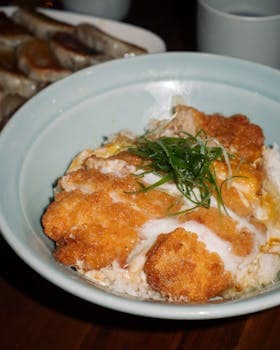
Japanese rice bowl with crispy pork cutlet, egg, and onions in dashi sauce — comfort, savory, satisfying.
Prep
20 min
Cook
20 min
Servings
2
Difficulty
Medium
4.9
Sign in to rate#japanese#pork#rice bowl#donburi#comfort
Japanese rice bowl with crispy pork cutlet, egg, and onions in dashi sauce — comfort, savory, satisfying.
Katsudon is a benchmark of Japanese comfort cooking: a crisp, panko-breaded pork cutlet (tonkatsu) sliced and simmered for moments in a sweet-savory broth of dashi, soy, mirin, and sake, then bound with barely-set beaten egg and tipped over a bowl of hot short-grain rice. The genius is in the contrast — the underside of the cutlet drinks in the sauce while the breaded top stays craggy and crisp, all softened by curtains of silky, custardy egg that should never be cooked hard. Onions sweeten and thicken the broth as they soften. Students famously eat it before exams, since 'katsu' puns on the verb 'to win,' making it both nourishment and good-luck charm in a single bowl.
Serves 2
Pound the pork loin to an even 1cm thickness with a meat mallet, then season both sides with salt and pepper. Even thickness ensures the cutlet fries uniformly and stays juicy rather than overcooking at the thin edges.
Snip the band of fat and silverskin around the edge in a few spots so the cutlet doesn't curl in the oil.
Dredge each cutlet in flour and shake off the excess, dip fully in beaten egg, then press firmly into the panko on both sides. A complete, well-pressed coat is what gives tonkatsu its signature shattering crust.
Heat oil to 170°C and fry the cutlets 4-5 minutes per side until deep golden and cooked through. Drain on a wire rack rather than paper so the crust stays crisp, then slice crosswise into 2cm strips.
Test the oil with a pinch of panko — it should sizzle and float steadily, not violently bubble.
In a small skillet, combine the dashi, soy sauce, mirin, sake, and sugar, then add the sliced onion. Simmer 3 minutes until the onion turns translucent and sweet and the broth tastes balanced between salty and sweet.
Lay one sliced cutlet, still in its fanned shape, on top of the onions in the simmering broth. Do not stir; keeping the cutlet on top preserves its crisp surface while only the base soaks up sauce.
Drizzle the beaten eggs evenly around and over the cutlet, cover, and cook about 1 minute until the eggs are just set but still glossy and soft. They should wobble slightly — carryover heat finishes them.
For classic texture, pour in two thirds of the egg first, then the rest at the end so part stays barely set.
Slide the entire contents, cutlet and silky egg together, over a bowl of hot rice and pour any remaining broth on top. Scatter with sliced green onion and serve immediately before the egg overcooks.
Everything you need to plan your week — free
Cook this hands-free
Get AI meal plans, step-by-step cooking mode, and your saved recipes in the free Bento app.
Don't overcook the eggs — authentic katsudon keeps them half-set and custardy.
Use Japanese short-grain rice for the right sticky, plump texture under the sauce.
Cook one bowl at a time in a small skillet so the cutlet and egg layer stay intact.
Fry the cutlets ahead; reheating them briefly in the broth is part of the method.
Adjust sugar to taste — the broth should lean slightly sweet to balance the salty soy.
Oyakodon: replace the pork cutlet with simmered chicken thigh ('parent and child' with the egg).
Gyudon-style: swap in thinly sliced beef simmered in the same broth.
Sauce katsudon: skip the egg and dip the fried cutlet in a thick Worcestershire-based sauce, as in Fukui.
Miso katsudon: glaze the cutlet with a sweet red-miso sauce, Nagoya style.
Katsudon is best assembled and eaten immediately while the egg is custardy. If you must prep ahead, store the fried cutlet and broth separately for up to 2 days and combine just before serving so the crust doesn't go soggy.
Katsudon emerged in early 20th-century Japan, marrying tonkatsu — itself a Japanese take on the Western breaded cutlet — with the traditional donburi rice bowl. Several Tokyo eateries are credited with the egg-bound version, and the exact originator remains a matter of local lore.
Stirring shreds the egg into scrambled bits and breaks the silky sheet that defines katsudon. Instead, drizzle the beaten egg over the simmering broth and cutlet, cover, and let it gently steam-set into a single soft, custardy layer that drapes over everything.
Keep the cutlet on top of the broth rather than submerging it, and simmer only briefly. The underside will absorb just enough sauce while the breaded top stays craggy. Drain the fried cutlet on a rack, never on paper, and assemble the bowl the moment the egg sets.
Yes. Boneless pork chops work well — just pound them to an even 1cm so they cook quickly and stay tender. Pork loin is traditional for its mild flavor and leanness, but a thin chop or even chicken thigh gives a similar result in this dish.
Per serving (600g / 21.2 oz) · 2 servings total
Ask our AI cooking assistant anything about this recipe — substitutions, techniques, scaling.
Chat with AI Chef →This recipe is featured in the following curated guides:
Join the conversation
Sign in to leave a comment and save your favourite recipes
Everything you need to plan your week — free
Have feedback or need help?
We read every email and reply within 1–2 business days.
© 2026 MyCookingCalendar. All rights reserved.