
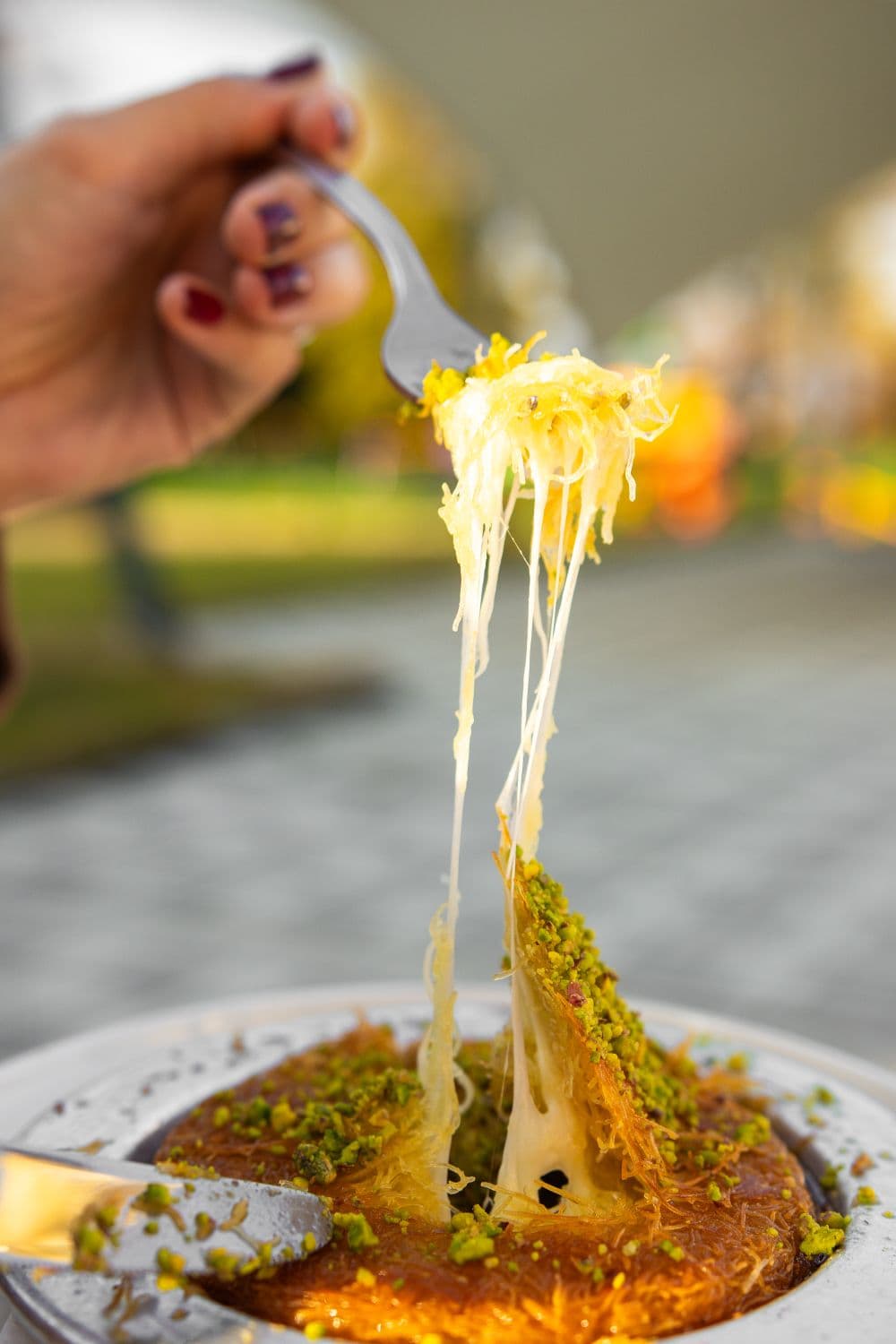
Knafeh
Lebanese cheese pastry soaked in rose water syrup — the king of Middle Eastern desserts.
About This Recipe
Knafeh is the dessert Lebanese arguments are made of — a molten layer of mild white cheese sandwiched in buttered kataifi pastry, baked until bronzed, drenched in orange-blossom and rose syrup, and crowned with pistachio. In Tripoli, Lebanon's sweets capital, it is breakfast: stuffed into a sesame kaak bun, cheese pulling in long strands with the first bite. The home cook's battle is fought on two fronts — desalting the akkawi thoroughly so the cheese is milky rather than briny, and the temperature ritual of cold syrup poured over hot pastry, which lets the kataifi drink the perfume without going soggy. Get those right and the rest is assembly: butter, press, layer, bake hot, flip, and serve while the cheese still stretches.
Ingredients
Serves 12
- 500 gkataifi (shredded phyllo) dough
- 150 gclarified butter (ghee)
- 500 gakkawi or fresh mozzarella cheese, sliced
- 200 gricotta cheese
- 1/4 cupcrushed pistachios (for topping)
- 2 cupssugar
- 1 cupwater
- 1 tbsprose water
- 1 tbsporange blossom water
- 2 tsplemon juice
- 1 tsporange food coloring (optional)
Instructions
- 1
Make syrup
Boil the sugar and water for 5 minutes with the lemon juice — the acid prevents crystallization — until lightly thickened. Off the heat, stir in the rose water and orange blossom water, then cool completely. The syrup must be fully cold when it meets the hot pastry, so make it first or even a day ahead.
Cold syrup on hot knafeh is the golden rule — same-temperature contact turns the pastry soggy.
- 2
Prepare dough
Pull the thawed kataifi apart and chop or pulse it into 2–3 cm lengths so it presses into an even layer. Work the melted ghee through it with your fingers until every strand glistens — dry patches bake pale and chewy instead of crisp. Add the optional orange coloring with the butter for the classic look.
- 3
Assemble
Press half the buttered kataifi firmly and evenly into a generously buttered 30 cm round pan, compacting it with the base of a cup. Layer the desalted akkawi slices and dollops of ricotta over it, leaving a 1 cm border so the cheese doesn't leak and burn. Top with the remaining kataifi and press down firmly again.
Firm compression is what gives knafeh its sliceable, cohesive crust — press harder than feels polite.
- 4
Bake
Bake at 180°C on a lower rack for 25–30 minutes, until the top is deep golden and the edges are visibly bubbling with melted cheese. If the base needs more color, give it a few minutes over low direct stovetop heat, rotating the pan — the traditional method for a copper knafeh tray.
- 5
Finish
Working immediately, pour about two-thirds of the cold syrup evenly over the hot knafeh — it will hiss and absorb. Invert onto a serving platter, shower with crushed pistachios, and serve warm, while the cheese pulls. Pass the remaining syrup at the table.
Serve within 15–20 minutes of baking; the dramatic cheese stretch is a fleeting pleasure.
Did you make this?
Rate it and help other cooks find the recipes that actually work.
One tap to sign in, and we'll save the rating you just picked.
Everything you need to plan your week — free
- Meal calendar
- Grocery list
- AI recipe ideas
Track what you eat
Snap your meal to log calories and macros, run fasting timers and track water in the free SnapCal app.
Pro Tips
- →
Desalt akkawi properly: slice it and soak in cold water for 4–8 hours, changing the water several times, until a nibble tastes milky, not salty.
- →
If using mozzarella, choose low-moisture blocks and add the ricotta for creaminess — fresh wet mozzarella waters out the filling.
- →
Compact the kataifi layers hard; loosely pressed knafeh falls apart at slicing.
- →
Make the syrup a day ahead so it is unambiguously cold when the pastry comes out hot.
- →
Reheat slices in a skillet or oven, never a microwave, to re-melt the cheese and revive the crust.
Variations
- •
Knafeh bil kaak: serve a hot slab inside a sesame bread bun, Tripoli street-style, for the iconic Lebanese breakfast sandwich.
- •
Cream knafeh (bil ashta): replace the cheese with thick ashta clotted cream for the milder, custardy version.
- •
Nabulsi-style: use a fine semolina-dough crust instead of kataifi for the smooth-topped knafeh naameh.
- •
Individual knafeh: bake in small tart pans for 15–18 minutes for single-serving portions with maximum crisp edge.
Storage
Knafeh is best within the hour, but leftovers keep covered in the fridge for 3 days — reheat slices in a 180°C oven or a covered skillet until the cheese softens again. Freeze baked, unsyruped knafeh for up to a month; reheat from frozen and syrup it hot.
History & Origin
Knafeh's deep history runs through the medieval Arab world, with cities from Nablus to Damascus to Cairo all woven into its story — its precise birthplace is contested and best left that way. What is certain is that Nablus made the cheese version famous, and that Tripoli in northern Lebanon became one of its great capitals, where knafeh eaten in a kaak bun for breakfast is a beloved institution. Each city guards its style fiercely.
Frequently Asked Questions
Where do I find kataifi dough?
Look in the freezer section of Middle Eastern, Greek, or Turkish grocery stores — it is sold in 450–500g packages, sometimes labeled kataifi, kadayif, or shredded phyllo. Thaw it overnight in the fridge, never the microwave, and keep it covered with a towel while working, as the fine strands dry out within minutes.
What cheese can replace akkawi?
The goal is a mild, melty white cheese without salt. Low-moisture mozzarella is the most reliable substitute, ideally blended with some ricotta for creaminess, as in this recipe. Desalted Nabulsi or halloumi also work, soaked the same way as akkawi. Avoid aged or sharp cheeses entirely — knafeh cheese should taste milky, not savory.
Why did my knafeh turn out soggy?
Three classic causes: the syrup was warm rather than cold when poured, the cheese carried too much moisture (under-desalted akkawi or fresh mozzarella), or the pastry was underbaked and pale. Bake until genuinely deep golden, drain or dry the cheese well, use cold syrup on the hot pastry — and don't drown it; serve extra syrup on the side.
Can I assemble knafeh ahead of time?
Yes — assemble the full pan, cover, and refrigerate up to 24 hours, then bake straight from the fridge, adding about 5 minutes. The syrup can be made days ahead. What you cannot do is bake it ahead: knafeh's magic is the contrast of crisp pastry and molten cheese, which only exists fresh from the oven.
Nutrition Facts
Per serving (200g / 7.1 oz) · 12 servings total
Time Summary
Have Questions?
Ask our AI cooking assistant anything about this recipe — substitutions, techniques, scaling.
Chat with AI Chef →Featured in Guides
This recipe is featured in the following curated guides:
More Lebanese Recipes
You Might Also Like
Similar dishes from other cuisines around the world.
Browse by Ingredient
More recipes built around the same core ingredients.
Free Kitchen Tools
Calculators and converters that pair with this page — no signup needed.
Put This Into a Plan
Schedule it, shop for it, and track what you already have.
Read Next
Longer reads that go deeper on the ideas behind this dish.
Community
Join the conversation
Sign in to leave a comment and save your favourite recipes