
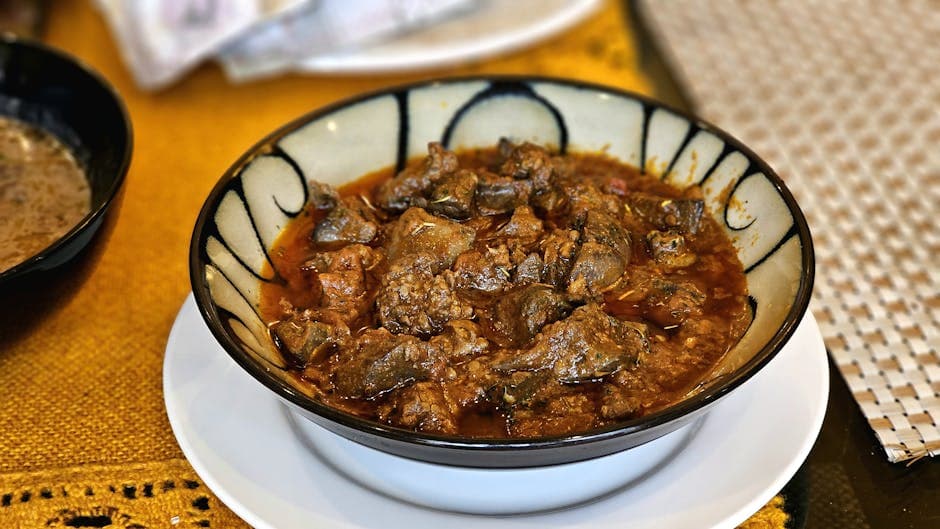
Bazin (Libyan Barley Dough with Lamb Stew)
Libya's national dish: a dense barley dough dome served in a fiery red lamb, egg, and potato sauce — eaten by hand from a shared platter.
About This Recipe
Bazin is Libya's national dish and the cornerstone of Friday family lunches across the country, from Tripoli to Benghazi. A dense, unleavened dough of barley flour and salted water is kneaded with a wooden stick directly inside a boiling pot, then shaped into a smooth dome and placed in the center of a wide communal platter. Around it is ladled a deeply spiced sauce of lamb on the bone simmered with tomato, onion, potato, hot pepper, and a heroic amount of paprika and turmeric, with hard-boiled eggs nestled into the sauce at the end. Diners gather around the platter and eat with their right hand, pinching small pieces of bazin and dragging them through the sauce. The dough is meant to be denser than bread — it's a vehicle for the sauce, holding its own beside the rich red lamb.
Ingredients
Serves 6
- 800 gbone-in lamb shoulder or leg, cut into 6 large chunks
- 2 largeyellow onions, finely chopped
- 5 tbsptomato paste
- 3 tbspsweet paprika
- 1 tbspground turmeric
- 1 tbspground cumin
- 1 tbsphot paprika or cayenne (to taste)
- 1dried red chili, whole
- 60 mlolive oil
- 4 mediumpotatoes, peeled and halved
- 6eggs, hard-boiled and peeled
- 2 tspfine salt, plus more to taste
- 1.2 Lwater, plus 800 ml for the dough
- 500 gbarley flour
- 1 tspfine salt, for the dough
Instructions
- 1
Brown the lamb
Heat olive oil in a heavy pot over medium-high. Brown the lamb chunks on all sides, 8 minutes total. Remove and set aside.
- 2
Sweat the onions
In the same pot, lower heat to medium and sweat the chopped onions for 10 minutes until soft and pale gold.
- 3
Build the spice base
Add tomato paste, sweet paprika, turmeric, cumin, hot paprika, and the whole dried chili. Stir constantly for 2 minutes — the tomato and spices should darken and lose their raw smell.
This 'tabkha' step is essential: under-cooked tomato paste tastes sharp; properly cooked it goes mahogany.
- 4
Simmer the lamb
Return the lamb to the pot. Add 1.2 L water and 2 tsp salt. Bring to a boil, reduce to a low simmer, and cook covered for 60 minutes.
- 5
Add potatoes
Slip in the halved potatoes and continue simmering uncovered for 25–30 more minutes, until the potatoes are tender and the sauce thick and red-orange. Taste for salt and heat.
- 6
Cook the dough
Bring 800 ml salted water to a hard boil in a wide pot. Tip in all the barley flour at once and immediately start stirring with a sturdy wooden stick (the 'meghraf'). Stir vigorously 8–10 minutes until the dough is dense, smooth, and pulls cleanly from the sides.
Don't be tentative — bazin dough requires strong, continuous stirring, like Italian polenta but stiffer.
- 7
Shape the dome
Wet your hands with cold water. Tip the hot dough onto the center of a wide serving platter and shape it into a smooth, pointed dome with rapid wet-handed pats. Work fast — it stiffens as it cools.
- 8
Plate and serve
Pour the lamb sauce around (not over) the dome. Arrange the lamb pieces, potatoes, and hard-boiled eggs around the base. Bring the platter to the table and let everyone tear pieces of bazin from the dome to dip into the sauce.
Did you make this?
Rate it and help other cooks find the recipes that actually work.
One tap to sign in, and we'll save the rating you just picked.
Everything you need to plan your week — free
- Meal calendar
- Grocery list
- AI recipe ideas
Cook this hands-free
Get AI meal plans, step-by-step cooking mode, and your saved recipes in the free Bento app.
Pro Tips
- →
Use barley flour, not wheat flour — the dense, slightly sour flavor of barley is what makes bazin recognizable. Wheat will give a gluey dough.
- →
If your dough is lumpy, you didn't stir fast enough at the start; next time tip the flour in all at once while the water is at a hard rolling boil.
- →
The sauce should be the color of bricks — keep adding paprika in stages until you reach that deep red.
Variations
- •
Bazin bil zeit: vegetarian version with no lamb, doubling the potatoes and adding chickpeas.
- •
Bazin asfar (yellow): made with semolina instead of barley flour for a lighter, paler dome — a Tripolitanian variation.
- •
Add a small piece of dried fish to the sauce for the Misurata-style version.
Storage
The sauce keeps refrigerated up to 3 days and improves overnight. The dough must be made fresh — it goes rock-hard within hours and cannot be revived.
History & Origin
Bazin has been documented in Libyan cookbooks and traveler accounts since the Ottoman period, when barley was the dominant cereal across the Libyan interior. It became formalized as Libya's de facto national Friday dish in the 20th century. The communal platter and shared-by-hand eating tradition predates Italian colonization and survived intact through it.
Frequently Asked Questions
What if I can't find barley flour?
Barley flour is sold at health-food stores and Middle Eastern groceries. As a last resort, mix 70% whole wheat flour with 30% rye flour for a similar dense, earthy result, though the flavor will be milder.
Why is bazin so dense?
It's intentional — bazin is supposed to be denser than bread. The density is what lets you tear pieces with one hand and use them to scoop sauce without falling apart.
Is bazin eaten with utensils?
Traditionally no — Libyan custom is to eat with the right hand from a shared platter. Forks are used at modernized restaurants but home meals stay traditional.
Nutrition Facts
Per serving (480g / 16.9 oz) · 6 servings total
Time Summary
Have Questions?
Ask our AI cooking assistant anything about this recipe — substitutions, techniques, scaling.
Chat with AI Chef →Featured in Guides
This recipe is featured in the following curated guides:
More Libyan Recipes
You Might Also Like
Similar dishes from other cuisines around the world.
Free Kitchen Tools
Calculators and converters that pair with this page — no signup needed.
Put This Into a Plan
Schedule it, shop for it, and track what you already have.
Read Next
Longer reads that go deeper on the ideas behind this dish.
Community
Join the conversation
Sign in to leave a comment and save your favourite recipes