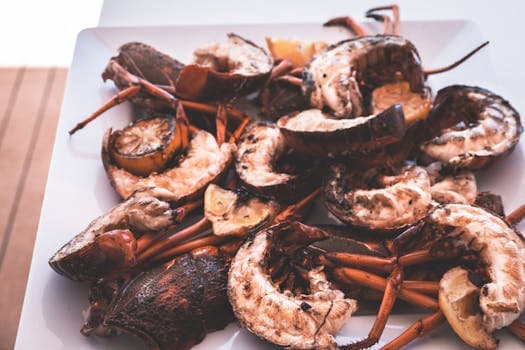
Anguilla's reputation as one of the Caribbean's finest dining destinations rests, more than anything else, on its spiny lobster. The Panulirus argus — the Caribbean spiny lobster, clawless but with an impressively thick, meaty tail — is harvested from the shallow, crystal-clear reefs surrounding the island and commands admiration far beyond its size. Split lengthwise and laid cut-side down on a grate over glowing hardwood charcoal, the lobster chars at the edges while the flesh steams in its own juices inside the shell. It is then flipped, each half generously anointed with garlic-lime compound butter, and left to cook until the butter sizzles and the flesh turns from translucent to just opaque. The preparation is deceptively simple, which is exactly as it should be when the ingredient is this good. The garlic butter — ideally made with the finest unsalted butter, freshly minced garlic, hand-squeezed lime, and fragrant flat-leaf parsley — is the only flavour framework the lobster needs. Timing is everything: spiny lobster tail, at around 600 g per animal, takes approximately 12–14 minutes total over high heat. Pull it a minute early rather than a minute late — the residual heat in the shell continues cooking the flesh for another minute off the grill. The best Anguillian lobster meals happen at the island's open-air beach shacks at places like Sandy Ground or Shoal Bay, where fishing boats pull in nearby and the afternoon light turns the sea gold. Recreating that experience at home requires good lobster, hot coals, and the willingness to eat with your hands.
Serves 2
In a small bowl, combine the softened butter, minced garlic, lime juice, chopped parsley, and salt. Beat together vigorously with a fork until smooth and fully incorporated. Taste — it should taste richly of garlic and have a bright citrus edge. Set aside at room temperature so it is soft and spreadable when needed.
Make the butter at least 30 minutes ahead so the garlic and lime have time to infuse into the fat. The flavour difference is noticeable.
Using a sharp, heavy knife, split each lobster lengthwise from head to tail in one firm motion through the shell. Remove and discard the dark intestinal tract running down the tail meat. Pat the cut flesh dry with paper towels — moisture on the surface will cause steaming rather than charring. Brush the cut surface lightly with a neutral oil.
Build a hot charcoal fire (or preheat a gas grill to maximum) and allow the grates to heat for 10–15 minutes. Brush the grates thoroughly with a folded paper towel dipped in oil held with tongs. The grill is ready when you can hold your hand 5 cm above the grate for no more than 1–2 seconds.
Place the lobster halves cut-side down directly over the hottest part of the coals. Grill undisturbed for 4–5 minutes — you should hear active sizzling and see char marks forming on the flesh. Resist the urge to move them; the natural sugars in the lobster need sustained contact with the hot grate to caramelise properly.
A perfect char mark creates texture and flavour; keep the lid open so you can monitor for flare-ups from the butter drips.
Using sturdy tongs, carefully flip each lobster half shell-side down. Immediately use a spoon to pile a generous amount of compound butter — about a tablespoon per half — directly onto the exposed flesh. It will melt and run into the crevices of the meat. Close the grill lid and cook for a further 7–9 minutes until the flesh is just opaque throughout and the butter is bubbling vigorously.
The flesh should feel just firm and spring back slightly when pressed at the thickest part of the tail. Translucency in the centre means undercooked; pure white throughout means overcooked.
Transfer the lobster halves to a warmed serving platter and allow to rest for 2 minutes — residual heat in the shell continues cooking the flesh slightly. Add a final spoonful of the remaining butter over each half and serve immediately with lime wedges, crusty bread to soak the butter, and a cold drink.
Pull the lobster 1 minute before you think it's done — residual heat inside the shell will finish the cooking. Overcooked spiny lobster turns rubbery and chalky within seconds.
Use hardwood lump charcoal rather than briquettes. It burns hotter, produces less ash-tasting smoke, and gives the lobster a cleaner, more complex char.
Dry the cut surface of the lobster with paper towels before grilling. Any moisture on the flesh will cause steam rather than sear, preventing the caramelisation that makes grilled lobster so exceptional.
Make more compound butter than you think you need. It is glorious on the bread served alongside, and any leftover freezes beautifully for six weeks.
Elevate the dish by adding a finely grated teaspoon of lime zest to the compound butter along with the juice — the zest contributes fragrant citrus oils that lime juice alone cannot provide.
Cayenne-lime butter: add 0.5 tsp of cayenne pepper and a pinch of smoked paprika to the compound butter for a version with gentle heat and depth.
Herbs de Provence version: substitute dried herbs de Provence for the parsley, and add a small clove of garlic extra — a preparation found in Anguilla's French-influenced beach restaurants.
Oven broiler version: place split lobster flesh-side up on a foil-lined baking sheet; broil 20 cm from the element for 8–10 minutes, adding butter halfway through. Less smoky but very effective.
Whole grilled version: for smaller lobsters under 400 g, grill whole and split at the table for a dramatic presentation.
Grilled lobster is best eaten the moment it comes off the grill. Leftovers can be refrigerated for up to 1 day and are excellent served cold in a lobster salad with mayonnaise, lime, and herbs — reheating cooked lobster tends to toughen the meat.
The spiny lobster (Panulirus argus) has been a dietary staple for the indigenous Arawak people of the Lesser Antilles long before European colonisation. Anguilla's particularly clear, nutrient-rich waters produce lobsters of exceptional size and quality, and grilling over charcoal or open wood fires has been the cooking method of choice for island fishermen for generations. As Anguilla developed its reputation as a luxury Caribbean destination during the late 20th century, this simple fisherman's preparation became the centrepiece of the island's fine-dining identity.
Yes, though the experience is different. Maine lobster has two large claws as well as a tail; the claw meat is more delicate and cooks faster than the tail. Split the lobster and grill tail and claws separately, removing the claws after about 5 minutes total. The sweet, briny quality of Maine lobster works beautifully with the garlic-lime butter.
The flesh should be fully opaque and white — no translucency at the centre of the tail. Press the thickest part of the tail meat with your finger; it should feel firm and spring back rather than feeling soft or leaving an indent. An instant-read thermometer in the thickest part of the tail should read 60–63 °C (140–145 °F).
Absolutely. Place split lobster halves flesh-side up on a foil-lined baking tray. Broil 20 cm from the top element, adding half the butter immediately and the rest after 5 minutes. Total broiling time is 10–12 minutes. You won't get the char marks or smoke of the grill, but the garlic-lime butter treatment produces a wonderful result.
Spiny lobster tails are widely available frozen at seafood markets and online fishmongers. Brazilian and Florida spiny lobster tails (from Panulirus argus) are the same species as Anguillian lobster. Thaw overnight in the refrigerator, butterfly the tails, and proceed from step 4 of the recipe.
Per serving · 2 servings total
Ask our AI cooking assistant anything about this recipe — substitutions, techniques, scaling.
Chat with AI Chef →This recipe is featured in the following curated guides:
Join the conversation
Sign in to leave a comment and save your favourite recipes
Have feedback or need help?
We read every email and reply within 1–2 business days.
© 2026 MyCookingCalendar. All rights reserved.