
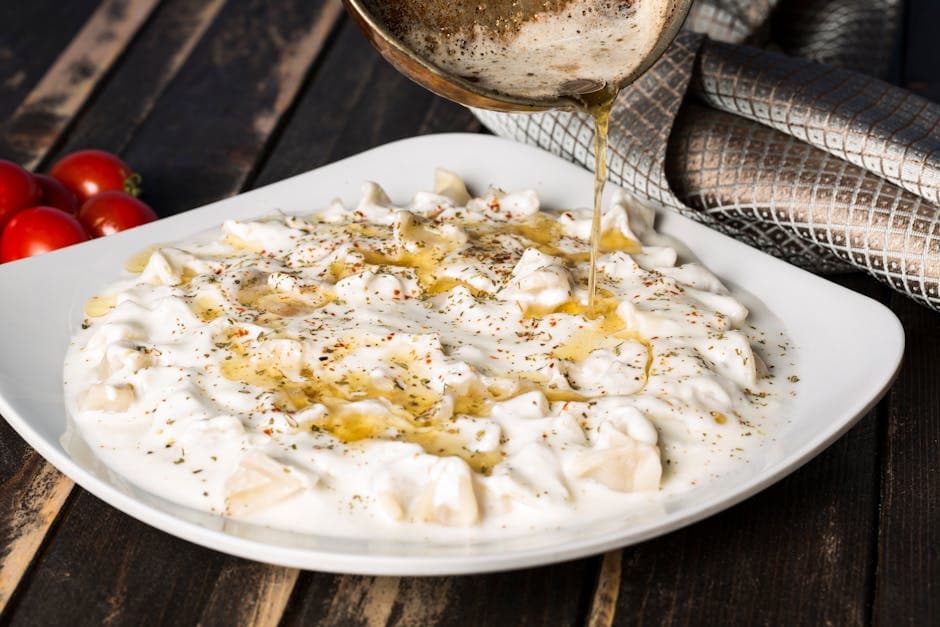
Turkish Manti (Tiny Lamb Dumplings with Garlic Yogurt)
Kayseri's beloved miniature lamb dumplings — sealed in fingertip-sized pasta squares, boiled, then drowned in garlic yogurt and chilli-spiced brown butter.
About This Recipe
Manti is the dumpling of Anatolia, and the version that defines all others comes from Kayseri in central Turkey, where women still gather in kitchens to pinch dumplings so small that the locals boast 'forty manti should fit on a single spoon.' Each manti is a tiny square of paper-thin dough — barely 1.5 cm across — sealed around a pinch of seasoned ground lamb, the four corners pinched up into a little parcel. They are boiled in salted water, then drowned in garlic-laced yogurt and finished with a slick of brown butter sizzled with Aleppo pepper, dried mint, and sometimes paprika. The result is a riot of contrasts: sour, garlicky yogurt against the cumin-and-onion-warm lamb, the silky pasta cradled in spiced butter that turns the surface fragrant and faintly nutty. Making manti is an act of patience and community; in Kayseri it was traditionally how potential brides demonstrated their domestic accomplishment, with mothers-in-law assessing the size and sealing of each dumpling. Modern Turkish women joke that buying manti from the village markets is the only feminist response. The technique here is for proper handmade manti at moderate size (about 2 cm) — small enough to be authentic, large enough to remain achievable for a weekend project.
Ingredients
Serves 4
- 300 gall-purpose flour, plus 1 tsp salt and 1 egg for the dough
- 120 mlwarm water, approximately (for dough)
- 250 gground lamb shoulder (or 70/30 beef-lamb mix), well-marbled
- 1 smallyellow onion, very finely grated and squeezed dry
- 1 tspsalt, plus 1 tsp ground cumin and 1/2 tsp black pepper for the filling
- 500 gthick Greek-style or strained Turkish yogurt (süzme yoğurt)
- 3 largegarlic cloves, very finely minced or pressed
- 80 gunsalted butter
- 2 tspAleppo pepper (pul biber), plus 1 tsp dried mint and 1 tsp Turkish paprika
Instructions
- 1
Make the dough
Mix the flour and salt on a clean work surface, make a well in the center, and crack in the egg. Slowly add the warm water while bringing flour into the well with a fork. Knead 8–10 minutes until smooth, elastic, and slightly tacky but not sticky. Wrap in plastic and rest 30 minutes — this is non-negotiable for rollable dough.
- 2
Make the filling
In a bowl, combine the ground lamb, finely grated and squeezed onion, salt, cumin and black pepper. Mix thoroughly with your hands for 2 minutes — the mixture should become slightly sticky and uniform, almost paste-like. This binding is what holds the tiny portions together inside the dough.
Grate the onion on the fine side of a box grater and squeeze HARD through a cloth — excess onion water makes the filling weep into the dough during sealing.
- 3
Roll the dough
Divide the rested dough into four pieces. Working one at a time (keep the others covered), roll each piece on a floured surface as thin as you can possibly get it — translucent enough to see the grain of the wood through. A long Turkish rolling pin (oklava) is traditional; a thin dowel works.
- 4
Cut and fill
Trim the rolled dough into a neat rectangle and cut into 2 cm squares with a sharp knife or pizza wheel. Place a tiny pinch of filling (less than 1/4 teaspoon, about the size of a chickpea) in the center of each square. Bring the four corners up to meet at the top and pinch them firmly together, leaving small openings on the sides — the classic manti shape.
Keep finished dumplings on a flour-dusted tray under a damp tea towel as you work — they dry out fast and crack at the seams.
- 5
Make the garlic yogurt
Whisk the yogurt with the minced garlic and a generous pinch of salt. Let stand at room temperature 15 minutes while you boil the manti — the garlic mellows slightly and infuses the yogurt.
- 6
Cook the manti
Bring a large pot of well-salted water to a rolling boil. Drop the manti in batches (do not crowd) and cook 8–10 minutes until they float and the pasta is tender and slightly translucent. Lift out with a slotted spoon, drain briefly, and divide between warmed bowls.
- 7
Make the spiced butter and assemble
While the manti cook, melt the butter in a small pan over medium heat until it foams and turns golden brown, 4–5 minutes — watch closely, brown butter goes black fast. Off heat, stir in the Aleppo pepper, dried mint and paprika; it should sizzle. To plate: spoon plenty of garlic yogurt over the hot manti, then drizzle the spiced brown butter over the top so the colors streak. Serve immediately.
Did you make this?
Rate it and help other cooks find the recipes that actually work.
One tap to sign in, and we'll save the rating you just picked.
Everything you need to plan your week — free
- Meal calendar
- Grocery list
- AI recipe ideas
Track what you eat
Snap your meal to log calories and macros, run fasting timers and track water in the free SnapCal app.
Pro Tips
- →
Make manti with friends or family — one person rolls, one cuts and fills, one pinches and shapes. Solo, it's a 3-hour Saturday project; with three people, an hour.
- →
Freeze pinched but uncooked manti in a single layer on a tray, then bag once frozen solid. Boil from frozen — add 3 extra minutes.
- →
Aleppo pepper (pul biber) is essential — it's gently fruity and mild, not aggressively hot. Generic chilli flakes will overwhelm the dish.
- →
Strained Turkish yogurt is preferred for its tang and thickness — Greek yogurt is the closest widely-available substitute. Thin runny yogurt will make a sad, watery sauce.
Variations
- •
Kayseri-style 'forty-on-a-spoon' — make the dumplings as small as you possibly can; serve with extra cumin in the butter.
- •
Yufkali manti (lazy manti) — instead of forming individual dumplings, layer the filling between sheets of yufka pastry and bake; quick alternative on a weeknight.
- •
Vegetarian manti — replace lamb with a mix of crumbled feta, walnuts and parsley for a satisfying meatless version.
- •
Tatar manti — much larger dumplings (about 6 cm), often steamed rather than boiled, popular in the Crimean-Tatar tradition.
Storage
Uncooked manti freeze well up to 2 months on trays then bagged. Boiled manti are best fresh — refrigerated leftovers (max 2 days) reheat poorly; instead, save the boiled dumplings and add fresh yogurt and butter when reheating in a steamer.
History & Origin
Manti likely traveled with Turkic peoples from Central Asia to Anatolia during the great Seljuk migrations of the 11th–12th centuries. The word 'manti' shares a root with Chinese 'mantou' and Korean 'mandu', and the dumpling-family represents one of the most widespread food technologies in human history, from Italy's ravioli to Mongolia's buuz.
Frequently Asked Questions
Can I use a pasta machine to roll the dough?
Yes — roll through to setting 6 or 7 (very thin). Trim into rectangles and proceed. Slightly less authentic but a huge time-saver for home cooks.
Why are mine bursting open during boiling?
Either insufficient sealing (re-pinch each one firmly) or too much water in the filling (squeeze the onion harder). A poorly-rested dough also splits — give it the full 30 minutes.
Can I buy manti dough sheets?
Yes — some Turkish groceries sell pre-rolled manti sheets in the refrigerated section, even pre-cut. The texture is acceptable but homemade dough is noticeably better.
What's the right ratio of yogurt to butter to manti?
Generous on the yogurt (about 100 g per serving), restrained on the butter (about 15 g per serving). Too much butter swamps the dumpling; too little leaves it dry.
Nutrition Facts
Per serving (380g / 13.4 oz) · 4 servings total
Time Summary
Have Questions?
Ask our AI cooking assistant anything about this recipe — substitutions, techniques, scaling.
Chat with AI Chef →Featured in Guides
This recipe is featured in the following curated guides:
More Turkish Recipes
You Might Also Like
Similar dishes from other cuisines around the world.
Browse by Ingredient
More recipes built around the same core ingredients.
Free Kitchen Tools
Calculators and converters that pair with this page — no signup needed.
Put This Into a Plan
Schedule it, shop for it, and track what you already have.
Read Next
Longer reads that go deeper on the ideas behind this dish.
Community
Join the conversation
Sign in to leave a comment and save your favourite recipes