
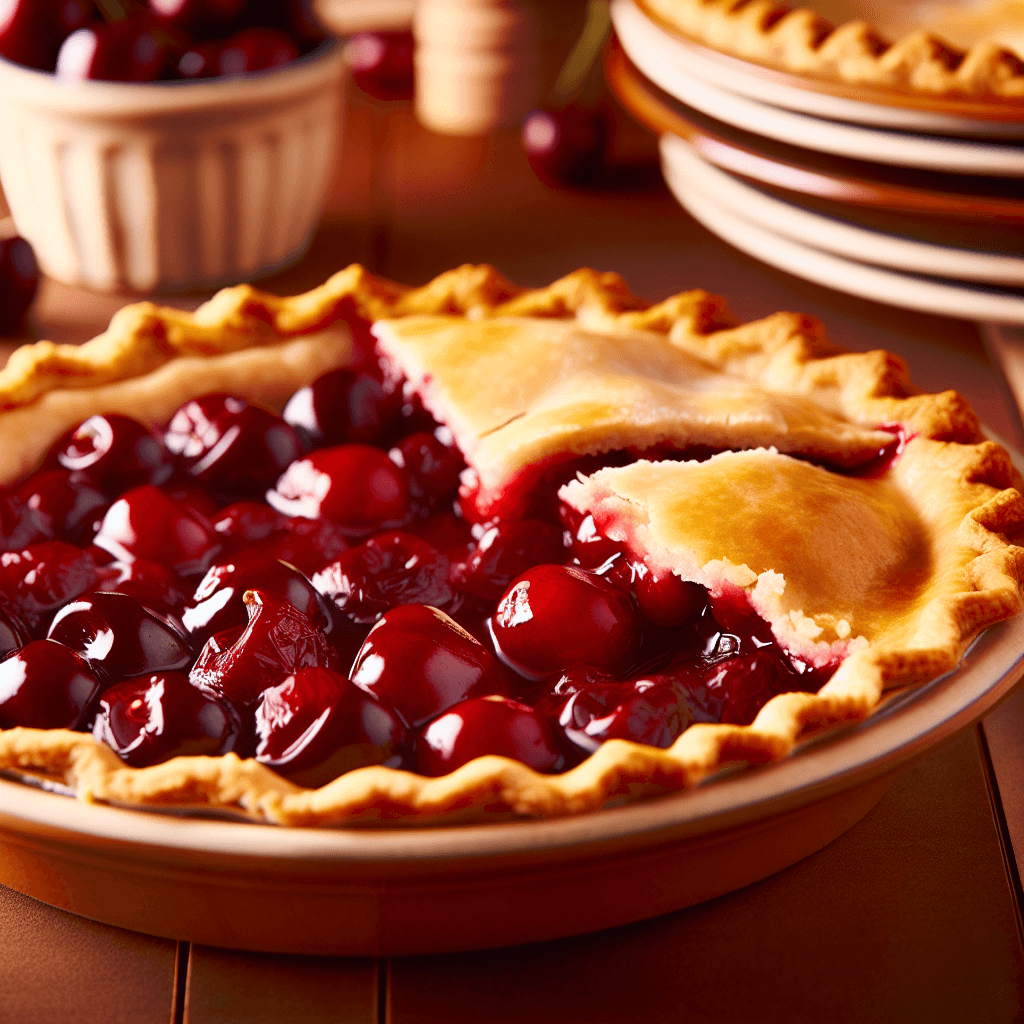
Michigan Cherry Pie
Tart Michigan cherries in flaky double-crust pie.
About This Recipe
Michigan is the tart cherry capital of the world — producing roughly 75% of the United States' annual tart cherry crop, concentrated along the Leelanau and Old Mission peninsulas on Lake Michigan's eastern shore, where the lake moderates temperatures and delays spring frosts long enough for the cherry trees to bloom safely. The Montmorency variety, a sour cherry (Prunus cerasus) with bright red skin and nearly clear juice, is what Michigan is known for, and its flavour profile — intensely tart, slightly bitter, with a depth that sweet cherries completely lack — is what makes a real Michigan cherry pie taste so dramatically different from a generic fruit pie. The tartness holds up to sugar and heat without collapsing into jam-sweet blandness, and the high natural pectin content of Montmorency cherries means the filling sets to a glossy, jewelled consistency that slices cleanly. The technique matters as much as the cherries. Flour alone as a thickener requires at least 15 minutes of resting after mixing so the starch can absorb juice; skipping this step produces a watery filling that pools under the crust. The quarter teaspoon of almond extract is a classic old-fashioned baker's trick — bitter almonds and cherries share the same aroma compound (benzaldehyde), and the extract amplifies the cherry's natural flavour in the same way vanilla amplifies chocolate, making the filling taste more intensely of cherry without tasting of almonds. The egg wash over the top crust creates a mahogany-brown, lacquered finish, and the filling must bubble actively through the vents for at least 5 minutes before the pie comes out — unbubbled filling means undercooked starch and a soupy pie. Serve warm with vanilla ice cream letting it melt into the tart-sweet juices.
Ingredients
Serves 8
- 2pie crusts(homemade or store-bought)
- 1 kgfresh or frozen Michigan cherries
- 150 gsugar
- 2 tbspflour
- 1 tbsplemon juice
- ¼ tspalmond extract
- 1egg(for egg wash)
- 1 tbspwater(for egg wash)
Instructions
- 1
Prepare the cherries
If using fresh Montmorency cherries, pit them over a bowl to catch every drop of juice — the juice is part of the filling. If using frozen, thaw completely in a colander set over a bowl, then reserve the drained juice. Fresh cherries should be washed, dried, and pitted; they will release more juice during baking than frozen.
A dedicated cherry pitter (OXO makes a reliable one) processes fresh cherries significantly faster than a knife — worth the investment if you bake cherry pie regularly.
- 2
Make the filling
Combine the pitted cherries with sugar, flour, lemon juice, and almond extract in a large bowl and toss thoroughly to coat every cherry. Let the mixture rest uncovered for 15–20 minutes until the sugar draws out the cherry juices and the flour absorbs some of the liquid — the filling will look syrupy and smell intensely of cherry and almonds.
- 3
Line the pan
Roll the bottom pie crust to a 30 cm circle on a lightly floured surface and transfer to a 23 cm deep-dish pie pan, pressing gently into the bottom and sides and leaving a 2.5 cm overhang. Refrigerate while you prepare the top crust — a cold crust holds its shape better and produces a flakier texture.
Work quickly and handle the dough as little as possible; body heat warms the fat and makes the crust tough and shrink-prone.
- 4
Fill and top
Pour the cherry filling into the chilled bottom crust, scraping in all the juices and syrup accumulated at the bottom of the bowl — don't leave any behind. Roll the second crust to the same size, drape it over the filling, and trim both overhangs to about 1.5 cm. Fold the overhang under itself and crimp or press decoratively. Cut at least 6 substantial vents in the top crust — small vents block with filling and the steam cannot escape.
- 5
Egg wash and bake
Whisk the egg with 1 tablespoon of water and brush the entire top crust and crimped edge — this creates the golden-brown lacquered finish. Bake at 200°C (400°F) for the first 20 minutes, then reduce to 180°C (350°F) and bake 25–30 minutes more until the crust is deeply golden and the filling is bubbling actively through the vents — watch for thick, glossy bubbles, not thin watery ones. Cool at least 2 hours before slicing.
Did you make this?
Rate it and help other cooks find the recipes that actually work.
One tap to sign in, and we'll save the rating you just picked.
Everything you need to plan your week — free
- Meal calendar
- Grocery list
- AI recipe ideas
Track what you eat
Snap your meal to log calories and macros, run fasting timers and track water in the free SnapCal app.
Pro Tips
- →
Tart Montmorency cherries from Michigan are non-negotiable for this pie — sweet Bing cherries make a flat, overly sweet filling with none of the tension that makes cherry pie exciting.
- →
Start at 200°C (400°F) for the first 20 minutes to set the crust quickly, then reduce heat — this prevents the bottom from becoming pale and soggy before the filling cooks through.
- →
Do not cut the pie before it has cooled for at least 2 hours; the filling thickens as it cools, and a pie sliced hot will pour rather than hold its shape.
- →
Brush the crimped crust edge with egg wash and cover it loosely with foil or a pie shield for the final 20 minutes to prevent over-browning while the filling finishes cooking.
- →
If the filling looks too liquid even after cooling, next time increase the flour to 3 tablespoons or substitute 1 tablespoon of cornstarch for a glossier, firmer set.
Variations
- •
Cherry-blueberry double fruit pie: replace 200 g of cherries with fresh blueberries for a colour-streaked filling where the blueberries add body and the cherries provide tartness.
- •
Crumb-topped Michigan cherry pie: skip the top crust entirely and cover the filling with a buttery streusel of flour, brown sugar, oats, and cold cubed butter — more casual, easier to assemble, and exposes the ruby filling visually.
- •
Sour cherry galette: roll a single crust into a rough 35 cm circle on parchment, mound the filling in the centre leaving a 5 cm border, fold the edges up and over, and bake freeform — rustically beautiful and forgiving for less confident pastry makers.
- •
Cherry pie bars: press two-thirds of a shortbread dough into a 23 x 33 cm pan, spread the filling over it, grate or crumble the remaining dough on top, and bake 35 minutes — transports and serves more easily than a traditional pie for picnics.
Storage
Michigan cherry pie keeps at room temperature loosely covered for up to 2 days, or refrigerated for up to 4 days. The crust softens slightly in the refrigerator but the filling holds well. Reheat individual slices in a 175°C (350°F) oven for 10 minutes rather than microwaving, which makes the crust steamy and soft. The baked pie freezes well for up to 3 months — cool completely, wrap tightly, and reheat from frozen at 175°C for 50–60 minutes.
History & Origin
Tart cherries were first planted commercially in Michigan around the Leelanau Peninsula in the 1880s, when Peter Dougherty, a Presbyterian missionary, recognized that the lake-moderating microclimate was ideal for stone fruit. The Montmorency variety — named after a valley north of Paris where it has grown since at least the 17th century — proved perfectly suited to Michigan's conditions and became the dominant commercial variety. Michigan has been the United States' leading tart cherry producer since at least the early 20th century, and the annual National Cherry Festival in Traverse City, Michigan, founded in 1926, celebrates that heritage every July.
Frequently Asked Questions
What is the difference between tart cherries and sweet cherries for pie?
The difference is fundamental. Sweet cherries like Bing and Rainier are bred for eating fresh — low acidity, high sugar, pleasant but mild. Tart (sour) cherries like Montmorency have a completely different flavour profile: intensely sour, slightly bitter, and aromatic in a way that intensifies rather than disappears under heat and sugar. A cherry pie made with sweet cherries tastes pleasant but flat; one made with tart cherries tastes complex, balanced, and genuinely exciting. Always use tart/sour cherries for baking.
Can I use canned or frozen tart cherries instead of fresh?
Yes, and frozen Montmorency cherries are often actually superior to fresh for pie, because they are picked at peak ripeness and frozen immediately, locking in their flavour and juice. Thaw completely and drain the juice but include it in your filling measurement. Canned tart cherries in juice (not syrup) also work well — drain them and reduce the sugar slightly since canned cherries are slightly less tart than fresh.
Why is my cherry pie filling runny when I cut it?
Three possible causes: the pie wasn't baked long enough for the filling to bubble properly (thick, glossy bubbles through the vents are required, not thin steam), the pie was cut while still warm before the filling had time to set (wait at least 2 hours), or the flour measurement was insufficient. Thickening cherry pie properly requires the starch to cook fully, which only happens after prolonged bubbling. If you want a more reliable set, use 1 tablespoon each of flour and cornstarch — cornstarch produces a clearer, firmer gel.
What does the almond extract actually do?
Cherries and almonds share a key aroma compound called benzaldehyde, which is why they are such a natural pairing. A tiny amount of almond extract amplifies the cherry's own natural aromatics, making the filling taste more intensely of cherry without any discernible almond flavour. The quarter teaspoon is calibrated to enhance rather than override. This is the same principle as adding vanilla to chocolate — you don't taste the vanilla, but you notice its absence.
How do I prevent a soggy bottom crust?
Three strategies work: first, ensure the filling has rested and the flour has absorbed the juice before pouring — wet filling soaks the raw crust immediately. Second, brush the raw bottom crust with a thin layer of beaten egg white before adding filling — the egg white creates a moisture barrier. Third, bake on the lowest oven rack position, which gets the bottom of the crust closest to the heat source for faster bottom browning.
Nutrition Facts
Per serving (200g / 7.1 oz) · 8 servings total
Time Summary
Have Questions?
Ask our AI cooking assistant anything about this recipe — substitutions, techniques, scaling.
Chat with AI Chef →Featured in Guides
This recipe is featured in the following curated guides:
More American Recipes
You Might Also Like
Similar dishes from other cuisines around the world.
Free Kitchen Tools
Calculators and converters that pair with this page — no signup needed.
Put This Into a Plan
Schedule it, shop for it, and track what you already have.
Read Next
Longer reads that go deeper on the ideas behind this dish.
Community
Join the conversation
Sign in to leave a comment and save your favourite recipes