
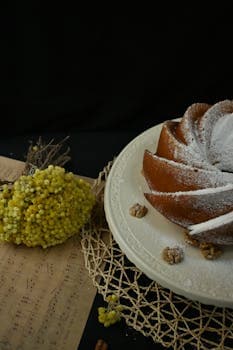
Monastic Walnut Cake
A dense, spiced walnut cake made with monastery honey and no refined sugar.
About This Recipe
The monastery walnut cake is a product of necessity shaped by centuries of resourcefulness. Across Central and Eastern Europe — Hungary, Romania, Poland, Austria, the Czech lands — monasteries and convents developed a distinct confectionery tradition in which the refined sugar they could not produce themselves was replaced by honey from their own hives, and expensive imported spices were used sparingly but with great impact. Walnut trees grew reliably in monastery gardens and orchards across the region, providing a protein-rich nut that could be harvested once a year and stored through winter. Combined with eggs, honey, and cinnamon, walnuts produced a dense, moist cake that kept exceptionally well — important in institutions where baking happened in large batches for feast days, visitors, and charitable distribution. The resulting cake is flourless or nearly so (this recipe uses a minimal amount of plain flour as a binder), which gives it a dense, fudgy texture closer to a brownie than a conventional sponge. The honey provides both sweetness and moisture retention, while cinnamon's warmth ties the egg, walnut, and honey together into an aromatic whole. The batter comes together quickly and requires no creaming or complex folding — just beaten eggs and honey, fold in the nuts, add the flour and raising agent. The key to the characteristic dense-yet-moist crumb is not overbaking: the cake should still be slightly soft when pressed in the centre as it comes from the oven, firming up as it cools.
Ingredients
Serves 8
- 200 gwalnuts(finely chopped)
- 3eggs
- 100 ghoney
- 80 gplain flour
- 1 tspcinnamon
- 1 tspbaking powder
Instructions
- 1
Prepare the walnuts
If your walnuts are whole or in large pieces, chop them finely by hand or pulse briefly in a food processor — you want a mixture of fine crumbs and small pieces about 3–5 mm, not a powder. The variety in size gives the finished cake its characteristic texture with occasional larger walnut pieces.
Toast the walnuts on a dry pan over medium heat for 3–4 minutes before chopping — this deepens their flavour noticeably and is worth the extra step.
- 2
Prepare tin and preheat oven
Preheat the oven to 175°C (fan 155°C). Grease a 20 cm round or square tin generously with butter and line the base with baking parchment. Bring the eggs to room temperature if refrigerated — this is important for proper incorporation with the honey.
- 3
Beat eggs and honey
In a large bowl, beat the eggs and honey together with an electric whisk for 3–4 minutes until the mixture is pale, thick, and has roughly doubled in volume. When you lift the whisk and trail the mixture across the surface, it should hold a visible ribbon for 2–3 seconds before dissolving. This aeration is essential to the cake's structure.
Honey that is very firm or crystallised should be gently warmed (30 seconds in a microwave, or set the jar in warm water) to make it liquid and easy to beat.
- 4
Add dry ingredients
In a separate bowl, mix the chopped walnuts, plain flour, cinnamon, and baking powder together. Add all at once to the egg-honey mixture and fold in using a large spatula with broad strokes from the bottom of the bowl upward. Mix only until just combined — 12–15 strokes should be enough. Some flour streaks are fine at this stage.
- 5
Pour and bake
Pour the batter into the prepared tin and spread to an even layer with the spatula. The batter will be quite thick. Bake in the centre of the oven for 30–35 minutes. The cake is ready when it has pulled away slightly from the sides of the tin, is golden on top, and a skewer inserted in the centre comes out with only a few moist crumbs.
This cake goes from perfect to overbaked within a few minutes. Start checking at 28 minutes.
- 6
Cool and finish
Leave the cake to cool in the tin for 10 minutes — it is fragile when hot. Turn out onto a wire rack and peel off the parchment. While still warm (but not hot), drizzle 1–2 teaspoons of honey over the top for a glossy, lightly sticky surface that sets as the cake cools. Cool completely before slicing.
Did you make this?
Rate it and help other cooks find the recipes that actually work.
One tap to sign in, and we'll save the rating you just picked.
Everything you need to plan your week — free
- Meal calendar
- Grocery list
- AI recipe ideas
Track what you eat
Snap your meal to log calories and macros, run fasting timers and track water in the free SnapCal app.
Pro Tips
- →
Toast the walnuts before chopping — 3–4 minutes in a dry pan significantly deepens their flavour and is arguably the most impactful optional step in this recipe.
- →
Strong, characterful honey (chestnut, buckwheat, or heather) makes a more complex and interesting cake than mild acacia honey — the flavour comes through clearly.
- →
The cake is intentionally dense and moist; do not expect a light, airy sponge. If yours is very dry, it was overbaked — reduce the oven temperature or time by 5 minutes on the next attempt.
- →
A pinch of ground cloves or allspice added alongside the cinnamon is a common variation in Hungarian and Romanian monastery recipes — it adds depth without changing the essential character.
- →
The cake improves significantly after 24 hours as the honey and walnut flavours meld — make it a day ahead when possible.
Variations
- •
Walnut and dried fruit cake: fold in 60g of raisins, dried cranberries, or chopped prunes with the walnuts — a common Central European monastery variation for feast days.
- •
Gluten-free walnut cake: replace the plain flour entirely with 30g of rice flour or almond flour for a fully gluten-free result that is equally moist.
- •
Dark chocolate walnut cake: add 30g of good-quality cocoa powder to the dry ingredients, reducing the flour to 50g — the result is a darker, more intense cake reminiscent of a flourless chocolate brownie.
- •
Honey and hazelnut variation: replace the walnuts with finely chopped roasted hazelnuts for a sweeter, less bitter nut flavour that works particularly well with a milk-honey or acacia honey.
Storage
This cake keeps at room temperature, loosely covered, for up to 4 days — and genuinely improves over the first 2 days as the moisture redistributes and the flavours deepen. Store in an airtight tin rather than cling-wrapped, as honey-sweetened cakes can become sticky if sealed in plastic. It freezes well for up to 2 months; wrap individual slices tightly in cling film before freezing.
History & Origin
Nut-and-honey confectionery has deep roots in Central European monastic life, with documented recipes from Benedictine and Cistercian abbeys in Austria, Bohemia, and Hungary from the 15th century onward. Honey was the principal sweetener in monastery kitchens until refined sugar became widely affordable in the 19th century, and walnut trees were cultivated in monastery orchards specifically for baking and oil production. The tradition of selling monastery cakes and sweets at church fairs — particularly at patron saint festivals and Christmas markets — was a significant source of income for smaller religious communities and survives to the present day in several Central European monasteries.
Frequently Asked Questions
Can I use maple syrup or other liquid sweeteners instead of honey?
Yes — maple syrup works in exactly the same quantity and produces a slightly less floral, more caramel-like sweetness. Brown rice syrup and barley malt syrup also work but produce a less sweet, more treacly result. Refined sugar does not work as a direct substitute in the same quantity as it doesn't add the moisture that honey contributes.
Why is my cake very dry?
Overbaking is the most common cause — honey-based cakes dry out faster than sugar-based ones because honey caramelises at a lower temperature. Try reducing the oven temperature by 10°C and checking from 25 minutes. Also ensure you are using liquid honey rather than set honey, which doesn't incorporate as smoothly.
Can I make this cake gluten-free?
Yes — replace the 80g of plain flour entirely with rice flour, oat flour (if not coeliac), or almond flour. The cake will be slightly denser and more fragile but very similar in flavour. Almond flour in particular works beautifully with walnuts and honey.
Is this cake suitable for a nut allergy?
No — the walnuts are the primary structural ingredient and cannot be removed without completely changing the recipe. A nut-free alternative would be a different cake entirely.
Nutrition Facts
Per serving · 8 servings total
Time Summary
Have Questions?
Ask our AI cooking assistant anything about this recipe — substitutions, techniques, scaling.
Chat with AI Chef →Featured in Guides
This recipe is featured in the following curated guides:
More Monastic Recipes
You Might Also Like
Similar dishes from other cuisines around the world.
Free Kitchen Tools
Calculators and converters that pair with this page — no signup needed.
Put This Into a Plan
Schedule it, shop for it, and track what you already have.
Read Next
Longer reads that go deeper on the ideas behind this dish.
Community
Join the conversation
Sign in to leave a comment and save your favourite recipes