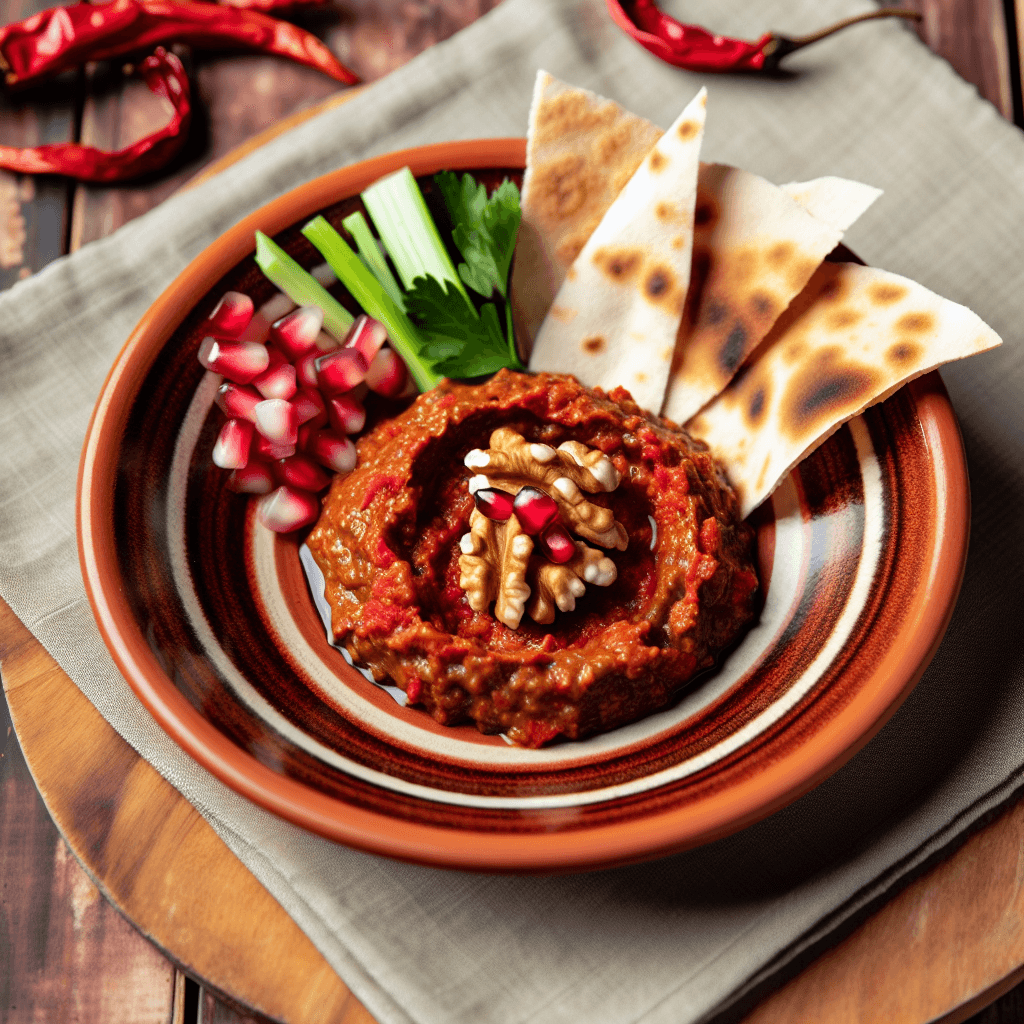
Muhammara is the Levant's most sophisticated dip — fire-roasted red peppers and toasted walnuts blended with pomegranate molasses, garlic, and cumin into a coarse, brick-red paste that hits sweet, smoky, tangy, and gently hot in a single bite. The name comes from the Arabic for 'reddened,' and the dish's character depends on getting each component right: peppers charred until their skins blister, walnuts toasted until aromatic, and real pomegranate molasses (never grenadine) for the signature sour-sweet backbone. Served at room temperature with warm flatbread, it anchors a mezze spread alongside hummus and baba ghanoush, but it's equally brilliant spooned over grilled chicken, fish, or roasted vegetables.
Serves 6
Char the red peppers directly over a gas flame or under a hot broiler, turning every few minutes, until the skins are blackened and blistered all over. Seal them in a covered bowl for 10 minutes to steam, then peel off the skins and discard the seeds and stems.
Resist rinsing the peeled peppers under water — you'll wash away the smoky charred flavor that defines muhammara. A few stubborn black flecks are fine.
Toast the walnuts in a dry skillet over medium heat, shaking the pan frequently, for 3–4 minutes until they smell deeply nutty and darken slightly. Tip them onto a plate immediately so the residual pan heat doesn't push them into bitterness.
Pulse the roasted peppers, walnuts, pomegranate molasses, garlic, breadcrumbs, cumin, salt, and cayenne in a food processor in short bursts, scraping down the sides between pulses. Stop while the texture is still slightly coarse and rustic — muhammara should never be a smooth purée.
If the dip looks loose, pulse in an extra spoonful of breadcrumbs; if too stiff, add a drizzle of olive oil. Roasted peppers vary widely in water content.
Spread the muhammara into a shallow bowl, swirl the surface with the back of a spoon, and drizzle generously with olive oil so it pools in the grooves. Scatter pomegranate seeds over the top and serve at room temperature with warm flatbread or pita.
Everything you need to plan your week — free
Cook this hands-free
Get AI meal plans, step-by-step cooking mode, and your saved recipes in the free Bento app.
Pomegranate molasses is essential and non-negotiable — it's a thick, tart reduction of pomegranate juice, completely different from sweet grenadine.
Toast the walnuts even if the package says 'roasted'; fresh toasting wakes up oils that fade in storage.
Let the finished dip rest 30 minutes before serving — the garlic mellows and the flavors knit together noticeably.
Keep the texture coarse; the pleasure of muhammara is in the slight crunch of walnut against silky pepper.
Traditional Aleppo-style versions use Aleppo pepper flakes — substitute them for the cayenne if you can find them, for fruitier, gentler heat.
Stir in toasted pine nuts at the end for extra richness and a luxurious garnish.
Increase the cayenne or add a spoonful of harissa for a fiery version closer to some Syrian renditions.
Use jarred roasted peppers (well drained) for a 10-minute weeknight shortcut — add a pinch of smoked paprika to compensate for lost char.
Thin with a little olive oil and lemon juice to make a sauce for grilled kebabs or roasted cauliflower.
Refrigerate in an airtight container with a thin film of olive oil over the surface for up to 5 days. Bring to room temperature before serving, as chilling mutes the pepper and pomegranate flavors.
Muhammara originated in Aleppo, Syria — a city famed for both its red pepper fields and its refined cuisine — and spread throughout the Levant, becoming a fixture of Lebanese mezze tables. Its pairing of local walnuts, peppers, and pomegranate molasses showcases the pantry of the region's silk-road trading heritage. Today it stands alongside hummus and baba ghanoush as one of the great dips of Middle Eastern cooking.
Middle Eastern grocers and most well-stocked supermarkets carry it, usually labeled 'pomegranate molasses' or 'dibs rumman,' and it's widely available online. It's a thick, dark, intensely tart syrup made by reducing pomegranate juice — do not substitute grenadine, which is sugary and artificial. In an emergency, simmer pomegranate juice with a little lemon juice and sugar until syrupy.
Yes. The breadcrumbs traditionally absorb the peppers' moisture and give body, but you can swap in crushed crackers, a small handful of extra walnuts, or gluten-free breadcrumbs with nearly identical results. If skipping a binder entirely, drain the roasted peppers very well and expect a slightly looser, more sauce-like dip — still delicious over grilled meats.
Usually it's under-acidified or under-salted. Pomegranate molasses brands vary in tartness, so taste and add another teaspoon, plus a squeeze of lemon if needed — the dip should have a bright sour edge cutting the walnut richness. Also confirm your walnuts were freshly toasted and your cumin isn't stale; both contribute most of the aromatic depth.
Warm pita or flatbread is classic, as part of a mezze spread with hummus, labneh, olives, and fresh vegetables. Beyond dipping, it's superb as a sauce for grilled chicken, lamb kofta, or roasted fish, spread inside sandwiches and wraps, or dolloped onto roasted eggplant and cauliflower. It effectively works anywhere romesco sauce would.
Per serving (150g / 5.3 oz) · 6 servings total
Ask our AI cooking assistant anything about this recipe — substitutions, techniques, scaling.
Chat with AI Chef →This recipe is featured in the following curated guides:
Join the conversation
Sign in to leave a comment and save your favourite recipes
Everything you need to plan your week — free
Have feedback or need help?
We read every email and reply within 1–2 business days.
© 2026 MyCookingCalendar. All rights reserved.