
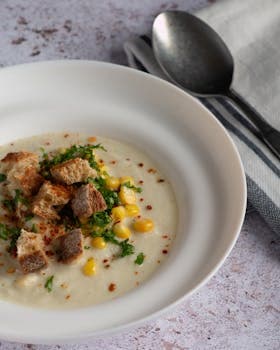
New England Corn Chowder
Creamy corn chowder with bacon, potatoes and fresh herbs.
About This Recipe
New England corn chowder occupies a sweet spot between the region's famous clam chowder and the heartier Midwestern corn soups — it has the same creamy, potato-studded base and smoky bacon undertow, but corn's natural sweetness gives it a brightness that clam chowder doesn't have. The technique starts with rendering thick-cut bacon until genuinely crispy, then using that rendered fat to soften onions and garlic into sweetness before the broth and potatoes go in. This layering of fat-soluble flavors into the base is what separates a chowder with real backbone from one that tastes flat despite looking identical. Yukon Gold potatoes are the right choice here: they have enough starch to lightly thicken the broth as they simmer without falling apart into a puree, and their buttery flavor complements the cream. The corn itself should go in late — just 5 minutes before serving — because prolonged cooking toughens the kernels and blunts their sweetness. In peak summer, nothing surpasses fresh corn cut straight from the cob; the milky liquid that runs from the cob into the pot adds an extra layer of starchy-sweet depth. Frozen corn is a fully legitimate year-round substitute that outperforms canned by a wide margin. A small amount of heavy cream at the end gives the chowder its characteristic silky body without making it heavy. Fresh thyme added in the last minute keeps its herbal brightness, while thyme added too early fades to bitterness. Serve it in wide, warmed bowls with the reserved bacon crumbled on top and crusty oyster crackers on the side.
Ingredients
Serves 4
- 4 cupscorn kernels(fresh (from ~5 ears) or frozen)
- 2 mediumYukon Gold potatoes(diced into ½-inch cubes)
- 4 slicesthick-cut bacon(chopped)
- 1 mediumyellow onion(diced)
- 2 clovesgarlic(minced)
- 3 cupschicken broth(low-sodium)
- 1 cupheavy cream
- 2 tbspunsalted butter
- 1 tspfresh thyme leaves
- salt and black pepper(to taste)
- oyster crackers or crusty breadfor serving
Instructions
- 1
Render the bacon
Add the chopped bacon to a cold Dutch oven or heavy pot, then set it over medium heat. Starting cold renders more fat slowly and produces crispier bacon. Cook for 7–8 minutes, stirring occasionally, until the bacon is deep golden and genuinely crispy. Transfer with a slotted spoon to a paper-towel-lined plate, leaving the rendered fat in the pot.
You need about 1 tablespoon of fat in the pot after removing the bacon — if your bacon was lean, add a tablespoon of butter.
- 2
Sauté the aromatics
With the bacon fat over medium heat, add the diced onion and cook, stirring frequently, for 5 minutes until translucent and softened but not browned. Add the garlic and cook 1 more minute until fragrant, scraping up any browned bits stuck to the bottom of the pot.
- 3
Add potatoes and broth
Pour in the chicken broth and add the diced potatoes. Raise the heat to medium-high and bring to a boil, then reduce to a brisk simmer. Cook uncovered for 12–15 minutes until the potatoes are tender enough to be pierced easily with a fork but still holding their shape — they should not be falling apart.
Yukon Gold potatoes hold their form better than russets; if you use russets, check for doneness at 10 minutes.
- 4
Add corn and cream
Stir in the corn kernels, heavy cream, butter, and thyme. If using fresh corn, scrape the milky liquid from the cobs into the pot as well — it thickens and sweetens the broth. Simmer gently for 5 minutes just to heat the corn through and let the cream meld with the broth. Do not boil the cream aggressively or it may curdle.
- 5
Adjust seasoning and serve
Taste the chowder and season with salt and pepper — chicken broth varies significantly in saltiness, so add carefully. Ladle into wide, warmed bowls and top each with a generous scatter of the reserved crispy bacon and a few extra thyme leaves. Serve with oyster crackers or crusty bread.
Warming the bowls in a low oven or with a splash of hot water before ladling keeps the chowder hotter for longer.
Did you make this?
Rate it and help other cooks find the recipes that actually work.
One tap to sign in, and we'll save the rating you just picked.
Everything you need to plan your week — free
- Meal calendar
- Grocery list
- AI recipe ideas
Track what you eat
Snap your meal to log calories and macros, run fasting timers and track water in the free SnapCal app.
Watch: New England Corn Chowder
Pro Tips
- →
Use fresh corn cut from the cob in summer — the starchy cob liquid you scrape into the pot adds sweetness and body that no other ingredient can replicate.
- →
Start the bacon in a cold pot so it renders slowly and evenly, producing crispier pieces and more usable fat than starting in a preheated pan.
- →
Don't rush the potato simmer — underdone potato cubes give the chowder a starchy, raw-flour flavor; properly tender ones melt slightly into the broth and thicken it naturally.
- →
Add the cream at the end and keep the heat at a gentle simmer, never a boil — vigorous boiling breaks the cream and gives the soup a slightly grainy texture.
- →
Chowder always tastes better the next day as the potatoes absorb the broth and the flavors deepen, making it an ideal make-ahead soup for parties.
Variations
- •
Clam corn chowder: add one 10-oz can of chopped clams (with their juice) along with the cream for a hybrid New England soup that bridges both traditions.
- •
Roasted corn version: char the corn kernels in a dry cast-iron skillet for 4–5 minutes before adding to the soup — the smoky sweetness transforms the flavor profile entirely.
- •
Vegan corn chowder: replace bacon with 1 tbsp smoked paprika sautéed in olive oil, swap chicken broth for vegetable broth, and use full-fat coconut milk in place of heavy cream.
- •
Lobster corn chowder: stir in 200g of rough-chopped cooked lobster meat in the last 2 minutes — an elegant summer version common in Maine and coastal Massachusetts.
Storage
Corn chowder keeps refrigerated in an airtight container for up to 3 days and actually tastes better on day two once the potatoes have absorbed more of the broth's flavor. Reheat gently over medium-low heat, stirring frequently, adding a splash of broth if it's thickened too much in the refrigerator. This chowder does not freeze well — the cream separates and the potatoes become grainy upon thawing.
History & Origin
Chowder has been a cornerstone of New England cooking since at least the early 18th century, when French and British fishing communities along the coast developed it as a hearty, practical way to use fresh catch. Corn chowder emerged as a landlocked variation as European settlers moved inland and encountered corn — a staple cultivated by Indigenous peoples throughout the Northeast for millennia. By the 19th century corn chowder appeared regularly in New England cookbooks, celebrating the sweet summer corn harvests of the region's farming communities and providing a lighter, meatless alternative to the fish and clam versions popular on the coast.
Frequently Asked Questions
What's the difference between corn chowder and clam chowder?
New England clam chowder uses briny littleneck or quahog clams as its central ingredient and has a distinctly oceanic, minerally flavor. Corn chowder uses sweet corn kernels in their place, producing a milder, sweeter soup that's accessible to people who don't eat shellfish. Both share the same creamy, potato-and-bacon base and thick, hearty consistency — corn chowder is really clam chowder's inland cousin, born when settlers moved away from the coast.
Can I use frozen corn instead of fresh?
Yes, and for most of the year frozen corn is actually the better choice — it's picked at peak sweetness and frozen immediately, giving it more consistent flavor than fresh corn that's been sitting in the store for days. Add frozen corn directly from the freezer in the last 5 minutes; it will thaw and cook through without becoming mushy. Only seek out fresh corn during peak summer (July through September) when you can get it the same day it was picked.
How do I make this chowder thicker without flour?
The easiest technique is to scoop out about 1 cup of the cooked potatoes and roughly mash them before stirring them back in — the starch thickens the broth naturally without any flour or cornstarch. You can also blend a portion of the soup with an immersion blender, leaving most of it chunky. Finally, the starchy liquid you scrape from fresh corn cobs adds meaningful thickening over the 5-minute corn simmer.
Can I make corn chowder ahead of time?
Yes, and it genuinely improves overnight. Make the soup through Step 4 but hold off on the fresh thyme, bacon crumble, and final seasoning. Refrigerate up to 2 days. When reheating, warm it slowly over medium-low heat with the lid on, stirring occasionally, and add the finishing garnishes fresh at serving time. The one thing to avoid is reheating over high heat, which can cause the cream to separate.
How do I cut corn off the cob cleanly?
Stand the shucked ear of corn on its flat end in the center of a wide, shallow bowl. Using a sharp chef's knife, slice downward close to the cob in strips, rotating the ear a quarter turn each time. The bowl catches the kernels and the liquid that splashes from the cut. After cutting, run the back of the blade down each side of the cob to scrape out the remaining milky corn liquid — this is the most flavorful part and goes straight into the pot.
Nutrition Facts
Per serving (350g / 12.3 oz) · 4 servings total
Time Summary
Have Questions?
Ask our AI cooking assistant anything about this recipe — substitutions, techniques, scaling.
Chat with AI Chef →Featured in Guides
This recipe is featured in the following curated guides:
More American Recipes
You Might Also Like
Similar dishes from other cuisines around the world.
Browse by Ingredient
More recipes built around the same core ingredients.
Free Kitchen Tools
Calculators and converters that pair with this page — no signup needed.
Put This Into a Plan
Schedule it, shop for it, and track what you already have.
Community
Join the conversation
Sign in to leave a comment and save your favourite recipes