
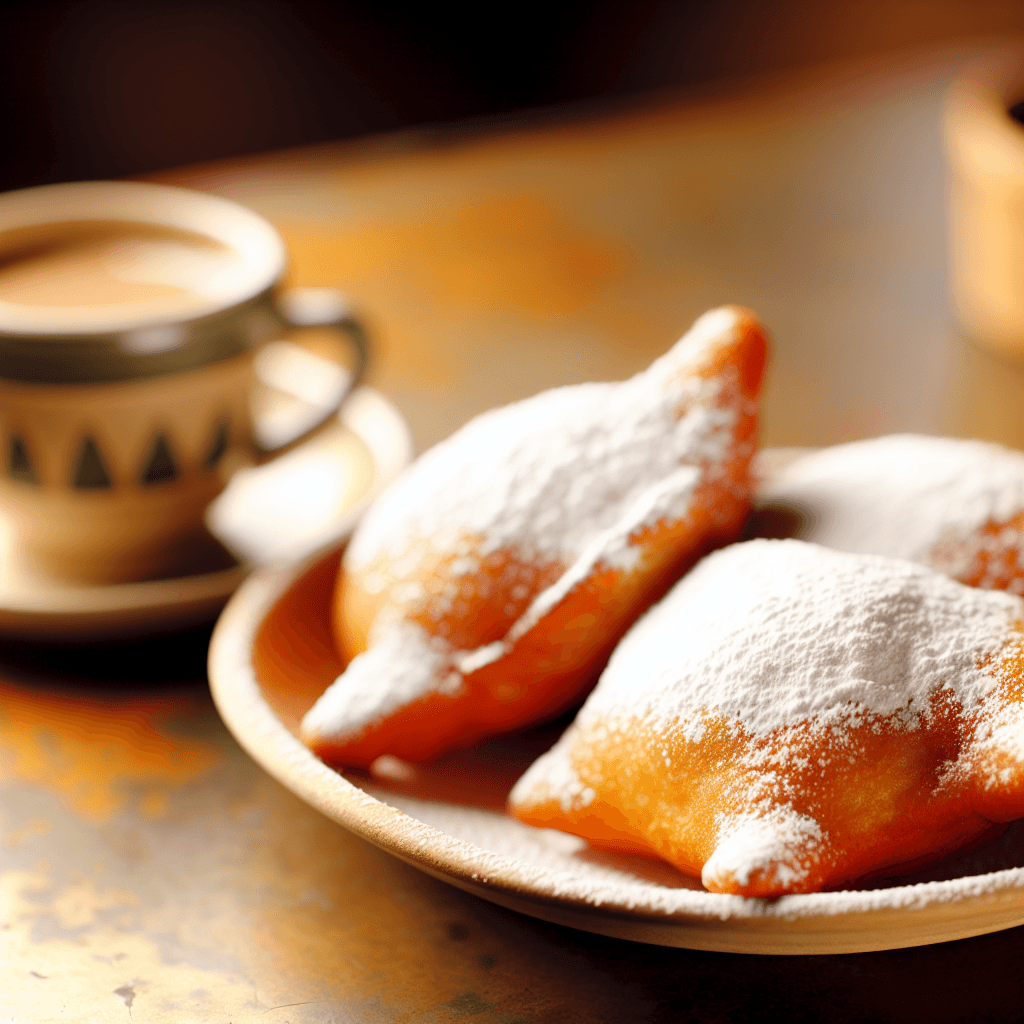
New Orleans Beignets
Puffy fried pastries generously dusted with powdered sugar.
About This Recipe
A New Orleans beignet (pronounced ben-YAY) is not a donut — it is a square of yeasted fried dough with a completely different character: hollow in the centre from the yeast-generated steam that puffs the dough as it hits hot oil, tender rather than chewy, and coated so extravagantly in powdered sugar that the first bite sends a small cloud across the table. This is not accidental. At Café du Monde on the edge of Jackson Square — open every hour of every day since 1862 — the sugar is applied from a long-handled sifter held high above the beignets, producing a layer so thick it settles like fresh snow. Locals wear dark clothing to Café du Monde for a reason. The dough traces back to the French colonists who brought their choux and fried pastry traditions to Louisiana in the 18th century, where they merged with local ingredients and Creole creativity. The classic Café du Monde recipe uses evaporated milk and shortening for a dough that is soft, slightly rich, and pliable enough to roll thin without springing back — that thin roll is critical, because thick beignets close up instead of puffing hollow. The frying temperature must be precise: at 375°F (190°C) the dough puffs dramatically within the first 30 seconds and turns deep golden in under 3 minutes per side. Lower temperatures produce pale, dense beignets that absorb oil; higher temperatures burn the outside before the centre cooks. Serve them immediately with café au lait made half-and-half with chicory-blended coffee — in New Orleans, beignets without that bitter, earthy coffee counterpoint feel somehow incomplete.
Ingredients
Serves 12
- 500 mlwhole milk
- 7 ginstant yeast
- 60 gsugar
- 1 tspsalt
- 1 tspvanilla extract
- 2egg yolks
- 300 gall-purpose flour
- 40 gshortening
- oil for fryingvegetable oil
- 250 gpowdered sugar
Instructions
- 1
Activate yeast and mix dough
Warm the milk to 38°C (100°F) — it should feel pleasantly warm on the inside of your wrist, not hot. Stir in the yeast and sugar and let stand 5 minutes until foamy. Add salt, vanilla, and egg yolks and whisk briefly. Add the flour and shortening all at once and mix with a wooden spoon until a shaggy dough forms.
Milk hotter than 43°C kills the yeast and the dough will not rise; use an instant-read thermometer if uncertain.
- 2
Knead and rise
Turn the dough onto a lightly floured surface and knead for 6–8 minutes until smooth, slightly tacky but not sticky, and springs back slowly when poked. Place in an oiled bowl, cover with cling film, and let rise in a warm spot for 1.5 hours until doubled. The dough can also be refrigerated overnight at this point for morning beignets.
- 3
Roll thin and cut
Punch down the risen dough and roll on a lightly floured surface to about 5 mm thickness — thinner than you might expect, roughly the thickness of a pound coin. Cut into 7.5 cm squares with a sharp knife or pizza cutter. Do not re-roll scraps more than once or the gluten tightens and the beignets won't puff properly.
Thin dough is the key to hollow, airy beignets; thick dough produces dense squares that don't puff open.
- 4
Fry to golden
Pour vegetable oil into a deep pot to a depth of at least 8 cm and heat to 190°C (375°F) — maintain this temperature between batches using a thermometer. Slide 3–4 beignet squares into the oil; they will sink, then rise and begin puffing dramatically within 20–30 seconds. Fry 1.5–2 minutes per side until deep golden brown on both sides.
- 5
Drain briefly
Remove beignets with a spider or slotted spoon and drain on a wire rack or paper towels for no more than 30 seconds — long draining makes them stiff. They should still feel warm and slightly soft when the sugar goes on.
- 6
Snow with powdered sugar
Immediately transfer 3–4 beignets to a serving plate and sift powdered sugar over them from a height of 30 cm or more, using a fine-mesh sieve. The coating should be extravagant — thick enough to obscure the golden surface entirely. Serve at once; beignets are at their best in the first 2 minutes after frying.
Did you make this?
Rate it and help other cooks find the recipes that actually work.
One tap to sign in, and we'll save the rating you just picked.
Everything you need to plan your week — free
- Meal calendar
- Grocery list
- AI recipe ideas
Track what you eat
Snap your meal to log calories and macros, run fasting timers and track water in the free SnapCal app.
Pro Tips
- →
Café du Monde uses Café du Monde Coffee and Chicory blend — make café au lait half coffee, half heated milk for the authentic pairing.
- →
Don't crowd the oil — 3–4 beignets at a time maximum; too many drops the temperature and produces pale, greasy results that won't puff properly.
- →
A kitchen thermometer is not optional here; the 10-degree difference between 375°F and 365°F is the difference between puffed golden beignets and dense, oily ones.
- →
Wear an apron and warn your dining companions — the powdered sugar mist produced when eating beignets is notoriously indiscriminate.
- →
The dough keeps covered in the refrigerator for up to 24 hours after rising; cold dough actually rolls more easily and produces slightly chewier beignets that some prefer.
Variations
- •
Sweet filled beignets: pipe strawberry jam or Nutella into the hollow centre of freshly fried beignets using a piping bag with a long narrow tip.
- •
Chocolate dough beignets: replace 30 g of the flour with Dutch-process cocoa for a mocha-scented square, dusted with a mix of powdered sugar and cinnamon.
- •
Savory cheese beignets: omit sugar and vanilla from the dough, add 80 g of finely grated Gruyere, and serve without powdered sugar — a French-Creole cocktail snack tradition.
- •
Brioche-style enriched beignets: replace the shortening with butter and add an extra yolk for a richer, more tender dough closer to French beignets de carnaval.
Storage
Beignets are emphatically a fresh food — they are best in the first 5 minutes after frying and acceptable for up to 2 hours. After that the exterior softens and the interior collapses. Leftover beignets can be reheated at 190°C (375°F) in an oven for 4–5 minutes to restore some crispness, but they will not recapture the original puffiness. The unfried dough keeps refrigerated for up to 24 hours.
History & Origin
Beignets were brought to Louisiana by French colonists in the 18th century — the French tradition of frying choux paste and yeasted dough was well established in Normandy and Provence. French Ursuline nuns arriving in New Orleans in 1727 are sometimes credited with introducing the pastry, though the earliest documented New Orleans beignet references appear in mid-19th century Creole cookbooks. Café du Monde opened on the edge of the French Market in 1862 and has served beignets continuously ever since, surviving the Civil War, multiple hurricanes, and one pandemic. Louisiana officially designated the beignet as the state doughnut in 1986.
Frequently Asked Questions
What is the difference between a beignet and a doughnut?
A doughnut is made from an enriched dough that is often ring-shaped, glazed, filled, or frosted, and the texture is deliberately dense and chewy. A New Orleans beignet is a square of thinner yeasted dough that puffs into a hollow pillow when fried — lighter, airier, and served plain with nothing but powdered sugar. The experience of eating one is fundamentally different: a beignet shatters slightly on the outside and the interior is almost nothing, just warm air and a thin layer of cooked dough.
Why won't my beignets puff up?
Three common causes: the dough was rolled too thick (aim for 5 mm or roughly the thickness of a coin), the oil temperature was too low (must be at 375°F/190°C; lower temps mean slow cooking and the dough sets before steam can inflate it), or the yeast was not active (test it in warm water first — it should foam within 5 minutes). All three are fixable with more precision on those variables.
Can I make the dough the night before?
Yes, and this is genuinely recommended. After the initial knead, place the dough in an oiled bowl, cover tightly, and refrigerate overnight. The slow cold rise develops more complex flavour than a quick room-temperature rise. Take the dough out 30 minutes before rolling to let it relax slightly, then roll and fry as normal.
What is chicory coffee and do I need it?
Café du Monde's signature coffee blend is mixed with roasted and ground chicory root, which adds a distinctive earthiness, slightly bitter edge, and deep brown colour. It is served as café au lait — half coffee, half hot whole milk — and the combination with sweet powdered-sugar beignets is one of the great food pairings in American cuisine. You can substitute any strong coffee, but the chicory version is worth seeking out; it is available online and in many specialty grocery stores.
How much powdered sugar is too much?
This is not a question asked in New Orleans. The correct answer is more. A true Café du Monde order arrives so thickly coated in powdered sugar that the beignet colour is invisible underneath, and the first breath after biting into one results in a powdered sugar cloud. This is the experience. Use at least 3–4 tablespoons per beignet, applied from a height to distribute evenly.
Nutrition Facts
Per serving (80g / 2.8 oz) · 12 servings total
Time Summary
Have Questions?
Ask our AI cooking assistant anything about this recipe — substitutions, techniques, scaling.
Chat with AI Chef →Featured in Guides
This recipe is featured in the following curated guides:
More American Recipes
You Might Also Like
Similar dishes from other cuisines around the world.
Free Kitchen Tools
Calculators and converters that pair with this page — no signup needed.
Put This Into a Plan
Schedule it, shop for it, and track what you already have.
Read Next
Longer reads that go deeper on the ideas behind this dish.
Community
Join the conversation
Sign in to leave a comment and save your favourite recipes