
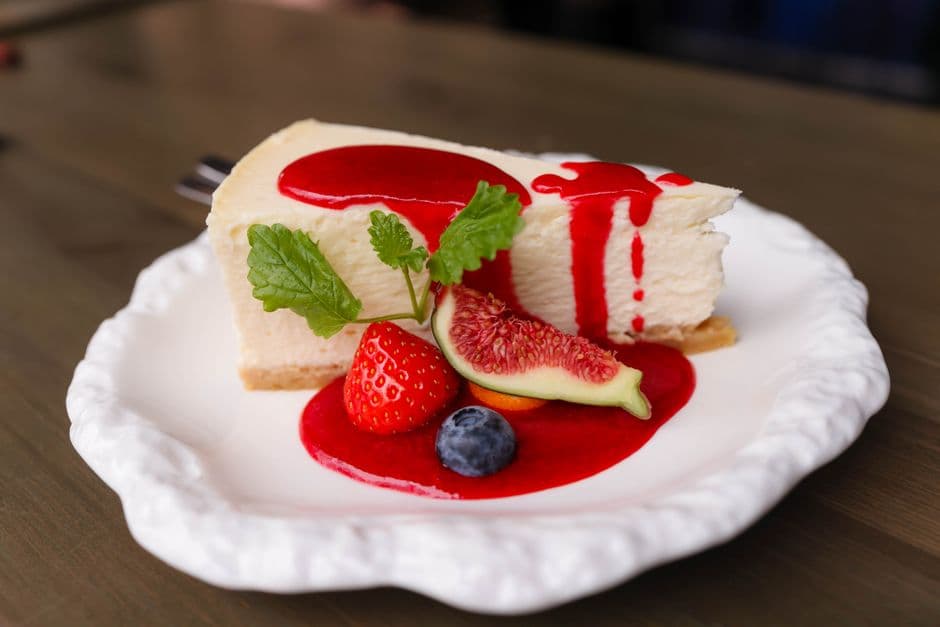
New York Cheesecake
The definitive baked cheesecake — impossibly dense, creamy and rich, with a buttery Graham cracker crust and that characteristic lightly bronzed top.
About This Recipe
New York cheesecake stands apart from its lighter European cousins through its sheer, unapologetic richness. The filling is made almost entirely from cream cheese — full-fat, with no compromises — enriched with sour cream, eggs and just enough sugar to balance the tang. The result is a dense, almost fudge-like texture that stands in glorious contrast to the crumbly, buttery base. Baking in a water bath ensures the custard sets slowly and evenly without cracking. The cheesecake must be refrigerated overnight to allow the texture to firm and the flavours to develop — patience is non-negotiable.
Ingredients
Serves 12
- 200 gGraham crackers or digestive biscuits(crushed to fine crumbs)
- 80 gunsalted butter(melted, for the crust)
- 2 tablespoonscaster sugar(for the crust)
- 900 gfull-fat cream cheese(at room temperature)
- 250 gcaster sugar
- 3 tablespoonsplain flour
- 1 teaspoonvanilla extract
- 3large eggs(plus 1 extra yolk, at room temperature)
- 240 mlsour cream(at room temperature)
Instructions
- 1
Make the crust
Preheat the oven to 170°C (150°C fan). Mix biscuit crumbs with melted butter and 2 tablespoons of sugar. Press firmly and evenly into the base of a 23 cm springform tin. Bake for 10 minutes until set. Leave to cool.
- 2
Beat the cream cheese
Using an electric mixer on medium speed, beat the cream cheese until completely smooth and fluffy, about 3 minutes. Scrape down the sides. Add the sugar and flour and beat for another 2 minutes until fully incorporated.
Room-temperature cream cheese is essential — cold cream cheese will leave lumps that never fully smooth out.
- 3
Add the remaining ingredients
Mix in the vanilla extract. Add the eggs and extra yolk one at a time, beating on low speed just until each is incorporated. Do not over-beat after adding the eggs — excess air causes cracks. Fold in the sour cream with a spatula.
- 4
Prepare the water bath
Wrap the outside of the springform tin tightly in two layers of heavy-duty foil to prevent water seeping in. Pour the filling over the cooled crust. Place the tin in a large roasting pan. Pour enough boiling water into the roasting pan to come 2 cm up the sides of the springform tin.
- 5
Bake
Bake for 70–80 minutes. The cheesecake is ready when the edges are set but the centre still has a noticeable jiggle. Turn off the oven, crack the door open and leave the cheesecake inside for 1 hour.
- 6
Chill overnight
Remove from the water bath, run a thin knife around the edge of the tin to loosen, and leave to cool completely at room temperature. Cover and refrigerate for at least 8 hours, or overnight. Unmould and serve at room temperature.
Did you make this?
Rate it and help other cooks find the recipes that actually work.
One tap to sign in, and we'll save the rating you just picked.
Everything you need to plan your week — free
- Meal calendar
- Grocery list
- AI recipe ideas
Track what you eat
Snap your meal to log calories and macros, run fasting timers and track water in the free SnapCal app.
Pro Tips
- →
All ingredients must be at room temperature to ensure a smooth, lump-free batter.
- →
Do not over-mix once the eggs are added — air in the batter causes the top to crack.
- →
A slow cool in the turned-off oven prevents cracking from thermal shock.
- →
The water bath creates steam that keeps the cheesecake moist and prevents the top from drying out.
Variations
- •
Berry swirl cheesecake: swirl 3 tablespoons of raspberry or blueberry coulis through the filling before baking.
- •
Lemon cheesecake: add the zest and juice of 2 lemons to the cream cheese mixture.
- •
Biscoff cheesecake: replace the Graham cracker base with crushed Lotus Biscoff and add 2 tablespoons of Biscoff spread to the filling.
- •
Vegetarian: swap the protein for roasted king oyster mushrooms, smoked tofu or cooked chickpeas — adjust seasoning slightly upward to compensate.
Storage
Refrigerate, covered, for up to 5 days. The cheesecake can be frozen (without topping) for up to 2 months — thaw overnight in the refrigerator.
History & Origin
New York-style cheesecake is associated with Arnold Reuben, who claimed to have created it in the early twentieth century, though Jewish-American bakers in New York had been making rich cream cheese cakes for decades. The style was popularised by Lindy's restaurant in Midtown Manhattan.
Frequently Asked Questions
Why did my cheesecake crack?
Cracks usually result from over-mixing (too much air), too-high an oven temperature, or cooling too quickly. A water bath and slow oven cool prevent most cracks.
Can I make it without a water bath?
Yes, but cracking is more likely. Bake at a slightly lower temperature (160°C) and cool very gradually with the oven door ajar.
Can I make this ahead of time?
Yes — most of the components can be prepared up to a day in advance and refrigerated separately. Reheat gently and assemble just before serving so textures stay distinct.
What can I substitute if I don't have all the ingredients?
Stay close to the role each ingredient plays: swap aromatics for similar ones (shallot for onion, lime for lemon), and keep the fat-acid-salt balance intact. Spice blends can usually be approximated with what's in the cupboard.
Nutrition Facts
Per serving · 12 servings total
Time Summary
Have Questions?
Ask our AI cooking assistant anything about this recipe — substitutions, techniques, scaling.
Chat with AI Chef →Featured in Guides
This recipe is featured in the following curated guides:
More American Recipes
You Might Also Like
Similar dishes from other cuisines around the world.
Browse by Ingredient
More recipes built around the same core ingredients.
Free Kitchen Tools
Calculators and converters that pair with this page — no signup needed.
Put This Into a Plan
Schedule it, shop for it, and track what you already have.
Community
Join the conversation
Sign in to leave a comment and save your favourite recipes