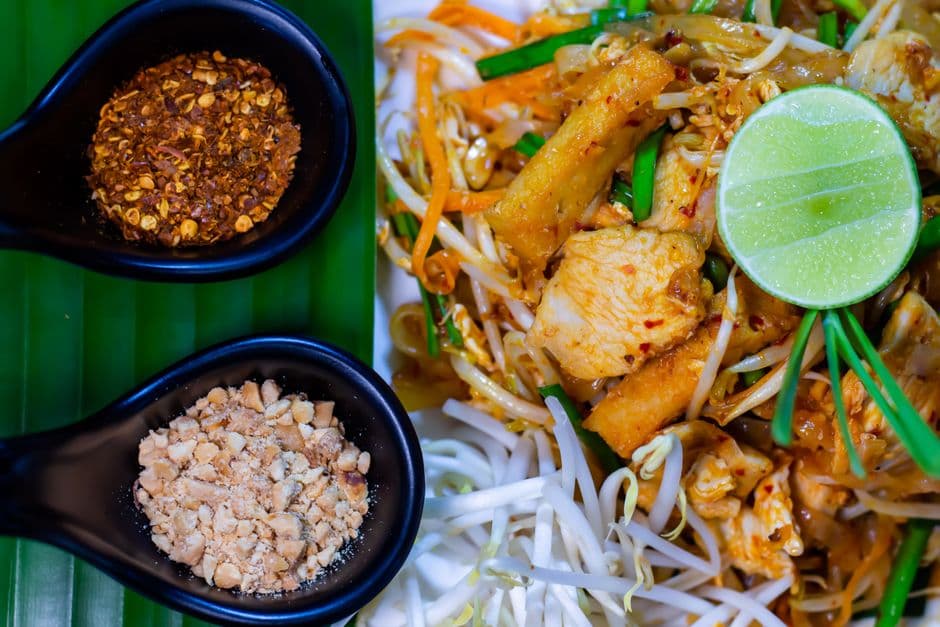
Thailand's most iconic noodle dish — tamarind-sweet, salty, and tangy stir-fried rice noodles with peanuts and lime.
Pad Thai is arguably Thailand's most recognized dish internationally, a stir-fried noodle dish that balances the four fundamental flavors of Thai cuisine: salty (from fish sauce), sour (from tamarind and lime), sweet (from palm sugar), and spicy (from dried chili). The dish traditionally uses dried, flat rice noodles (about 5–8 mm wide), stir-fried over very high heat with a simple protein (shrimp, chicken, tofu, or a combination), along with protein (eggs), aromatics (garlic), and vegetables (scallions, bean sprouts, Chinese chives). The sauce is made from a balance of tamarind paste, fish sauce, and palm sugar, adjusted to taste. The finished dish is topped with roasted peanuts, lime wedges, and fresh bean sprouts, giving it contrasts of texture and flavor. Pad Thai is street food in Thailand, served from carts and small shops, and while the basic recipe is consistent, each vendor has a slightly different version depending on how they balance the sauce and what proteins they use. The dish relies on high heat (a wok is ideal), quick cooking, and precise timing — the noodles can go from perfect to overcooked in seconds.
Serves 2
Place dried rice noodles in a bowl and soak in room-temperature water for 20–30 minutes until pliable but still firm. The noodles should bend without breaking but still have a bit of firmness — they will soften more during stir-frying. Drain well before cooking.
In a small bowl, whisk together tamarind paste, fish sauce, and palm sugar until the sugar dissolves and the sauce is smooth. Taste and adjust — it should balance salty, sour, and sweet with no single flavor dominating. This is your sauce base and can be made ahead.
Have all ingredients prepped and ready (mise en place) — once the wok heats up, you'll work quickly. Mince garlic, cut protein, chop chives, crush peanuts, and have noodles drained and ready.
Place a wok or large skillet over high heat until it's screaming hot — you should see heat waves rising. The wok must be very hot for the noodles to fry, not steam. Add 1 tbsp of oil.
Add minced garlic and let it sizzle for 5 seconds (don't let it burn). Add the protein (shrimp, chicken, or tofu) and stir-fry for 1–2 minutes until cooked through or starting to brown. If using shrimp, cook until they turn pink. If using chicken, cook until no longer pink inside.
Push the cooked protein to the side of the wok. Pour the beaten eggs into the empty space and let them set for 10 seconds. Scramble lightly with a spatula, breaking into small pieces. Do not fully cook — the eggs should still be slightly wet.
Add the drained rice noodles and the prepared sauce to the wok. Using two spatulas or a spatula and tongs, toss and stir constantly for 2–3 minutes. The noodles should become tender and evenly coated with sauce. If the noodles seem too dry, add a splash of water; if too wet, keep tossing until liquid reduces.
Add the chives or scallions and half the bean sprouts. Toss for 30 seconds until the vegetables are hot but still have a slight crunch. Do not overcook — bean sprouts should remain fresh and crisp.
Take a noodle and taste it. Adjust the flavor — add more fish sauce for saltiness, lime juice for sourness, sugar for sweetness, or chili for heat. It should taste bright and balanced.
Plate immediately into two bowls. Top with remaining fresh bean sprouts, crushed peanuts, and a lime wedge. Sprinkle with dried chili flakes if desired. Serve with extra lime wedges and additional fish sauce/chili paste on the side for diners to adjust to taste.
The noodles must be soaked but not overcooked before the wok — they should still have firmness and will finish cooking in the wok.
High heat is essential. If the wok isn't hot enough, the noodles will steam and become mushy instead of frying. Let the wok get smoking hot.
Work quickly once the noodles are in the wok — the whole stir-fry from adding noodles to plating should take 3–4 minutes maximum.
Taste constantly and adjust — Thai food is about balance and personal preference. Each person may want different amounts of lime, chili, or fish sauce.
With cashews — add roasted cashews instead of or in addition to peanuts for a different texture.
Extra spicy — add fresh Thai chilies, sliced, or increase the chili flakes.
Vegetarian pad thai — omit the protein or use only eggs and tofu, use vegetable broth instead of fish sauce (less traditional but works).
With seafood — use shrimp, squid, and mussels together for a richer dish.
Pad thai is best eaten immediately, while the noodles are still hot and the vegetables are crisp. Leftovers can be stored in the refrigerator for up to 2 days and reheated gently in a wok or skillet with a splash of water, though the texture deteriorates.
Pad Thai became the national dish of Thailand in the 1930s–1940s, promoted by the Thai government as a way to unify the nation around a shared cuisine and reduce rice consumption (due to rice shortages). The dish is actually a relatively modern creation, combining Chinese stir-frying techniques with Thai flavors. Today, it is served everywhere in Thailand and has become Thailand's most recognized dish internationally.
Tamarind is the pulp of a tropical fruit with a sour flavor. Tamarind paste (concentrate) is available in Asian markets and online. It's essential to authentic pad thai — lime juice is not a good substitute as it has a different flavor profile.
Fresh (wet) rice noodles are thicker and softer — they're different from dried noodles. They can be used but require less cooking time (just 30–60 seconds in the wok) and will have a different texture. Dried noodles are more traditional for pad thai.
Likely, the sauce wasn't balanced. Check that you have all four flavors: salt (fish sauce), sour (tamarind), sweet (sugar), and spice (chili). Adjust each to taste.
Yes, fish sauce provides crucial umami and saltiness. There is no good substitute for authentic pad thai. If you cannot eat it, the dish becomes very different.
Per serving (380g / 13.4 oz) · 2 servings total
Ask our AI cooking assistant anything about this recipe — substitutions, techniques, scaling.
Chat with AI Chef →Join the conversation
Sign in to leave a comment and save your favourite recipes