
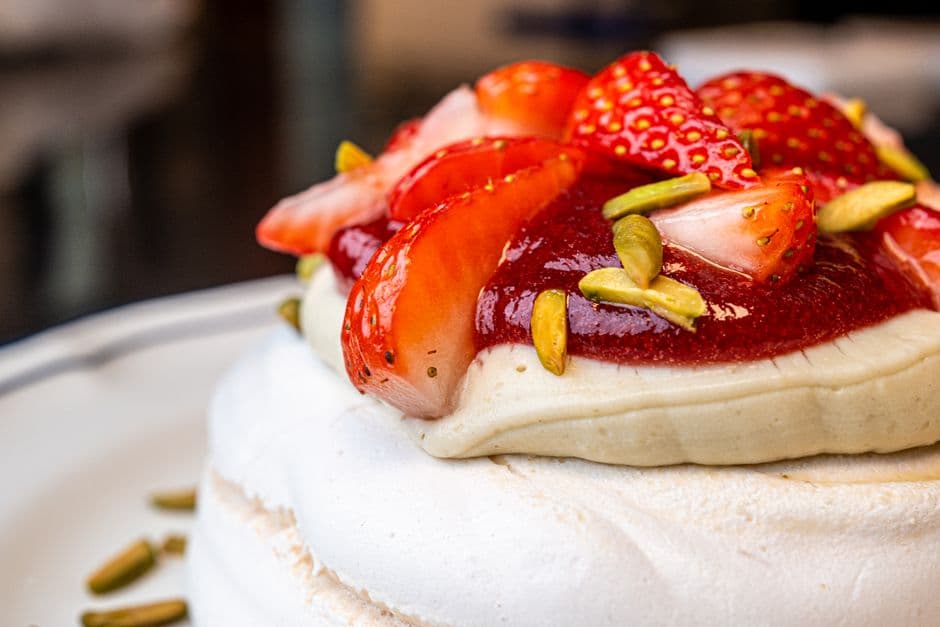
New Zealand Pavlova (Crisp-Shell Soft-Center Meringue)
A snow-white meringue with a marshmallowy soft center and crisp shell, crowned with whipped cream and a riot of summer fruit — NZ's national dessert.
About This Recipe
The pavlova — a large round meringue with a crisp outer shell and a soft, marshmallow-like interior, topped with whipped cream and fruit — is the dessert that Australia and New Zealand have fought over for nearly a century. Both nations claim its invention in honor of Russian ballerina Anna Pavlova during her 1926 tour, but Helen Leach's 2008 book The Pavlova Story produced documentary evidence that placed the first recognizable recipe in a 1929 New Zealand cookbook, settling the debate (at least in Kiwi eyes). Whatever its origin, pavlova has become the ceremonial summer dessert of both countries — at every Christmas table, every Boxing Day picnic, every Waitangi Day barbecue. The technique is straightforward but requires patience: egg whites are whipped to stiff peaks with caster sugar, stabilized with cornflour and vinegar (the secret to the marshmallow center), shaped into a low disc on parchment paper, and baked at a very low temperature for over an hour, then cooled in the closed oven for another hour to prevent cracking. The result is a fragile snow-white shell that shatters under the spoon to reveal a tender, almost-set-meringue interior, topped lavishly with softly whipped cream and a tumble of strawberries, raspberries, passionfruit, kiwifruit and whatever else summer provides. It is at once humble (5 ingredients) and showstopping.
Ingredients
Serves 8
- 6 largeegg whites (about 200 g), at room temperature
- 300 gcaster sugar (superfine sugar)
- 2 tspcornflour (cornstarch)
- 1 tspwhite vinegar (or lemon juice)
- 1 tspvanilla extract
- 1 pinchsalt
- 500 mldouble (heavy) cream
- 2 tbspicing sugar
- 1 tspvanilla extract (for cream)
- 250 gstrawberries, hulled and halved
- 150 graspberries
- 2kiwifruit, peeled and sliced
- 4passionfruit, pulp scooped
Instructions
- 1
Prepare the oven and tray
Preheat oven to 150°C (300°F). Line a baking tray with parchment paper and draw a 22 cm circle on the back of the paper with a pencil as a guide (flip the paper so the pencil mark is underneath). Make sure the bowl and whisk are spotlessly clean — any trace of fat kills meringue.
- 2
Whip the egg whites
Place egg whites and a pinch of salt in the bowl of a stand mixer. Whip on medium-high speed 2 minutes until soft peaks form — the whites should look like shaving foam, not lemon meringue topping. Don't rush this stage; whites at soft peaks accept sugar much better.
- 3
Add sugar gradually
With the mixer running on medium-high, add caster sugar 1 tablespoon at a time over 5–6 minutes — never more than a tablespoon at a time or the meringue will collapse. When all the sugar is in, whip another 5 minutes until the meringue is thick, glossy and stands in stiff peaks when the whisk is lifted.
Rub a pinch of meringue between thumb and finger — if you feel grittiness from undissolved sugar, whip another 2 minutes. Properly whipped pavlova meringue should feel completely smooth.
- 4
Fold in stabilizers
Sift the cornflour over the meringue and add the vinegar and vanilla. Fold in gently with a large rubber spatula in 6–8 sweeps — just enough to combine, no more. The cornflour and vinegar are what give pavlova its signature marshmallow center; without them you just have a meringue cookie.
- 5
Shape on the tray
Spoon the meringue onto the parchment within the drawn circle. Use the back of a spoon to shape into a round disc about 6 cm tall, with the top slightly hollowed in the center and the sides showing decorative swooping marks. The hollow holds the cream later.
- 6
Bake low and slow
Reduce oven temperature to 120°C (250°F) immediately when you put the pavlova in — this drop is what produces the crisp shell and soft center. Bake 75 minutes without opening the door. The pavlova should be pale ivory (not browned) and feel firm on the outside when gently tapped.
- 7
Cool in the oven
Turn off the oven and prop the door open slightly with a wooden spoon. Let the pavlova cool inside the oven for at least 1 hour or until completely cold — this gradual cooling prevents the meringue from cracking dramatically. Some cracks are normal and even beautiful.
- 8
Assemble and serve
Just before serving (not earlier — assembled pavlova softens within 30 minutes), whip the cream with icing sugar and vanilla to soft peaks. Transfer the cooled pavlova carefully to a serving plate. Pile the whipped cream into the central hollow, top with strawberries, raspberries and kiwi, and drizzle with passionfruit pulp. Bring to the table whole and cut into wedges with a sharp knife.
Did you make this?
Rate it and help other cooks find the recipes that actually work.
One tap to sign in, and we'll save the rating you just picked.
Everything you need to plan your week — free
- Meal calendar
- Grocery list
- AI recipe ideas
Track what you eat
Snap your meal to log calories and macros, run fasting timers and track water in the free SnapCal app.
Pro Tips
- →
Use room-temperature egg whites — cold whites whip to less volume. Crack the eggs straight from the fridge and let the whites sit covered 30 minutes before whipping.
- →
Even a speck of egg yolk or grease will prevent meringue from whipping. Wipe the bowl and whisk with a paper towel dipped in vinegar before starting.
- →
Don't open the oven door during baking or cooling — the temperature shock causes cracks. Resist the urge to peek.
- →
Assemble pavlova within 30 minutes of serving — the meringue stays crisp but softens once the cream touches it. The fully assembled dessert is best within 2 hours.
Variations
- •
Chocolate pavlova — fold 2 tbsp cocoa powder into the meringue with the cornflour, drizzle with chocolate ganache.
- •
Mini pavlovas — pipe 8 individual 10 cm discs and bake 45 minutes; perfect for dinner parties.
- •
Lemon curd pavlova — replace half the cream with lemon curd folded into whipped cream.
- •
Tropical pavlova — use mango, papaya, passionfruit and toasted coconut for an Auckland summer version.
Storage
Unfilled meringue base keeps 2 days in an airtight container at room temperature (do not refrigerate — humidity softens it). Assembled pavlova is best eaten within 4 hours; refrigerated leftovers soften completely within 24 hours but are still delicious in a melty, bread-pudding way. Do not freeze.
History & Origin
The pavlova was created in honor of ballerina Anna Pavlova's 1926 tour of Australia and New Zealand. Helen Leach's 2008 research traced the first published recipe to New Zealand's Davis Dainty Dishes (1929), giving Kiwis the strongest historical claim despite competing Australian assertions. The dessert became a fixture of Christmas dinner across both countries during the post-war years.
Frequently Asked Questions
Can I make this without a stand mixer?
Yes, but it's hard work — you'll need a hand mixer and 12–15 minutes of continuous whipping. The whites must reach stiff, glossy peaks, which takes serious motor power.
Why did my pavlova crack?
Some cracking is normal and traditional. Dramatic cracks are caused by opening the oven door, sudden temperature changes, or under-whipped meringue. The good news: cracks disappear under the cream.
Can I make the meringue ahead?
Yes — bake the meringue up to 2 days ahead and store in an airtight container at room temperature. Only assemble (cream and fruit) within hours of serving.
What's the difference from a regular meringue?
Cornflour and vinegar — they create the soft marshmallow center that defines pavlova. A traditional French meringue is crisp all the way through; pavlova is crisp shell, marshmallow middle.
Nutrition Facts
Per serving (180g / 6.3 oz) · 8 servings total
Time Summary
Have Questions?
Ask our AI cooking assistant anything about this recipe — substitutions, techniques, scaling.
Chat with AI Chef →Featured in Guides
This recipe is featured in the following curated guides:
More New-zealand Recipes
You Might Also Like
Similar dishes from other cuisines around the world.
Free Kitchen Tools
Calculators and converters that pair with this page — no signup needed.
Put This Into a Plan
Schedule it, shop for it, and track what you already have.
Community
Join the conversation
Sign in to leave a comment and save your favourite recipes