
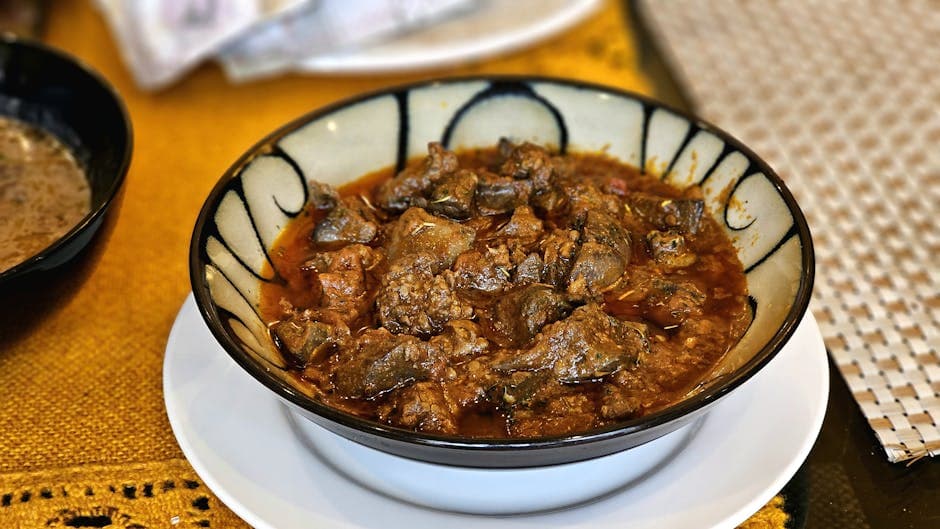
Khoresht-e Bademjan (Persian Lamb and Eggplant Stew)
Iran's beloved tomato-eggplant stew — slow-braised lamb shoulder with fried eggplant, dried limes and saffron in a tart, savory sauce.
About This Recipe
Khoresht-e bademjan is one of Iran's most-loved khoreshts (stews) and a fixture of Persian home tables, especially in the eggplant season of late summer and autumn. The dish layers tender chunks of lamb shoulder with golden-fried eggplant in a tomato-based sauce flavored with turmeric, saffron, and the unmistakable tartness of limoo amani (dried Persian limes) — small, light-as-paper black limes that infuse the stew with an almost-fermented citrus depth that no fresh lime can replicate. The eggplants are salted, drained and shallow-fried separately to a deep gold before being layered into the lamb base in the final 30 minutes — this prevents them from disintegrating into the sauce. Saffron is added in two stages: bloomed with hot water into a golden infusion that dyes the stew, and again as a final flourish over the rice. The dish is always served with chelow — Persian basmati rice with its prized golden tahdig (crisp crust) — and a side of mast-o-khiar (cucumber yogurt). The texture is the signature: tender meat, melting eggplant that holds its shape just enough, and a thick tart-savory sauce that begs to be spooned over rice.
Ingredients
Serves 6
- 800 gboneless lamb shoulder, cut into 3 cm cubes
- 5 mediumglobe eggplants (about 1.2 kg total)
- 2 tbspfine salt, for salting eggplant
- 180 mlneutral oil (vegetable or sunflower), for frying
- 2 largeyellow onions, finely diced
- 4 clovesgarlic, minced
- 2 tspground turmeric
- 1 tspground cinnamon
- 0.5 tspfreshly ground black pepper
- 3 tbsptomato paste
- 400 gcanned crushed tomatoes
- 600 mlwater or light chicken/lamb stock
- 4limoo amani (dried Persian limes), pierced once with a knife
- 1 large pinch (30 strands)saffron threads, ground and steeped in 60 ml hot water
- 1.5 tspfine sea salt
- 2 tbspfresh lime juice (to finish)
- chelow (Persian basmati rice with tahdig), to serve
- mast-o-khiar (cucumber-yogurt) and fresh herbs, to serve
Instructions
- 1
Salt the eggplants
Peel the eggplants in alternating stripes (zebra-style) and cut into 8 cm-long wedges or thick batons. Lay on a tray and salt generously on all sides. Let stand 45 minutes to draw out bitterness and water.
- 2
Press and dry the eggplant
After 45 minutes, the eggplant will have beaded with water. Press each piece between paper towels to remove as much moisture as possible. Eggplant frying requires very dry pieces — wet eggplant absorbs oil dramatically.
- 3
Fry the eggplant
Heat 120 ml of oil in a wide skillet over medium-high. Fry eggplant in batches, 3 minutes per side, until deeply golden — almost mahogany — on each cut face. Transfer to paper towels. Add more oil between batches as needed.
Don't crowd the pan — eggplant steams instead of frying if packed in.
- 4
Brown the lamb
In a heavy Dutch oven, heat 2 tbsp of oil over medium-high. Brown the lamb in batches, 4 minutes per batch, until colored on all sides. Transfer to a plate.
- 5
Build the sauce base
Reduce heat to medium. Add the onions to the pot with another tablespoon of oil and cook 8 minutes until softened and lightly golden. Add the garlic, turmeric, cinnamon and black pepper. Stir 1 minute until fragrant.
- 6
Add tomato
Stir in the tomato paste and cook 90 seconds — the paste should darken slightly and lose its raw smell. Add the crushed tomatoes and stir to combine.
- 7
Braise the lamb
Return the lamb to the pot. Add the water/stock, dried limes, half the saffron infusion and 1.5 tsp salt. Bring to a simmer, then cover and cook 60 minutes on low heat, stirring once or twice.
- 8
Layer the eggplant
After 60 minutes, the lamb should be tender. Arrange the fried eggplant on top of the lamb in a single overlapping layer — do not stir in. Cover and cook another 25–30 minutes until the eggplant has absorbed flavors but still holds its shape.
The eggplant on top steams gently and stays intact. Stirring breaks it apart.
- 9
Finish with saffron and lime
Drizzle the remaining saffron infusion over the eggplant layer. Squeeze in the fresh lime juice. Taste for salt. The sauce should be thick, deeply tart-savory, and the lamb should be falling apart. Discard the dried limes.
- 10
Serve over chelow
Spoon onto plates of Persian chelow basmati rice (with a piece of golden tahdig crust if you have it). Serve mast-o-khiar (yogurt with grated cucumber and dried mint) and a plate of fresh herbs (parsley, basil, mint) on the side.
Did you make this?
Rate it and help other cooks find the recipes that actually work.
One tap to sign in, and we'll save the rating you just picked.
Everything you need to plan your week — free
- Meal calendar
- Grocery list
- AI recipe ideas
Track what you eat
Snap your meal to log calories and macros, run fasting timers and track water in the free SnapCal app.
Pro Tips
- →
Limoo amani (dried Persian limes) are non-negotiable for authentic flavor — find them at Middle Eastern groceries or online (Sadaf brand is good). Substitute 2 tbsp dried lime powder + 2 tbsp lemon zest, plus fresh lime at the end.
- →
Salt and dry the eggplant before frying — this is the single biggest factor in non-greasy, golden eggplant. Skipping this step gives you sad, oil-saturated eggplant.
- →
Use lamb shoulder, not lamb leg — shoulder has the connective tissue and fat needed for a long braise. Leg goes dry and stringy.
- →
Make khoresht-e bademjan a day ahead and reheat — the flavor genuinely peaks 24 hours later as the dried limes finish releasing their character.
Variations
- •
Khoresht-e bademjan with split chickpeas — add 100 g soaked yellow split peas with the lamb for a more rustic, thicker version popular in central Iran.
- •
Vegetarian — replace lamb with king oyster mushrooms and chickpeas; braise the chickpeas in the tomato base 45 minutes before layering eggplant.
- •
Chicken version (khoresht-e bademjan ba morgh) — substitute bone-in chicken thighs; reduces braise time to 35 minutes before adding eggplant.
- •
With ghooreh (sour grapes) instead of dried limes — a regional Caspian variation that's brighter, less smoky-tart.
Storage
Refrigerate up to 5 days — improves dramatically by day 2. Reheat gently in a covered pot; never microwave (turns eggplant gummy). Freezes well 2 months, though the eggplant texture softens slightly on thaw.
History & Origin
Khoresht-e bademjan dates to medieval Persian court cooking, with eggplant (introduced to Iran via India around the 4th century) becoming a staple of Sassanid-era cuisine. The use of dried limes — a Persian Gulf innovation — became widespread in Iranian cooking by the Safavid era (16th-17th century), distinguishing Iranian stews from their Arab and Turkish neighbors.
Frequently Asked Questions
What can I substitute for dried Persian limes?
Use 2 tablespoons of dried lime powder mixed with the zest of 2 fresh limes, plus extra fresh lime juice at the end. The flavor will be close but lacks the unique fermented depth of whole dried limes — worth ordering online if you cook Persian food regularly.
Why is my eggplant greasy?
You either skipped the salt-and-drain step, didn't pat the eggplant dry before frying, or the oil wasn't hot enough. Dry eggplant + hot oil (medium-high) = golden, non-greasy eggplant. Wet eggplant + cooler oil = sad sponges.
Can I bake the eggplant instead of frying?
Yes — brush salted, dried eggplant slices with oil and roast at 220°C for 20–25 minutes until deep golden. The texture is slightly less silky than fried but considerably lighter. Many modern Iranian home cooks do this.
What is tahdig and how do I make it?
Tahdig is the crisp golden crust on the bottom of Persian rice. To make it: parboil basmati rice 5 minutes, drain, layer with butter and saffron-water in a non-stick pot, wrap the lid in a clean towel to absorb steam, and cook 45 minutes on very low heat. Invert onto a plate to reveal the crust.
Nutrition Facts
Per serving (380g / 13.4 oz) · 6 servings total
Time Summary
Have Questions?
Ask our AI cooking assistant anything about this recipe — substitutions, techniques, scaling.
Chat with AI Chef →Featured in Guides
This recipe is featured in the following curated guides:
More Persian Recipes
You Might Also Like
Similar dishes from other cuisines around the world.
Browse by Ingredient
More recipes built around the same core ingredients.
Free Kitchen Tools
Calculators and converters that pair with this page — no signup needed.
Put This Into a Plan
Schedule it, shop for it, and track what you already have.
Read Next
Longer reads that go deeper on the ideas behind this dish.
Community
Join the conversation
Sign in to leave a comment and save your favourite recipes