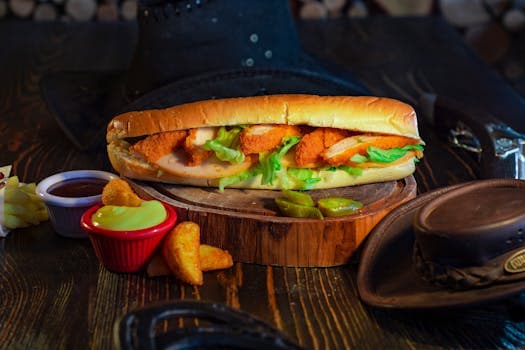
The po-boy is the sandwich that defines New Orleans: an airy loaf of local-style French bread with a shatter-thin crust, stuffed with anything from crackly fried seafood to slow-roasted beef dripping gravy, and dressed with shredded lettuce, tomato, pickles, and mayonnaise. Born during the 1929 streetcar strike, when the Martin brothers fed striking poor boys for free, it remains democratic food — sold at corner groceries, gas stations, and white-tablecloth restaurants alike. This master recipe covers the dressed fried-filling formula that works for shrimp, oysters, catfish, or hot roast beef, with the bread treated as reverently as the filling.
Serves 4
Choose and prepare your filling: soak seafood in seasoned buttermilk and set up a cornmeal-flour dredge, or warm sliced roast beef in its gravy. Stir together mayonnaise, Creole mustard, and hot sauce for the spread.
For fried fillings, heat oil to 350°F and fry the dredged seafood in batches for 2 to 3 minutes until golden and crisp, draining on a wire rack and salting immediately while hot.
Split light French bread loaves lengthwise and toast briefly under the broiler, 1 to 2 minutes, until the crust crisps but the crumb stays soft. Spread both faces generously with the mayonnaise mixture.
The bread is half the sandwich; if your loaf is dense and chewy, lighten it by toasting and removing some interior crumb.
Load the hot filling onto the bread and dress fully: shredded iceberg, thin tomato, and dill pickle rounds. Close, press lightly, halve on the diagonal, and serve with hot sauce on the side.
Add pickles directly against the meat or seafood so their brine cuts the richness in every bite.
Seek out the lightest French loaf available; New Orleans bread is closer to a cloud than a baguette.
Always dress it fully unless someone objects — lettuce, tomato, pickle, mayo is the default.
Serve immediately; a po-boy waits for no one once the hot filling meets the bread.
Roast beef po-boys should be messy; ladle extra gravy and serve with napkins.
Toast the bread cut-side only, keeping the outside crust intact and brittle.
Roast beef debris: chuck slow-cooked until collapsing, chopped into its own gravy.
Hot sausage po-boy: spicy Creole hot sausage patties, a beloved neighborhood order.
French fry po-boy: the Depression-era original, fries and gravy on bread.
Surf and turf: half fried shrimp, half roast beef, gravy over everything.
Assembled po-boys do not keep; eat within the hour. Fillings store separately — fried seafood re-crisps in a 400°F oven for 6 to 8 minutes, and roast beef in gravy keeps 4 days refrigerated.
The po-boy dates to the 1929 New Orleans streetcar strike, when brothers Bennie and Clovis Martin, former conductors themselves, promised free sandwiches to any striking worker and reportedly announced here comes another poor boy as each one arrived. They worked with baker John Gendusa to develop a long, uniform loaf that sliced evenly. A creation of the Creole city rather than Cajun country, the po-boy became New Orleans' everyday sandwich, celebrated each fall at the Oak Street Po-Boy Festival.
Fried shrimp and fried oysters are the seafood icons, with roast beef and gravy the great non-seafood classic. Catfish, hot sausage, ham, and even French fries with gravy are all traditional. The constant is the airy New Orleans French bread and the dressed garnish.
New Orleans French bread has a brittle, paper-thin crust and an extremely light crumb that compresses around the filling instead of fighting it. A chewy baguette forces the filling out the back with each bite. The bread's texture, more than any filling, is what makes a po-boy.
Debris refers to the shreds and scraps of roast beef that fall into the gravy during slow roasting. A debris po-boy piles those gravy-soaked bits onto dressed French bread, creating the wettest, most beloved version of the roast beef po-boy, famously served at Mother's Restaurant.
Yes — fry seafood in batches and hold it crisp on wire racks in a 200°F oven, toast loaves all at once under the broiler, and set out a dressing station of remoulade, lettuce, tomato, and pickles. Assemble just before serving so the bread stays crisp.
Per serving (300g / 10.6 oz) · 4 servings total
Ask our AI cooking assistant anything about this recipe — substitutions, techniques, scaling.
Chat with AI Chef →This recipe is featured in the following curated guides:
Join the conversation
Sign in to leave a comment and save your favourite recipes
Have feedback or need help?
We read every email and reply within 1–2 business days.
© 2026 MyCookingCalendar. All rights reserved.