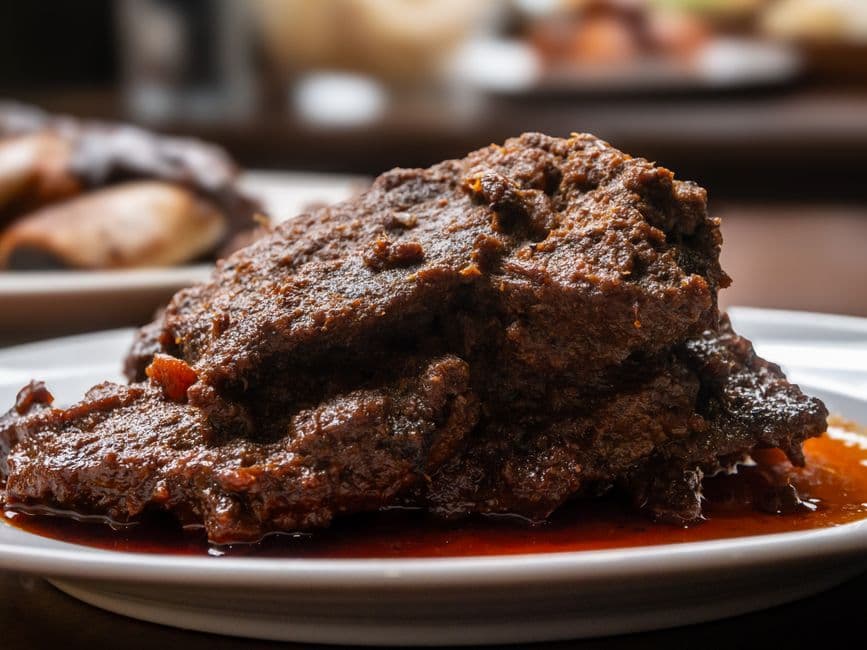
The world's most celebrated dry curry — beef slowly braised for hours in coconut milk and spices until all the liquid evaporates, leaving darkly caramelized, intensely flavored meat.
Rendang is arguably the world's most complex dry curry, voted one of CNN's most delicious foods multiple times. What makes it extraordinary is the cooking process — a wet curry cooked for hours until every drop of moisture evaporates and the meat is surrounded by concentrated spices in caramelized coconut fat. The Minangkabau people of West Sumatra developed this technique as a preservation method in a tropical climate without refrigeration.
Serves 6
Blend dried chilies, shallots, garlic, galangal, and ginger into a smooth paste.
Combine rempah, coconut milk, lemongrass, and kaffir lime leaves in a large wok. Add beef. Bring to boil.
Reduce heat and simmer uncovered for 2–2.5 hours, stirring occasionally. The liquid will gradually reduce.
When liquid is nearly gone, add kerisik, salt, and sugar. Stir-fry constantly for 15–20 minutes until meat is dark and dry.
Patience is everything — the long caramelization at the end is what makes rendang unique
Kerisik (toasted coconut paste) adds essential nutty flavor
Taste and adjust salt at the very end — flavors concentrate as liquids reduce, and a final pinch of flaky salt sharpens the whole dish.
Mise en place pays for itself: chop, measure and pre-mix everything before the heat goes on, especially for any step that moves fast.
Use chicken for faster cooking (45 minutes)
Add potato chunks in the last 30 minutes
Vegetarian: swap the protein for roasted king oyster mushrooms, smoked tofu or cooked chickpeas — adjust seasoning slightly upward to compensate.
Spicier: add a finely chopped fresh chile or a teaspoon of crushed Aleppo/Urfa pepper to the aromatics for warm, layered heat instead of a single sharp hit.
Keeps 1 week refrigerated — the preservation properties improve over time. Freeze up to 3 months.
Rendang originates from the Minangkabau people of West Sumatra, Indonesia, dating back at least 500 years. It spread throughout the Malay world and is now considered a national dish of both Indonesia and Malaysia.
It originates from the Minangkabau people of West Sumatra (Indonesia) but is considered a national dish in both Indonesia and Malaysia.
Yes — most of the components can be prepared up to a day in advance and refrigerated separately. Reheat gently and assemble just before serving so textures stay distinct.
Stay close to the role each ingredient plays: swap aromatics for similar ones (shallot for onion, lime for lemon), and keep the fat-acid-salt balance intact. Spice blends can usually be approximated with what's in the cupboard.
Authenticity sits on a spectrum — what matters more is honoring the technique and balance of flavors. If the dish tastes harmonious and respects how cooks in its home region would build it, you're on solid ground.
Per serving · 6 servings total
Ask our AI cooking assistant anything about this recipe — substitutions, techniques, scaling.
Chat with AI Chef →Join the conversation
Sign in to leave a comment and save your favourite recipes