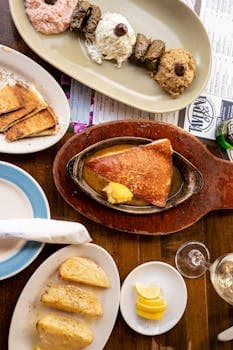
Saganaki is the simplest brilliant idea in Greek cooking: a thick slab of firm cheese — kefalograviera, kasseri, or graviera — dredged in flour and seared in olive oil until a golden crust forms while the inside slumps into warm, salty softness. The whole dish takes five minutes, but technique is everything: the cheese is wetted so the flour adheres into a proper crust, the oil must be properly hot before the cheese touches it, and the finished slab is hit immediately with fresh lemon juice and oregano. In Greek-American restaurants — famously in Chicago — it arrives flaming, doused with brandy and ignited tableside to shouts of 'Opa!' Either way, it must be eaten at once, with bread to drag through the lemony oil.
Serves 4
Cut the cheese into slabs about 1.5cm thick — thick enough that the center stays soft while the outside crisps. Rinse each slice briefly under cold water; the wet surface is what makes the flour cling and form a real crust rather than dusting off in the pan.
Dredge the wet cheese slices in flour, pressing gently so every side and edge is coated, then shake off the excess. The thin flour jacket fries into the golden shell that holds the melting cheese together.
Coat the cheese just before frying, not ahead of time — the flour turns gummy if it sits on the wet surface.
Heat the olive oil in a heavy skillet — cast iron or the traditional small two-handled saganaki pan — over medium-high heat until it shimmers and a pinch of flour sizzles instantly. Cheese added to underheated oil sticks, leaks, and never crusts.
Lay the cheese in the hot oil and fry 1–2 minutes per side, flipping once with a thin spatula, until a deep golden-brown crust forms. Don't overcook: the goal is a crisp shell with a center that's warm and yielding, not a puddle of fully melted cheese.
Flip with confidence in one swift motion — hesitating mid-flip is how the crust tears and the cheese escapes.
For the theatrical version, take the pan off the heat, pour the ouzo or brandy over the cheese, and carefully ignite it with a long match, standing back. Let the flames burn off completely — about 10–15 seconds — before serving.
Always flambé off the heat and away from anything overhead; the alcohol vapor ignites instantly.
Squeeze fresh lemon juice generously over the hot cheese — it will sizzle — then sprinkle with dried oregano and cracked black pepper. Serve immediately in the pan with plenty of crusty bread to scoop up the cheese and lemony oil.
Everything you need to plan your week — free
Cook this hands-free
Get AI meal plans, step-by-step cooking mode, and your saved recipes in the free Bento app.
The cheese must be firm and high-melting-point — kefalograviera, kasseri, graviera, or halloumi. Soft cheeses like feta dissolve in the pan.
Wetting the cheese before flouring is the trick most home cooks miss; dry cheese won't hold its crust.
Get the oil genuinely hot before the cheese goes in — a fast sear keeps the slab intact.
Serve within a minute or two of frying; cooling saganaki stiffens into rubbery cheese with none of its molten charm.
Cut slabs at least 1.5cm thick — thinner slices melt through before a crust can form.
Use halloumi for a squeaky, salty version that holds its shape even more reliably.
Drizzle the finished cheese with honey and sesame seeds for the popular sweet-savory style served in modern Athens tavernas.
Crust the cheese in sesame seeds over the flour for extra crunch and nuttiness.
Add a quick pan sauce of cherry tomatoes and chili after frying for a saganaki-meets-bouyourdi hybrid.
Saganaki doesn't keep — the magic is the contrast of hot crust and molten center, gone within minutes of cooling. Slice and flour-coat the cheese ahead if you like, but fry only at the moment of serving.
Saganaki takes its name not from the cheese but from the sagani, the small two-handled pan it's fried and served in, a word with roots in Ottoman-era cookware. Pan-fried cheese has long been a taverna staple across Greece. The flaming brandy version is a Greek-American invention, popularized in Chicago's Greektown restaurants in the late 1960s, where the tableside fireball and the shout of 'Opa!' became inseparable from the dish.
No — feta is too soft, moist, and crumbly to survive pan-frying; it slumps and dissolves rather than forming a crust around a molten center. Stick to firm Greek cheeses with high melting points: kefalograviera is the classic, kasseri is milder and creamier, and graviera works beautifully. Halloumi, though Cypriot, is the most widely available substitute and behaves perfectly.
Greek and Mediterranean grocers carry both, and many supermarket specialty cheese counters stock at least one. Look for firm, pale-yellow wheels or wedges. If neither appears, halloumi is sold almost everywhere and fries identically, or try Italian provolone or Mexican queso para freír — any firm, salty cheese that browns before fully melting will give you the saganaki experience.
Not at all — flaming saganaki is Greek-American restaurant theater, invented in Chicago, not how it's served in Greece, where the cheese arrives simply golden with lemon. The flambé burns off the alcohol and adds a faint brandy caramel note, but the dish loses nothing without it. If you do flambé, do it off the heat, use a long match, and keep a lid nearby to smother flames.
Either the cheese was wrong (too soft or low-melting — see the feta warning), the slices were cut too thin, or the oil wasn't hot enough, letting the cheese heat through before a crust could form. Use firm cheese in 1.5cm slabs, get the oil shimmering hot, and fry briefly — 1–2 minutes per side is all a proper crust needs.
Per serving (130g / 4.6 oz) · 4 servings total
Ask our AI cooking assistant anything about this recipe — substitutions, techniques, scaling.
Chat with AI Chef →This recipe is featured in the following curated guides:
Join the conversation
Sign in to leave a comment and save your favourite recipes
Everything you need to plan your week — free
Have feedback or need help?
We read every email and reply within 1–2 business days.
© 2026 MyCookingCalendar. All rights reserved.