
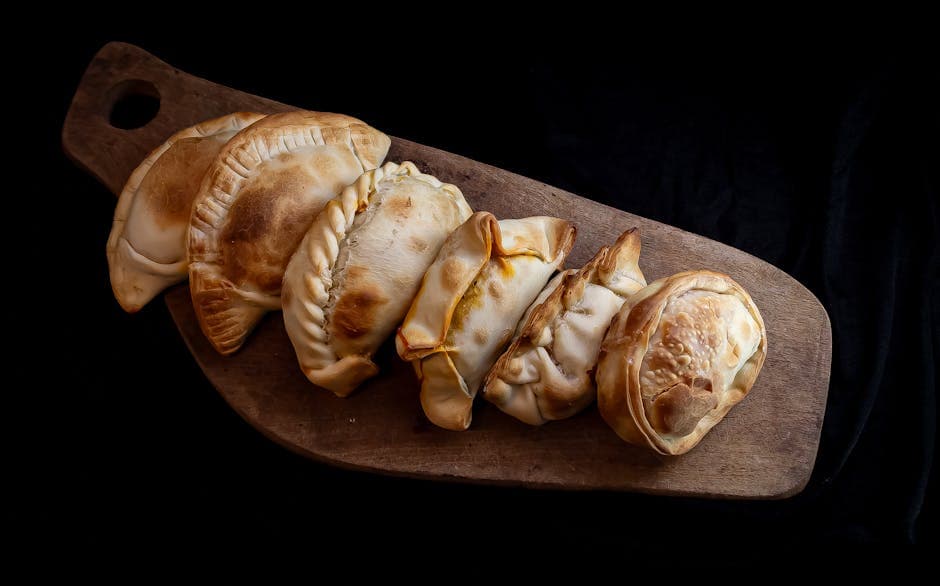
Salteñas (Bolivian Baked Empanadas)
Bolivia's juicy breakfast empanadas with stew-filled centers, sweet-savory pastry, and a signature standing-up eating ritual.
About This Recipe
Salteñas are Bolivia's most distinctive empanada and one of South America's great street foods: a slightly sweet, golden-baked pastry shell shaped like a football, filled with a chunky, soupy stew of beef or chicken, potatoes, peas, olives, raisins, and hard-boiled egg. The trick — and the source of their fame — is the broth: the stew is set with gelatin and chilled to a jelly before filling, then melts during baking into a savory soup trapped inside the crust. Bolivians eat salteñas standing up before 11 am, bite the top corner, sip the broth, then eat the rest with their hands. They are never eaten at dinner — a salteña after noon is a foreigner's mistake.
Ingredients
Serves 12
- 500 gbeef chuck, finely diced (or chicken thigh)
- 2 tbspneutral oil
- 1 largewhite onion, finely diced
- 3 tbspaji panca paste (or 2 tbsp paprika + 1 tsp cayenne)
- 1 tspground cumin
- 0.5 tspground oregano
- 0.5 tspground black pepper
- 1 tbspsugar
- 2 tspsalt
- 500 mlbeef stock
- 200 gpotato, finely diced
- 150 gfrozen peas
- 10 gpowdered gelatin (3 packets)
- 3hard-boiled eggs, finely chopped
- 60 ggreen olives, pitted and chopped
- 40 graisins
- 500 gall-purpose flour
- 80 glard or cold butter, cubed
- 2 tbspsugar
- 1 tspsalt
- 0.5 tspground annatto (achiote) for color
- 180 mlwarm water
- 1egg yolk + 1 tbsp milk, for wash
Instructions
- 1
Make filling
Heat oil; sauté onion 5 minutes until soft. Add aji panca, cumin, oregano, pepper, sugar; toast 1 minute. Add beef and brown 3 minutes. Stir in stock, salt, and potatoes. Simmer 25 minutes until potato is tender.
- 2
Add gelatin
Off heat, sprinkle gelatin over filling and stir until fully dissolved. Stir in peas. Cool, then spread on a tray and refrigerate at least 4 hours, ideally overnight, until set to a chunky jelly.
The gelatin is the secret — without it the filling leaks during baking and the salteña fails.
- 3
Make dough
Rub flour, sugar, salt, annatto, and lard until sandy. Add warm water; knead 5 minutes to a smooth, elastic dough. Wrap and rest 30 minutes.
- 4
Add inclusions
Once filling is firm-set, stir in chopped egg, olives, and raisins. The mixture should hold together but still be cold from the fridge.
- 5
Shape
Divide dough into 12 balls. Roll each to a 14 cm disc, slightly thicker in the center.
Thinner edges seal better; thicker centers stop the broth from breaking through.
- 6
Fill
Place 3 tbsp filling on each disc, slightly off-center. Fold the dough over to form a half-moon. Pinch the seam firmly, then crimp by twisting the edge into a rope along the top — this repulgue ridge is the salteña's signature.
Work quickly so the gelatin doesn't melt; if it softens, return tray to fridge.
- 7
Egg wash and bake
Place salteñas on a parchment-lined tray. Brush with egg yolk wash. Bake at 220°C for 18–22 minutes until deep golden and shiny.
- 8
Eat with the ritual
Eat immediately, standing up. Bite the top corner first, sip the molten broth before it cools, then eat the rest with hands.
Did you make this?
Rate it and help other cooks find the recipes that actually work.
One tap to sign in, and we'll save the rating you just picked.
Everything you need to plan your week — free
- Meal calendar
- Grocery list
- AI recipe ideas
Cook this hands-free
Get AI meal plans, step-by-step cooking mode, and your saved recipes in the free Bento app.
Pro Tips
- →
Aji panca paste is the authentic Bolivian heat — paprika+cayenne is a workable substitute but the flavor is fruitier with real aji.
- →
Don't skip the annatto in the dough — it's what gives salteñas their characteristic golden-orange shell.
- →
Bake on the bottom rack of your oven so the bottom crusts before the top over-browns — a soggy bottom is the cardinal failure.
Variations
- •
Salteñas de pollo: substitute chicken thigh for beef.
- •
Vegetarian: use mushroom and lentil base; gelatin can be replaced with agar-agar (use half the weight).
- •
Tarijeña-style: spicier, with more aji and less sugar in the dough.
Storage
Best the day they're baked. Unbaked filled salteñas freeze well 1 month — bake from frozen, adding 5 minutes. Reheat baked ones at 180°C for 6 minutes (microwave murders them).
History & Origin
Salteñas were created in Potosí in the early 19th century by Juana Manuela Gorriti, an exiled Argentinian writer from Salta — hence the name 'salteña' meaning 'from Salta'. The gelatin-set filling technique she devised remains unchanged 200 years later.
Frequently Asked Questions
Why does my salteña filling leak out?
The gelatin wasn't fully set, the dough seam wasn't pinched tightly enough, or you put too much filling. Filling must be cold and jelly-firm; seal seams firmly, then crimp.
Can I make salteñas without gelatin?
No — the gelatin is what makes a salteña a salteña. Without it you have a regular empanada with leaky filling. Agar-agar can substitute for vegetarians.
What is aji panca?
Aji panca is a dried red Peruvian chili (also widely used in Bolivia) — fruity, smoky, only mildly hot. Sold as paste at Latin markets. Closest substitute: smoked paprika plus a pinch of cayenne and a drop of vinegar.
Why only in the morning?
Salteñas were originally a workers' second breakfast, and Bolivian custom treats them as a strictly pre-noon food. Selling them after lunchtime is considered improper by many traditional areperas.
Nutrition Facts
Per serving (150g / 5.3 oz) · 12 servings total
Time Summary
Have Questions?
Ask our AI cooking assistant anything about this recipe — substitutions, techniques, scaling.
Chat with AI Chef →Featured in Guides
This recipe is featured in the following curated guides:
More Bolivian Recipes
You Might Also Like
Similar dishes from other cuisines around the world.
Free Kitchen Tools
Calculators and converters that pair with this page — no signup needed.
Put This Into a Plan
Schedule it, shop for it, and track what you already have.
Read Next
Longer reads that go deeper on the ideas behind this dish.
Community
Join the conversation
Sign in to leave a comment and save your favourite recipes