
Salteñas (Bolivian Soup-Filled Baked Empanadas)
Sweet, slightly crisp baked dough enclosing a juicy, almost-soup filling of beef, potato, peas, olives and hard-boiled egg in a gelatin-thickened broth — Bolivia's beloved mid-morning snack.
About This Recipe
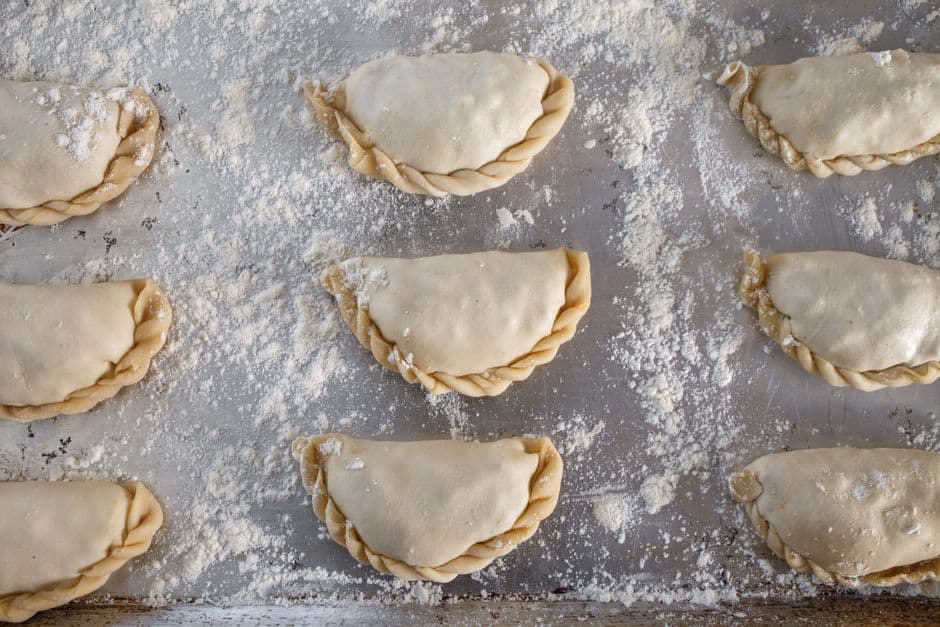
Salteñas are Bolivia's most distinctive culinary export and one of the great empanadas of South America. What sets them apart from Argentine or Chilean empanadas is the filling: where most empanadas are filled with a dry-ish mixture of meat and vegetables, salteñas contain what is essentially a thick, gelled soup. Cooks make a rich, spiced beef-and-vegetable jugo (juice) seasoned with cumin, sweet paprika, aji panca and a touch of sugar, then thicken it with gelatin or unflavoured agar and chill the mixture overnight until it sets into a sliceable jelly. The set jelly is spooned, in cube form, into rounds of slightly sweet wheat dough along with a piece of hard-boiled egg, an olive, a chunk of potato and a few peas; the dough is folded into a half-moon and pleated along the seam with a distinctive raised repulgue — the salteña braid — that runs across the top like a small rope. When baked at high heat, the gelatin melts inside, the dough sets golden and barely crisp, and what was solid becomes a torrent of fragrant broth on the first bite. The art of eating a salteña is its own ritual: hold it upright by the pinched end, bite carefully off the tip, and sip the hot juice before it pours down your wrist. Sold from street carts and dedicated salteñerias every morning across La Paz, Cochabamba, Santa Cruz and Sucre, salteñas are Bolivia's beloved late-morning snack — eaten with a small cup of strong coffee, never as a meal, never after midday.
Ingredients
Serves 12
- 500 gbeef chuck, cut into 1 cm cubes (the filling)
- 300 gwaxy potato, peeled and cut into 1 cm cubes
- 150 gfrozen peas, plus 12 pitted black olives and 3 hard-boiled eggs (quartered)
- 2 tbspaji panca paste plus 1 tsp ground cumin and 1 tsp sweet paprika
- 12 gpowdered unflavoured gelatin (one envelope)(essential for the soup-jelly)
- 500 gall-purpose flour, plus 1 tsp salt and 1 tbsp sugar (the dough)
- 120 glard or unsalted butter, melted (the dough)
- 200 mlwarm water mixed with 1 tsp annatto powder (the dough)
- 1egg yolk beaten with 1 tbsp water (egg wash)
- sea salt, beef stock, white sugar, and white pepper
Instructions
- 1
Make the jugo filling (day before)
In a heavy pot over medium heat, melt 2 tbsp lard. Add 1 finely chopped onion and cook 6 minutes until soft. Add aji panca paste, cumin, paprika and 1 tsp sugar and toast 60 seconds. Add the beef cubes and brown 5 minutes. Add 400 ml beef stock, the potato cubes and ½ tsp salt. Simmer covered 25 minutes until potato is tender and meat is just cooked through. Stir in peas. Taste — should be assertively spiced and lightly sweet.
- 2
Set with gelatin
Bloom gelatin in 50 ml cold water 5 minutes, then stir into the hot filling until fully dissolved. Pour into a shallow rectangular tray, cool to room temperature, then refrigerate 6 hours or overnight until firmly set into a sliceable jelly.
- 3
Make the dough
In a large bowl, mix flour, salt and sugar. Make a well, pour in the melted lard/butter and the warm annatto water. Mix to a soft, slightly tacky dough, then knead on a floured surface 6 minutes until smooth and elastic. Wrap and rest 30 minutes — gives a tender, pliable dough.
- 4
Cut and fill
Divide dough into 12 balls (about 60 g each). Roll each into a 14 cm round, slightly thicker in the centre than the edges. Cut the set jelly into 12 cubes (about 70 g each). Place a jelly cube in the centre of a round, top with a quarter of egg, an olive, and a few extra peas if you like.
- 5
Fold and pleat the repulgue
Bring the dough edges up over the filling and pinch firmly along the top seam. Starting at one end, fold a small flap of dough over and pinch; continue along the entire seam, folding each new flap over the last, creating a raised twisted braid that runs from one tip to the other. This braid is the signature salteña look — and it must be tight, or the juice will leak.
- 6
Chill and egg-wash
Arrange salteñas on a parchment-lined baking sheet, seam side up. Refrigerate 20 minutes to firm the dough and re-set the jelly. Brush all over with egg wash for a deep mahogany finish.
Chilling before baking is what prevents leaks — never skip it.
- 7
Bake hot
Heat oven to 220°C / 425°F. Bake 18–22 minutes until deeply golden and slightly puffed. The gelatin inside has now melted back into hot soup. Rest 5 minutes before serving — the jugo is volcanically hot inside.
- 8
Eat correctly
Hold by the pinched end like a small horn, bite a small opening at the tip, and sip the hot juice first before eating the dough and filling. Serve with a small cup of strong black coffee — never as a full meal, only mid-morning between 10 and noon, as Bolivians do.
Did you make this?
Rate it and help other cooks find the recipes that actually work.
One tap to sign in, and we'll save the rating you just picked.
Everything you need to plan your week — free
- Meal calendar
- Grocery list
- AI recipe ideas
Cook this hands-free
Get AI meal plans, step-by-step cooking mode, and your saved recipes in the free Bento app.
Pro Tips
- →
The gelatin step is non-negotiable — without it the filling leaks and you get dry empanadas, not salteñas.
- →
Aji panca paste is a smoky, mild Peruvian-Bolivian red chilli paste; if unavailable, sub 1 tbsp smoked paprika plus 1 tsp tomato paste.
- →
Annatto in the dough water gives the signature orange-gold colour; substitute with a pinch of turmeric or saffron in a pinch.
- →
Bake on the lowest oven rack to fully set the bottom dough before the top browns — prevents leaky bottoms.
Variations
- •
Salteñas de pollo — replace beef with poached shredded chicken thigh for a milder version popular with children.
- •
Sucre-style — add raisins and a single peanut to each salteña for a sweeter version typical of the colonial capital.
- •
Salteñas vegetarianas — swap meat for cooked quinoa and finely diced carrot plus extra peas.
- •
Tarija version — add a small slice of chorizo to each for a spicier, smokier southern Bolivian take.
Storage
Best eaten the day they're baked. Refrigerate baked salteñas up to 3 days; reheat in 180°C / 360°F oven 8 minutes. Unbaked filled and pleated salteñas freeze beautifully on a tray, then bagged — bake from frozen at 220°C / 425°F for 28 minutes.
History & Origin
Salteñas were created in Bolivia in the early 19th century by Juana Manuela Gorriti, an Argentinian writer exiled in Bolivia during the Rosas dictatorship; she sold soup-filled empanadas in Tarija and Potosí to support her family. Locals called them 'las empanadas de la salteña' (the empanadas of the woman from Salta), and the name stuck — they are now Bolivia's national snack.
Frequently Asked Questions
Why does the filling have to be jellied?
If you add raw soup to dough, it leaks and steams the dough mushy. Setting the soup with gelatin lets you handle it as solid cubes; it melts back to liquid only inside the sealed baked dough.
Can I use a tortilla press?
No — salteña dough must be slightly thicker in the centre to support the soup, which a press makes uniformly thin. Hand-roll each one.
Can I deep-fry them instead?
Then they become tucumanas, a different (also delicious) Bolivian dish. True salteñas are always baked.
My braid keeps falling apart — help?
Either dough is too dry (brush seam with water before pleating) or you're not pinching firmly enough. Practice: every Bolivian abuela needed three attempts to learn.
Nutrition Facts
Per serving (160g / 5.6 oz) · 12 servings total
Time Summary
Have Questions?
Ask our AI cooking assistant anything about this recipe — substitutions, techniques, scaling.
Chat with AI Chef →Featured in Guides
This recipe is featured in the following curated guides:
More Bolivian Recipes
You Might Also Like
Similar dishes from other cuisines around the world.
Free Kitchen Tools
Calculators and converters that pair with this page — no signup needed.
Put This Into a Plan
Schedule it, shop for it, and track what you already have.
Read Next
Longer reads that go deeper on the ideas behind this dish.
Community
Join the conversation
Sign in to leave a comment and save your favourite recipes