
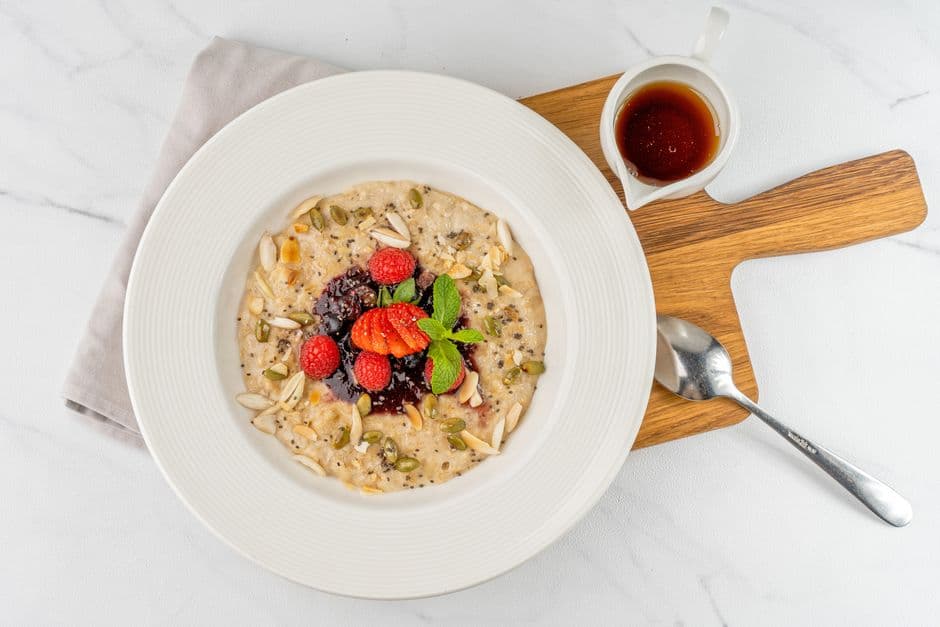
Scottish Porridge with Raspberry & Heather Honey
Proper Scottish porridge — pinhead oats slow-stirred with water and salt into a creamy, savory base, topped with crushed raspberries, double cream and a drizzle of heather honey.
About This Recipe
Real Scottish porridge bears almost no relation to the instant-oats-in-microwave version that passes for porridge in most modern kitchens. It is made with pinhead oatmeal — chunks of whole oat groats roughly chopped, never rolled — cooked slowly in water with only a pinch of salt for thirty to forty minutes, stirred constantly with a wooden spurtle (a Scottish stirring stick said to keep the porridge from going lumpy and from picking up a metallic taste). The result is creamy without any cream, with discrete bits of toothsome oat suspended in a silky base, deeply savory and nutty in a way modern porridge has long forgotten. Tradition dictates that the porridge be eaten standing up, from a wooden bowl, dipped in a separate cup of cold milk or cream rather than mixed in; the contrast of hot oats and cold dairy is essential to the experience. Sugar was historically forbidden by Highland custom — porridge was breakfast or supper, a savory meal — but modern Scots have relaxed the rule, and a drizzle of dark heather honey, a handful of crushed Scottish raspberries (Tayberries and Glen Moy raspberries from Perthshire are world-class), and a generous spoon of thick double cream now transforms breakfast porridge into something that competes with the best European bowls. This is the breakfast that powered Scottish farmers, fishermen and shipwrights for centuries, and it remains the official breakfast of competitors at the World Porridge Making Championships held annually in Carrbridge, Scotland.
Ingredients
Serves 2
- 100 gScottish pinhead oatmeal (steel-cut, coarse)(Hamlyn's or Mornflake are widely available)
- 500 mlcold water
- 0.5 tspfine sea salt
- 200 gfresh raspberries (or thawed frozen)
- 1 tbspdemerara or muscovado sugar (optional, for the raspberries)
- 120 mldouble cream or whole milk, very cold, to serve
- 2 tbspScottish heather honey (or any dark wildflower honey)
- 1 tbsptoasted pinhead oats, to garnish (optional)
Instructions
- 1
Soak the oats (optional but recommended)
Combine the pinhead oatmeal with the water in a heavy saucepan and let stand at room temperature 30 minutes, or overnight in the refrigerator. This hydration shortens cooking time and produces a creamier finished texture. Skip if you forgot — just expect a slightly longer cook.
- 2
Bring to a boil
Place the soaking pan over medium heat, uncovered. Bring slowly to a gentle boil, stirring occasionally to prevent the oats from settling to the bottom. Once boiling, add the salt — never before, since salt added at the start toughens the oats.
- 3
Begin the slow cook
Reduce heat to low. Stir frequently with a wooden spurtle or wooden spoon — the traditional Scottish way is to stir always in a clockwise direction, supposedly to avoid 'awakening the devil.' Cook 25 to 35 minutes (less if soaked overnight) until the oats are tender, swollen and creamy, with discrete grains still visible but soft to the bite.
- 4
Adjust consistency
The finished porridge should be loose enough to pour off a spoon but not watery — about the texture of thick, pourable custard. If too thick, stir in a splash of hot water; if too thin, simmer another 3 minutes uncovered. Taste and check salt; pinhead oats can take more than you expect.
- 5
Prepare the raspberries
While the porridge finishes, gently crush three quarters of the raspberries in a small bowl with the back of a fork, leaving the remaining quarter whole. If using sugar, sprinkle it over now and let macerate 5 minutes — the berries will release a beautiful pink juice.
- 6
Warm the bowls
Run two heavy ceramic bowls under hot tap water and dry — cold bowls cool porridge instantly. Pour the cream or milk into a small cold jug or cup for serving alongside, not on top.
- 7
Plate the porridge
Spoon the hot porridge into the warm bowls. Make a deep well in the center of each with the back of a spoon. Spoon the crushed raspberries into and around the well, letting the pink juice run into the oats. Top with the reserved whole raspberries.
- 8
Finish and serve
Drizzle the heather honey generously over the surface in a slow zigzag. Scatter the toasted pinhead oats on top for texture. Serve immediately with the jug of cold cream alongside — pour a little cold cream into a spoonful of hot porridge with each bite, never stirring it in. The contrast of hot oats, cold cream, sweet honey and tart raspberry is the entire point of the dish.
Did you make this?
Rate it and help other cooks find the recipes that actually work.
One tap to sign in, and we'll save the rating you just picked.
Everything you need to plan your week — free
- Meal calendar
- Grocery list
- AI recipe ideas
Cook this hands-free
Get AI meal plans, step-by-step cooking mode, and your saved recipes in the free Bento app.
Pro Tips
- →
Pinhead (steel-cut) oats are non-negotiable for proper Scottish porridge — rolled oats produce a thick, gluey breakfast cereal, not the textured, nutty bowl this dish requires.
- →
Add salt only after the oats begin to soften; salt added at the start prevents the oat grains from absorbing water properly and gives a tough finished texture.
- →
Stir consistently with a wooden spurtle or spoon — metal spoons can leave a faint mineral taste, especially in cast-iron pans, and the constant motion releases the starch that gives porridge its creaminess.
- →
Eat the porridge with cold cream alongside, not mixed in — the heat-cold contrast is part of the traditional Scottish way and dramatically improves every bite.
Variations
- •
Brose: skip cooking entirely and just pour boiling water over the oats with salt, stir, and eat after 5 minutes — the ancient Highland breakfast.
- •
Whisky porridge: a slug of Scotch added at the end of cooking — particularly good with smoky Islay malts. Try Laphroaig or Talisker for an adult breakfast.
- •
Apple and cinnamon: replace raspberries with sautéed apple wedges cooked in butter with a pinch of cinnamon — a popular winter version.
- •
Savory porridge: skip honey and fruit entirely, top with a poached egg, crumbled black pudding and a swirl of cream — a proper Highland farmhouse breakfast.
Storage
Cooked porridge keeps refrigerated 3 days — it solidifies into a sliceable block (like polenta) that can be cut into squares and pan-fried in butter, a traditional Scottish second-day breakfast. Reheat with a splash of milk and stir until creamy again. Soaked uncooked oats can be refrigerated 48 hours.
History & Origin
Oats have been the staple grain of Scotland since the medieval period, thriving where wheat and barley struggle in the cool, wet climate. Porridge appears in records from the 14th century and was the primary breakfast (and often supper) of Scottish farmers, fishermen and crofters for the next 500 years. The wooden spurtle — a stirring stick rather than spoon — became a marker of Scottish identity, and the World Porridge Making Championships, held annually in Carrbridge since 1994, awards the 'Golden Spurtle' to the year's best porridge maker. The dish remains a point of national pride; Scottish chefs argue passionately about water versus milk, salt levels, oat varieties and stirring direction.
Frequently Asked Questions
Can I use rolled oats instead of pinhead?
You can, but the result is a different dish — softer, denser, less textured. If you only have rolled oats, use 80 g and reduce cooking time to 8 minutes. The traditional Scottish texture absolutely requires pinhead (steel-cut) oats.
Why water and not milk?
Tradition. Highland farmers had limited fresh milk, so porridge was historically cooked in water with salt, and the cold milk or cream was served alongside as a 'condiment.' Milk-cooked porridge is creamier but has a different character — both are legitimate.
How do I avoid lumps?
Constant stirring at the start of cooking is the key. Soaking the oats first (30 minutes or overnight) helps enormously. A wooden spurtle or whisk works better than a spoon for breaking up clumps.
Is overnight soaking really necessary?
No, but it cuts cooking time roughly in half and produces a noticeably creamier texture. Many Scottish households soak their oats every night for the next morning's breakfast as a matter of routine.
Nutrition Facts
Per serving (380g / 13.4 oz) · 2 servings total
Time Summary
Have Questions?
Ask our AI cooking assistant anything about this recipe — substitutions, techniques, scaling.
Chat with AI Chef →Featured in Guides
This recipe is featured in the following curated guides:
More Scottish Recipes
You Might Also Like
Similar dishes from other cuisines around the world.
Free Kitchen Tools
Calculators and converters that pair with this page — no signup needed.
Put This Into a Plan
Schedule it, shop for it, and track what you already have.
Read Next
Longer reads that go deeper on the ideas behind this dish.
Community
Join the conversation
Sign in to leave a comment and save your favourite recipes