
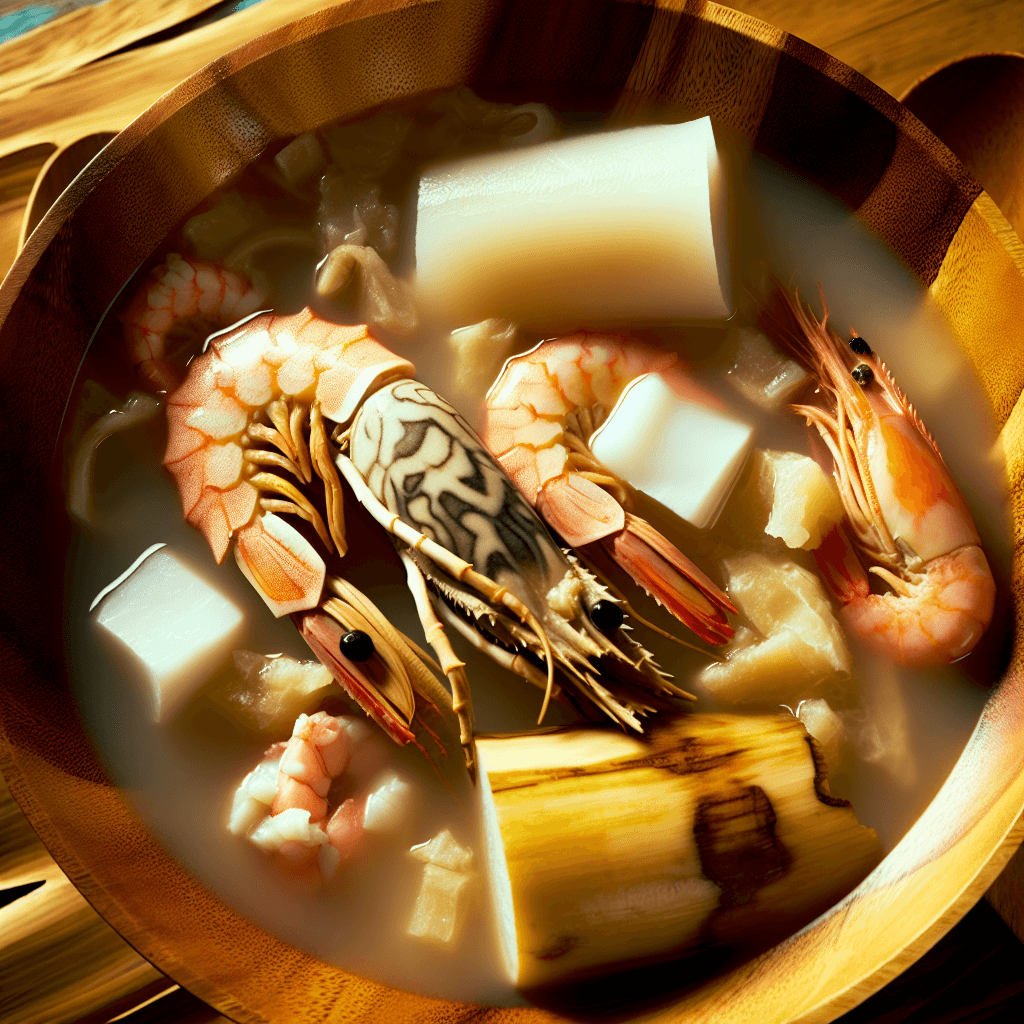
Seafood Taro Soup
Micronesian coconut-based soup with taro, fish, and shrimp.
About This Recipe
Seafood Taro Soup is a cornerstone of Micronesian home cooking — a deeply nourishing, coconut-based broth built on two ingredients that have sustained Pacific island communities for thousands of years: taro root and the ocean's daily catch. Taro (Colocasia esculenta) has been cultivated across Micronesia, Polynesia, and Melanesia for over three millennia, serving as the primary starchy staple before rice was widely introduced. In this soup, cubed taro is simmered until tender and creamy, thickening the broth naturally with its starch before white fish and shrimp are added in the final minutes. The soup's character is defined by restraint. Unlike richer curried seafood soups, this Micronesian preparation uses coconut milk not as a dominant flavour but as a gentle enrichment: the broth should taste of the sea, of sweet taro, and of coconut in equal measure, with salt and white pepper as the primary seasoning. This balance reflects the cooking philosophy of Pacific island cuisines — honouring fresh, high-quality local ingredients rather than masking them with complex spice layering. Across the many islands that comprise Micronesia (the Federated States of Micronesia, Palau, the Marshall Islands, Kiribati, and Guam among them), variations of this soup appear with different fish depending on what is caught that day — mahi-mahi, snapper, parrotfish, or reef fish — and different taro varieties. What remains constant is the simplicity of the method and the quality of the raw materials. At home, the key is not overcooking the seafood: white fish becomes rubbery and tasteless after just a minute of excess heat, so it goes in last and comes off the heat as soon as it turns opaque.
Ingredients
Serves 4
- 400 gtaro root, peeled and cubed
- 300 gwhite fish fillets, cubed
- 200 gshrimp, peeled
- 400 mlcoconut milk
- 3 cupswater
- 1 tspsalt and white pepper
Instructions
- 1
Prepare the taro
Peel the taro root wearing gloves if desired (the raw sap can cause mild skin irritation in some people) and cut into 2–3 cm cubes. Rinse the cubed taro under cold water to remove excess starch from the cut surfaces.
Wear gloves or oil your hands when handling raw taro — the calcium oxalate crystals in fresh taro can cause temporary itching. This disappears completely with cooking.
- 2
Simmer the taro
Bring 3 cups of water to a boil in a medium pot. Add the taro cubes, reduce heat to medium, and simmer for 15–18 minutes until the taro is completely tender — a skewer or fork should slide in and out with no resistance. The water will become cloudy and slightly thickened from the taro starch releasing into the broth; this is desirable and forms the body of the soup.
- 3
Add coconut milk
Pour in the coconut milk and stir to combine with the taro-thickened water. Season with salt and white pepper. Bring the soup back to a gentle simmer over medium heat — do not allow it to boil hard at this stage, as vigorous boiling can cause coconut milk to split and look grainy.
- 4
Taste the base
Before adding the seafood, taste the coconut-taro broth and adjust seasoning. It should be gently savoury with a clean coconut sweetness and the mild starchiness of the taro. If it tastes flat, add a little more salt; if it is too rich, add a splash of water.
- 5
Add fish
Add the white fish cubes to the simmering soup. Cook for 3 minutes — the fish should begin to turn opaque. Do not stir aggressively as white fish breaks apart easily; nudge pieces gently with a spoon if needed.
The seafood will continue cooking from residual heat after the pot is removed from the stove — err on the side of slightly underdone when removing from heat.
- 6
Add shrimp and finish
Add the peeled shrimp to the soup. Cook for a further 2–3 minutes until the shrimp curl into a loose 'C' shape (if they curl tightly into an 'O' they are overcooked) and turn pink throughout. Remove from heat immediately.
- 7
Serve
Ladle immediately into deep bowls, distributing the taro, fish, and shrimp evenly. Serve with steamed white rice alongside (served separately or with the rice added directly to the bowl) or with warm titiyas flatbread. A small wedge of lime or a few drops of soy sauce on the side are common accompaniments.
Did you make this?
Rate it and help other cooks find the recipes that actually work.
One tap to sign in, and we'll save the rating you just picked.
Everything you need to plan your week — free
- Meal calendar
- Grocery list
- AI recipe ideas
Cook this hands-free
Get AI meal plans, step-by-step cooking mode, and your saved recipes in the free Bento app.
Pro Tips
- →
The single most important rule: do not overcook the seafood. White fish goes from perfectly flaky to dry and rubbery in under 2 minutes. Add it last, cook briefly, and serve immediately.
- →
Use full-fat coconut milk — light or reduced-fat versions produce a thin, watery broth that lacks the characteristic gentle richness of Pacific island soups.
- →
Fresh taro is far superior to frozen for this soup — it releases starch into the broth that naturally thickens and enriches it; frozen taro, while usable, releases less starch and produces a thinner result.
- →
If you cannot find taro, breadfruit (ulu) is a traditional Micronesian substitute and behaves very similarly in soup.
- →
For a more aromatic version, add 2 smashed lemongrass stalks and 3 slices of fresh ginger to the water when cooking the taro — remove before serving.
Variations
- •
Aromatic island version: add 2 stalks of smashed lemongrass, 3 slices of ginger, and the zest of 1 lime to the simmering base — inspired by the cooking of Palau and the FSM outer islands.
- •
Crab version: replace shrimp with 300 g of picked crab meat stirred in at the very end (crab needs only 1 minute to warm through) — this is considered the most traditional version on several outer islands.
- •
Tuna version: substitute canned or fresh tuna for the white fish — canned tuna in spring water, drained and flaked in at the end, makes an accessible weeknight version.
- •
Breadfruit version: replace taro with cubed breadfruit (ulu) — a staple across Micronesia with a starchy, potato-like texture that works identically in this soup.
Storage
Seafood soups should be consumed as fresh as possible; this soup keeps in the refrigerator for up to 2 days but the seafood will continue to firm up in the broth. Reheat very gently over low heat until just warmed through — do not bring to a boil, which overcooks the already-cooked seafood further. Do not freeze soups containing cooked shellfish or fish, as freezing dramatically degrades the texture of seafood.
History & Origin
Taro (Colocasia esculenta) has been cultivated on Micronesian islands for over 3,000 years, arriving with the Austronesian migrants who spread from Southeast Asia across the Pacific beginning around 1500 BCE. Taro became the primary caloric staple of island diets before rice was introduced through Asian and later Western trade contacts in the 18th and 19th centuries. The combination of taro with fresh seafood is one of the most ancient meal patterns in the Pacific — an expression of the two resources most reliably available on small coral islands: the root crop cultivated in swampy inland paddies, and the fish and shellfish caught from the surrounding reef and deep ocean.
Frequently Asked Questions
Can I use frozen taro instead of fresh?
Yes — frozen taro is sold in many Asian grocery stores (often labelled as 'taro root' or 'eddo') and works reasonably well in this soup. Add it directly from frozen to the boiling water (no need to thaw), and reduce the cooking time to about 12 minutes. The main difference is that frozen taro releases less starch, so the broth will be slightly thinner — you can compensate by mashing 2–3 taro cubes into the broth before adding the coconut milk.
What fish works best in this soup?
Any mild, firm white fish produces a good result: mahi-mahi, red snapper, tilapia, cod, or halibut are all excellent. Avoid oily, strongly flavoured fish like mackerel or sardines — their robust flavour overwhelms the delicate coconut and taro broth. In Micronesia, whatever reef fish was caught that morning is used.
Why did my coconut milk split and look curdled?
Coconut milk splits when heated too quickly or at too high a temperature — the fat and water separate, producing a grainy, curdled appearance. To fix a split broth, reduce the heat to the lowest setting and whisk vigorously while adding 2–3 tablespoons of cold water; this often brings it back together. To prevent splitting, always add coconut milk to a soup that is simmering gently, not boiling hard.
Is raw taro dangerous to eat?
Raw taro contains calcium oxalate crystals that cause intense burning and itching in the mouth and throat — it should never be eaten raw. However, thorough cooking completely neutralises the crystals, making cooked taro completely safe and mild. Ensure the taro is fully tender (no resistance when pierced) before serving.
Nutrition Facts
Per serving (380g / 13.4 oz) · 4 servings total
Time Summary
Have Questions?
Ask our AI cooking assistant anything about this recipe — substitutions, techniques, scaling.
Chat with AI Chef →More Micronesian Recipes
You Might Also Like
Similar dishes from other cuisines around the world.
Free Kitchen Tools
Calculators and converters that pair with this page — no signup needed.
Put This Into a Plan
Schedule it, shop for it, and track what you already have.
Read Next
Longer reads that go deeper on the ideas behind this dish.
Community
Join the conversation
Sign in to leave a comment and save your favourite recipes