
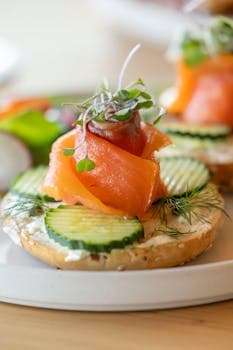
Smoked Salmon Bagel
Toasted bagel with cream cheese, smoked salmon, and capers.
About This Recipe
The smoked salmon bagel is the crown jewel of the New York Jewish deli tradition, a meal built by successive waves of Ashkenazi Jewish immigrants who arrived on the Lower East Side from the 1880s onward. The bagel itself — boiled before baking for its characteristic chewy ring and glossy crust — was a staple of Polish and Eastern European Jewish bakeries, and pairing it with lox (salt-cured salmon) and cream cheese became the defining Sunday breakfast of New York by the mid-twentieth century. Today the combination is eaten around the world, but the best versions remain true to those deli roots: a real bagel (not a supermarket roll shaped like one), properly cold-smoked salmon with a silky, translucent texture, and full-fat cream cheese applied with genuine generosity. Cold-smoked salmon — cured first with salt and sometimes dill, then exposed to smoke at temperatures below 30 °C — retains its raw, glossy texture and delicate flavour. It is fundamentally different from hot-smoked salmon, which flakes like cooked fish. The former is the correct choice for bagels: its suppleness folds elegantly over the cream cheese and releases its omega-rich fat slowly on the palate. The supporting cast matters too: briny capers provide the salty, acidic pop that cuts the richness of cream cheese; paper-thin rings of raw red onion add sharpness and crunch; and a squeeze of fresh lemon brightens everything. Fresh dill — the herb most closely associated with Scandinavian and Eastern European salmon preparations — ties the flavours together with its anise-like sweetness.
Ingredients
Serves 1
- 1 wholeeverything bagel, halved
- 60 gcream cheese
- 80 gcold-smoked salmon slices
- 1 tbspcapers, drained
- 2 thin slicesred onion
- 1 tspfresh lemon juice
- 1 pinchfreshly ground black pepper
- 1 sprigfresh dill
Instructions
- 1
Bring cream cheese to room temperature
Set the cream cheese out 15–20 minutes before assembling. Cold cream cheese tears the bagel rather than spreading smoothly, and room-temperature cream cheese also tastes creamier and less chalky.
Full-fat Philadelphia or a good artisan cream cheese works best — reduced-fat versions are too thin and watery.
- 2
Toast the bagel
Slice the bagel horizontally with a serrated knife, cutting slightly off-centre so the base is thicker — it holds the toppings better. Toast on the medium-high setting of a toaster or under a grill for 2–3 minutes until deep golden and crisp on the cut faces.
If the bagel is a day old, brush the cut side lightly with water before toasting to revive the crust.
- 3
Spread cream cheese generously
Spoon the cream cheese onto both halves while the bagel is still warm. Spread it right to the edges in a thick, even layer — at least 5–6 mm deep. In a proper deli, cream cheese is applied with what regulars call 'a schmear': thick enough that it slightly mounds in the centre.
Season the cream cheese lightly with a grind of black pepper and a few drops of lemon juice before spreading to brighten its flavour.
- 4
Layer the smoked salmon
Drape cold-smoked salmon slices over the cream cheese, loosely folded or layered rather than pressed flat. The folds trap pockets of the silky fish against the cream cheese and create visual appeal. Use the full 80 g — this is not a dish that rewards skimping.
- 5
Add the garnishes
Scatter drained capers evenly across the salmon. Lay the red onion rings over them, then place a sprig of fresh dill on top. The dill fronds are more than decorative — they add a gentle anise note that connects the salmon's smokiness to the briny capers.
- 6
Finish and serve
Squeeze fresh lemon juice across both halves just before eating and add a final grind of black pepper. Serve open-faced on the plate so toppings are not compressed, and eat immediately while the bagel is still warm and crisp.
Did you make this?
Rate it and help other cooks find the recipes that actually work.
One tap to sign in, and we'll save the rating you just picked.
Everything you need to plan your week — free
- Meal calendar
- Grocery list
- AI recipe ideas
Track what you eat
Snap your meal to log calories and macros, run fasting timers and track water in the free SnapCal app.
Pro Tips
- →
Buy cold-smoked salmon — not hot-smoked — for a bagel. Cold-smoked has a silky, translucent texture; hot-smoked flakes like cooked fish and turns the bagel soggy.
- →
An everything bagel (coated with sesame seeds, poppy seeds, dried garlic, onion flakes, and coarse salt) is the gold standard for this preparation — its seedy crust provides crunch and seasoning that a plain or sesame-only bagel lacks.
- →
Rinse the capers if they are packed in salt rather than brine; salt-packed capers have a more nuanced flavour but need soaking first.
- →
Slice the red onion as thin as possible — use a mandoline if you have one. Thick onion rings overpower the delicate salmon rather than complementing it.
- →
If serving a crowd, lay out all the toppings in small bowls and let people build their own — the assembly is part of the pleasure.
Variations
- •
Avocado smoked salmon bagel: replace or supplement the cream cheese with mashed avocado seasoned with lime juice and flaky salt — the fatty richness of avocado works beautifully with salmon.
- •
Bagel and lox board: serve an assembled platter of sliced bagels, cream cheese, smoked salmon, capers, red onion, cucumber, sliced tomato, and hard-boiled eggs for a traditional New York brunch spread.
- •
Cucumber and dill open sandwich: for a lighter, gluten-conscious version, use sliced cucumber rounds as the base instead of bagel — a popular Scandinavian-inspired canapé for parties.
- •
Bagel with smoked trout: substitute smoked trout fillets for salmon — their earthier flavour pairs well with horseradish cream cheese instead of plain.
Storage
Smoked salmon bagels cannot be stored once assembled — the toast softens within minutes under the cream cheese. Keep smoked salmon refrigerated in its vacuum pack up to the use-by date (typically 2 weeks after opening if kept at 2–4 °C). Opened packs should be consumed within 2–3 days. Cream cheese keeps refrigerated for up to 2 weeks once opened.
History & Origin
The bagel was documented in the Jewish community records of Kraków, Poland, as early as 1610, where it was given as a gift to women following childbirth. Ashkenazi Jewish immigrants brought the bagel to New York's Lower East Side in the 1880s and 1890s, where the International Beigel Bakers' Union (Local 338) maintained strict hand-rolling traditions through the mid-twentieth century. The classic pairing with lox (salmon cured in brine, a tradition inherited from Scandinavian-influenced Eastern European preservation methods) and cream cheese became an iconic New York Sunday ritual by the 1940s, documented in the menus of legendary delis like Russ & Daughters, which opened on Houston Street in 1914.
Frequently Asked Questions
What is the difference between lox and smoked salmon?
Traditional lox is salmon cured exclusively in a brine of salt (and sometimes sugar), with no smoking involved — it has a very briny, intense flavour. Cold-smoked salmon is first cured with salt and then cold-smoked at below 30 °C, giving it a milder, subtly smoky flavour and a more widely appealing taste. Most supermarket 'smoked salmon' is cold-smoked; true lox is harder to find outside specialty Jewish delis.
Can I prepare the components of a smoked salmon bagel in advance?
Yes — everything except the toasting. Slice the red onion and store in cold water (which mellows its sharpness), keep the salmon refrigerated, and have capers and dill ready. Toast the bagel and assemble at the last possible moment so the crust stays crisp. Once assembled, eating within 5 minutes is ideal; after 10 minutes the base begins to soften noticeably.
What if I can't find everything bagels?
A plain, sesame, or poppy seed bagel works well — the seeds add texture. Avoid flavoured bagels like blueberry or cinnamon-raisin, which clash with the savoury toppings. A good sourdough English muffin or thick-cut sourdough toast is an acceptable substitute if bagels are unavailable.
How do I prevent the bagel from tearing when slicing?
Use a proper serrated bread knife and a steady sawing motion — never a straight-edged chef's knife, which squashes the chewy crust. Hold the bagel flat on the board and slice horizontally through the middle, keeping your fingers curled safely away from the blade.
Is smoked salmon safe to eat during pregnancy?
Cold-smoked salmon is considered high-risk during pregnancy because it is not cooked to a temperature that kills listeria. Most pregnancy guidelines recommend avoiding it and switching to hot-smoked salmon (which is fully cooked) or cooked alternatives like poached salmon or canned tuna. Always consult a healthcare provider for personalised advice.
Nutrition Facts
Per serving (210g / 7.4 oz) · 1 servings total
Time Summary
Have Questions?
Ask our AI cooking assistant anything about this recipe — substitutions, techniques, scaling.
Chat with AI Chef →More American Recipes
You Might Also Like
Similar dishes from other cuisines around the world.
Browse by Ingredient
More recipes built around the same core ingredients.
Free Kitchen Tools
Calculators and converters that pair with this page — no signup needed.
Put This Into a Plan
Schedule it, shop for it, and track what you already have.
Read Next
Longer reads that go deeper on the ideas behind this dish.
Community
Join the conversation
Sign in to leave a comment and save your favourite recipes