
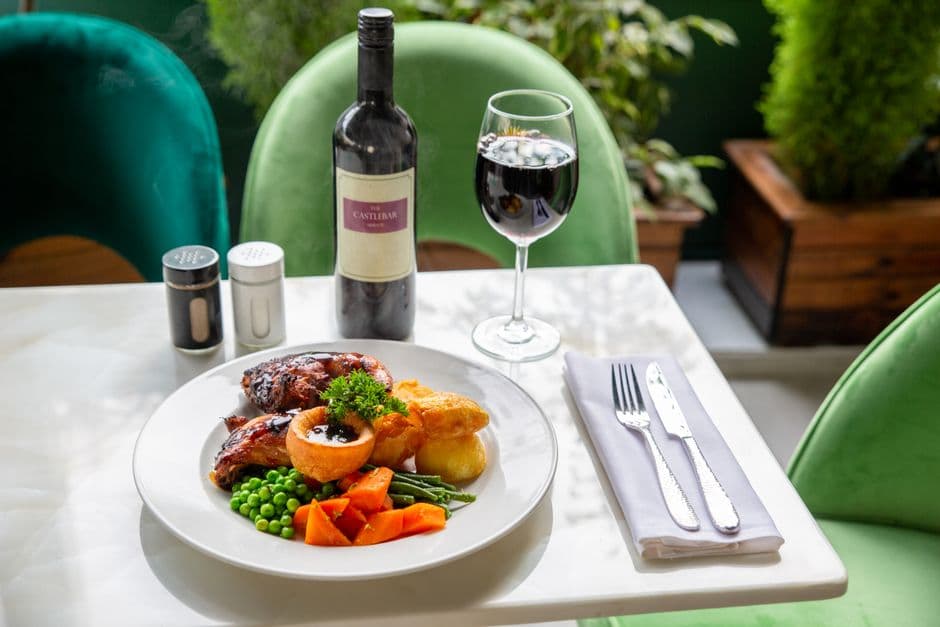
English Sunday Roast Beef with Yorkshire Pudding
Britain's defining Sunday lunch — slow-roasted topside or rib of beef, towering Yorkshire puddings, roast potatoes in dripping, seasonal vegetables and proper gravy from the pan.
About This Recipe
The Sunday roast is the closest thing the English have to a national religion, a weekly ritual built around a single piece of slow-roasted beef and its supporting cast of crisp roast potatoes, ballooning Yorkshire puddings, seasonal greens, and a proper jug of gravy made from the pan dripping. Done well it is one of the world's great meals and one of its simplest: a forequarter or hindquarter of beef (rib for special occasions, topside or sirloin for everyday), seasoned aggressively, seared, then roasted at a steady temperature until the centre is rosy-pink. The drip tray catches the fat that becomes the medium for the roast potatoes — first parboiled until their edges fluff, then crashed and tossed in screaming-hot beef dripping until they shatter at the touch. Yorkshires are their own act of theatre: a thin batter of equal volumes egg, flour and milk poured into smoking-hot dripping so it puffs in the oven into golden hollow towers. The gravy is made in the same pan from the fond, deglazed with red wine and beef stock and thickened lightly with the flour from the meat. Every Englishman has an opinion on doneness, on whether to add mustard to the gravy, on whether parsnips belong, on the role of horseradish, and on whether the Yorkshires come before, with, or after the meat. There is no correct answer — only the family rules, the smell of beef in the hallway from noon, and the obligation to be at the table at 1pm sharp.
Ingredients
Serves 6
- 2.5 kgtopside or sirloin of beef, tied (or 2-bone fore rib for a special occasion)
- 2 tbspEnglish mustard powder
- 1.5 kgMaris Piper or King Edward potatoes, peeled and cut into 6 cm chunks
- 150 gbeef dripping, lard, or goose fat
- 200 gplain flour (for Yorkshires)
- 300 mlwhole milk (for Yorkshires)
- 4large eggs (for Yorkshires)
- 500 gcarrots, peeled and halved lengthways
- 400 gSavoy cabbage or spring greens, shredded
- 200 mlred wine
- 500 mlhot beef stock
- 1 tbspplain flour (for gravy)
- sea salt and freshly ground black pepper
- horseradish sauce, to serve
Instructions
- 1
Bring the beef to room temperature
Take the beef out of the fridge 90 minutes before cooking — a cold joint roasts unevenly. Pat the surface bone-dry with kitchen paper, then rub all over with mustard powder, plenty of salt and pepper, pressing the seasoning into the fat cap.
- 2
Sear and roast
Heat the oven to 240°C/220°C fan/465°F. Sear the beef in a heavy roasting tin over high heat on the hob, 2 minutes per side until deeply coloured. Transfer to the oven and roast 20 minutes at 240°C, then drop to 160°C/140°C fan/325°F. Roast 12 minutes per 500 g for rare, 15 minutes for medium-rare, 18 for medium.
- 3
Rest the beef
Pull the beef when the internal temperature reads 52°C/126°F for medium-rare (it will rise to 56°C as it rests). Lift onto a warm board, tent loosely with foil, and rest at least 30 minutes — this is non-negotiable for juicy slicing. Pour the dripping out of the tin and reserve everything.
- 4
Mix the Yorkshire batter
Whisk the flour with a generous pinch of salt, then beat in the eggs to make a thick paste. Slowly whisk in the milk until smooth — the consistency should be like single cream. Rest 30 minutes (or overnight in the fridge) — rested batter rises taller.
- 5
Parboil and roast the potatoes
While the beef cooks, boil potatoes in well-salted water for 8 minutes until the edges fluff when shaken in the colander. Heat 100 g dripping in a roasting tin in the oven until smoking. Tip in the potatoes, turn to coat, and roast 50 minutes, turning twice, until shatteringly crisp and deep gold.
- 6
Cook the Yorkshires
Crank the oven to 230°C/210°C fan/450°F. Add a teaspoon of dripping to each cup of a 12-hole muffin tin and heat in the oven until smoking, 6 minutes. Pour the batter into each cup, filling two-thirds full, and bake 22–25 minutes without opening the door until towering and deep golden brown.
- 7
Make the gravy
Set the roasting tin over medium heat on the hob. Stir the flour into the residual fond and beef juices, cook 2 minutes. Pour in the red wine and bubble hard for 2 minutes, scraping up everything. Whisk in the hot stock and any beef resting juices, simmer 6 minutes, and strain into a warm jug. Taste and season.
- 8
Cook the vegetables and serve
Boil the carrots 8 minutes until just tender, drain, and toss in butter and salt. Wilt the cabbage in 2 tbsp butter and a splash of water for 4 minutes. Carve the beef thinly against the grain, and serve at once with potatoes, vegetables, Yorkshires, plenty of gravy, and horseradish on the side.
Did you make this?
Rate it and help other cooks find the recipes that actually work.
One tap to sign in, and we'll save the rating you just picked.
Everything you need to plan your week — free
- Meal calendar
- Grocery list
- AI recipe ideas
Track what you eat
Snap your meal to log calories and macros, run fasting timers and track water in the free SnapCal app.
Pro Tips
- →
Resting the meat for 30 minutes is the single most important step — skip it and all the juices end up on the chopping board.
- →
The dripping must be screaming hot before the Yorkshire batter or roast potatoes hit it. If it isn't smoking, you'll get pale, flat results.
- →
Never open the oven during the first 20 minutes of Yorkshire pudding cooking — the cold air collapses the rise.
- →
Beef dripping gives the best flavour, but goose fat or lard work. Vegetable oil produces inferior potatoes and is not traditional.
Variations
- •
Roast pork with crackling and apple sauce — Sunday's second-most-popular roast, with the same Yorkshires and potatoes.
- •
Roast lamb with mint sauce and redcurrant jelly — the traditional Easter and spring version.
- •
Roast chicken — a weeknight-budget Sunday version, served with bread sauce and stuffing.
- •
Toad in the hole — the leftover-batter, leftover-sausage cousin made with the same Yorkshire mix.
Storage
Carved beef refrigerates 3 days, makes superb cold sandwiches with horseradish and mustard. Cooked Yorkshires keep 2 days; refresh in a hot oven 4 minutes. Roast potatoes do not refrigerate well — eat the lot. Gravy keeps 3 days; reheat gently, adding a splash of stock if it has thickened too much.
History & Origin
The Sunday roast became standard in English households after the Industrial Revolution, when working-class families would prepare a joint on Saturday evening for the baker to slow-roast in the bread oven on Sunday morning while the family was at church. Yorkshire pudding, originally a fat-soaked 'dripping pudding' served before the meat to fill people up, was first recorded by Hannah Glasse in 1747.
Frequently Asked Questions
What cut of beef is best?
Fore rib (with the bone in) is the special-occasion king — it gives the best flavour. Sirloin (boneless) is the next step down. Topside is the affordable weekly choice. Avoid silverside, which goes dry without slow-braising.
Why didn't my Yorkshires rise?
Three usual suspects: the dripping wasn't smoking hot when the batter went in; the oven was opened in the first 20 minutes; or the batter was too thick. The batter should be the consistency of single cream.
Can I make any of this ahead?
Yorkshire batter benefits from being made the day before. Parboil and rough up the potatoes hours ahead and finish in dripping just before serving. The beef and gravy must be done à la minute.
Is horseradish necessary?
Not strictly, but it is traditional — the sharp heat cuts through the richness of the beef and Yorkshires. English mustard is the alternative. Most households put both on the table.
Nutrition Facts
Per serving (720g / 25.4 oz) · 6 servings total
Time Summary
Have Questions?
Ask our AI cooking assistant anything about this recipe — substitutions, techniques, scaling.
Chat with AI Chef →Featured in Guides
This recipe is featured in the following curated guides:
More British Recipes
You Might Also Like
Similar dishes from other cuisines around the world.
Browse by Ingredient
More recipes built around the same core ingredients.
Free Kitchen Tools
Calculators and converters that pair with this page — no signup needed.
Put This Into a Plan
Schedule it, shop for it, and track what you already have.
Read Next
Longer reads that go deeper on the ideas behind this dish.
Community
Join the conversation
Sign in to leave a comment and save your favourite recipes