
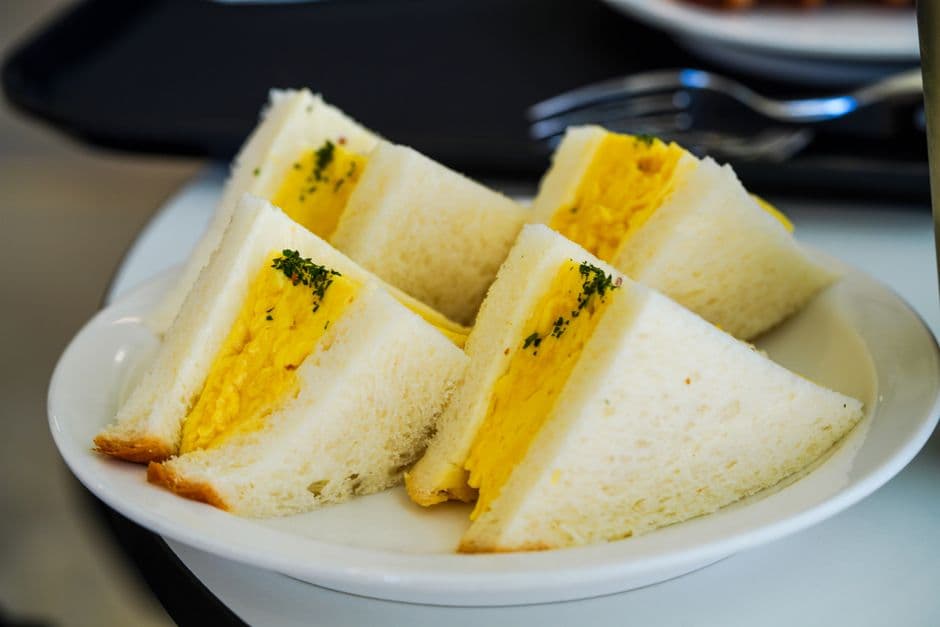
Japanese Tamago Sando (Egg Salad Sandwich on Pillowy Shokupan)
The cult Japanese convenience-store sandwich — silky, mayo-rich egg salad piled thick between crustless slices of pillow-soft milk bread.
About This Recipe
The Japanese tamago sando — the egg salad sandwich sold from refrigerated cases at every 7-Eleven, FamilyMart and Lawson convenience store in Japan — has acquired international cult status as one of the most quietly perfect sandwiches in the world. Anthony Bourdain famously called it 'shockingly good,' and visitors to Tokyo now make pilgrimages to konbini just to buy a Y150 plastic-wrapped triangle of it. The sandwich is deceptively simple — egg salad on white bread — but every element has been engineered to a level of refinement that supermarket egg salad in most countries has never aspired to. The bread is shokupan: a pillowy, slightly sweet Japanese milk bread enriched with milk and sometimes a tangzhong roux, with a crumb so soft and uniform it almost compresses under your finger like a pillow. The crusts are always removed. The egg salad is made with Kewpie mayonnaise — a Japanese mayo made with only egg yolks (no whites), a touch of rice vinegar, and MSG, giving it a creamier, richer, more umami-laden flavor than American mayo. The eggs themselves are usually a mix: most are hard-boiled and chopped fine, but one or two are mashed completely smooth to act as a binding mousse, and sometimes a halved soft-boiled egg with a jammy yolk is laid through the center of the sandwich for visual drama. A tiny touch of Japanese mustard or sugar finishes the salad. Cold, soft, salty-creamy, with that yellow yolk running across the white bread, the tamago sando is breakfast, lunch, midnight snack and souvenir all in one.
Ingredients
Serves 2
- 5 largevery fresh eggs (3 for hard-boiled, 2 for soft-boiled center)
- 3 tbspKewpie mayonnaise(the red-capped Japanese mayo — not optional)
- 1 tspDijon mustard or Japanese karashi
- 0.5 tspsugar
- 0.25 tspfine sea salt
- white pepper, a pinch
- 4 thick slicesshokupan (Japanese milk bread), 2 cm thick
- 20 gsoftened salted butter, for the bread
Instructions
- 1
Hard-boil 3 eggs
Bring a small saucepan of water to a rolling boil. Lower 3 of the eggs in gently with a slotted spoon and cook exactly 9 minutes — fully set yolks but not chalky. Immediately transfer to a bowl of ice water for 5 minutes. Peel carefully under a thin stream of cold running water.
- 2
Soft-boil 2 eggs (optional but excellent)
In the same pot of fresh boiling water, lower the remaining 2 eggs in gently and cook exactly 6 minutes 30 seconds for a jammy bright-orange yolk. Transfer to ice water for 5 minutes and peel carefully — soft-boiled eggs are fragile, so go slow under cool running water.
- 3
Make the egg salad
Roughly chop two of the hard-boiled eggs (give them texture, not paste). In a separate bowl, mash the third hard-boiled egg completely smooth with a fork — this becomes the binding mousse that gives the salad its silky uniformity. Combine the chopped and mashed eggs in a bowl. Add the Kewpie mayonnaise, mustard, sugar, salt and white pepper. Fold gently with a spatula. Taste and adjust — it should be markedly salty and faintly sweet.
- 4
Prepare the bread
Trim the crusts off all four slices of shokupan with a sharp serrated knife — a clean, light sawing motion gives the cleanest edge. Save the crusts to toast as croutons later. Spread a thin, even layer of softened butter on the inner side of each slice. The butter acts as a moisture barrier so the egg salad doesn't soak the bread.
- 5
Build the base
Lay 2 slices of bread butter-side-up on a board. Pile the egg salad in a tall mound on each, then use the back of a spoon to flatten it slightly — but keep it thick. The salad should be at least 2 cm tall in the center for proper konbini-style abundance.
- 6
Add the soft-boiled egg (optional)
Slice the soft-boiled eggs in half lengthwise with a wet sharp knife. Place one half cut-side-up in the center of each sandwich, pressed gently into the egg salad so the yolk faces upward and outward. When you slice the finished sandwich, the egg cross-section will appear in the center — the visual signature of premium tamago sando.
- 7
Close and chill
Top with the remaining bread slices butter-side-down. Press very gently to settle without squashing the soft-boiled egg. Wrap each sandwich tightly in plastic film and refrigerate for at least 20 minutes (and up to overnight). This rest firms everything up and lets the flavors meld — and is essential for clean slicing.
- 8
Slice and serve
Unwrap the sandwiches. Using a very sharp serrated knife wiped clean between cuts, slice each in half on the diagonal or vertically straight down through the center of the egg. The cross-section should reveal a thick layer of yellow egg salad with the half-orb of bright orange yolk in the middle — instantly Instagrammable. Serve cold with a cup of green tea or cold barley tea.
Did you make this?
Rate it and help other cooks find the recipes that actually work.
One tap to sign in, and we'll save the rating you just picked.
Everything you need to plan your week — free
- Meal calendar
- Grocery list
- AI recipe ideas
Track what you eat
Snap your meal to log calories and macros, run fasting timers and track water in the free SnapCal app.
Pro Tips
- →
Kewpie mayo is genuinely irreplaceable here. It has a richer, eggier, more umami-laden flavor than American mayo because it uses only egg yolks plus a small amount of MSG. Buy a squeeze bottle; it lasts for months.
- →
The mix of chopped and mashed egg is the textural trick — chopped eggs give bite, mashed egg binds everything into a silky cohesive salad. Skip either and the salad goes either too chunky or too pasty.
- →
Shokupan is the bread — Japanese pillow-soft milk bread, available at Asian grocers or H Mart. King's Hawaiian sweet bread is the closest Western substitute. Sturdy white sandwich bread will work in a pinch but the dish loses character.
- →
Resting the wrapped sandwich for 20 minutes before slicing is essential for that clean konbini-style cross-section. Skip the rest and the sandwich smears when you cut it.
Variations
- •
Curry tamago sando: add 1 teaspoon of Japanese curry powder to the salad for a yellower, spicier version — a Tokyo specialty.
- •
Salmon tamago sando: tuck a slice of cured smoked salmon between the egg salad and the bread — popular at high-end Tokyo sandwich shops like Konbi.
- •
Add 1 tablespoon of finely chopped Japanese pickles (takuan or cucumber tsukemono) to the salad for a brighter, crunchier version.
- •
Tamago katsu sando: pile a panko-crusted, deep-fried egg yolk patty on top of the salad — a maximalist Osaka invention.
Storage
Tamago sando is at its best within 24 hours; the egg salad refrigerates 3 days but the bread eventually goes stale. If making for a lunch box, wrap tightly in plastic film and pack in a cooler with ice — the sandwich should stay cold from kitchen to consumption.
History & Origin
The tamago sando as we know it emerged in the 1970s and 1980s with the rise of Japanese konbini culture — the 7-Eleven, Lawson and FamilyMart convenience stores that became indispensable to Japanese urban life. Each chain refined its egg salad sandwich into a small masterpiece, with food engineers tweaking egg-to-mayo ratios and bread softness to find the perfect balance. Lawson's 'Premium Tamago Sando' and 7-Eleven's egg sandwich both became cultural icons. International fame came in the 2010s via travel writers and chefs like Anthony Bourdain and David Chang, who marveled at the elevated quality of what was supposed to be a $1.50 convenience-store snack.
Frequently Asked Questions
Can I use regular mayo?
You can, but the sandwich loses its specific character. Kewpie is creamier, eggier, and slightly umami-laden in a way regular mayo isn't. If you only have American mayo, add a few drops of rice vinegar and a tiny pinch of MSG to push it closer. Or just hunt down Kewpie — it's now widely available.
What is shokupan?
Japanese milk bread — a pillowy, slightly sweet white bread enriched with milk and often made with the tangzhong roux method, which gives it that signature ultra-soft texture. King's Hawaiian rolls or any soft milk-bread loaf is the closest Western equivalent.
Why is the bread crustless?
It's a Japanese sandwich convention — the soft crust-free white bread emphasizes the pillowy texture against the creamy filling. Crusts are saved and toasted as croutons rather than wasted.
Can I make these the night before?
Yes — wrap tightly in plastic film and refrigerate overnight. The egg salad actually improves with rest as the flavors meld. The bread stays soft because of the butter barrier, and slicing the next day gives cleaner cuts than slicing fresh.
Nutrition Facts
Per serving (240g / 8.5 oz) · 2 servings total
Time Summary
Have Questions?
Ask our AI cooking assistant anything about this recipe — substitutions, techniques, scaling.
Chat with AI Chef →Featured in Guides
This recipe is featured in the following curated guides:
More Japanese Recipes
You Might Also Like
Similar dishes from other cuisines around the world.
Browse by Ingredient
More recipes built around the same core ingredients.
Free Kitchen Tools
Calculators and converters that pair with this page — no signup needed.
Put This Into a Plan
Schedule it, shop for it, and track what you already have.
Read Next
Longer reads that go deeper on the ideas behind this dish.
Community
Join the conversation
Sign in to leave a comment and save your favourite recipes