
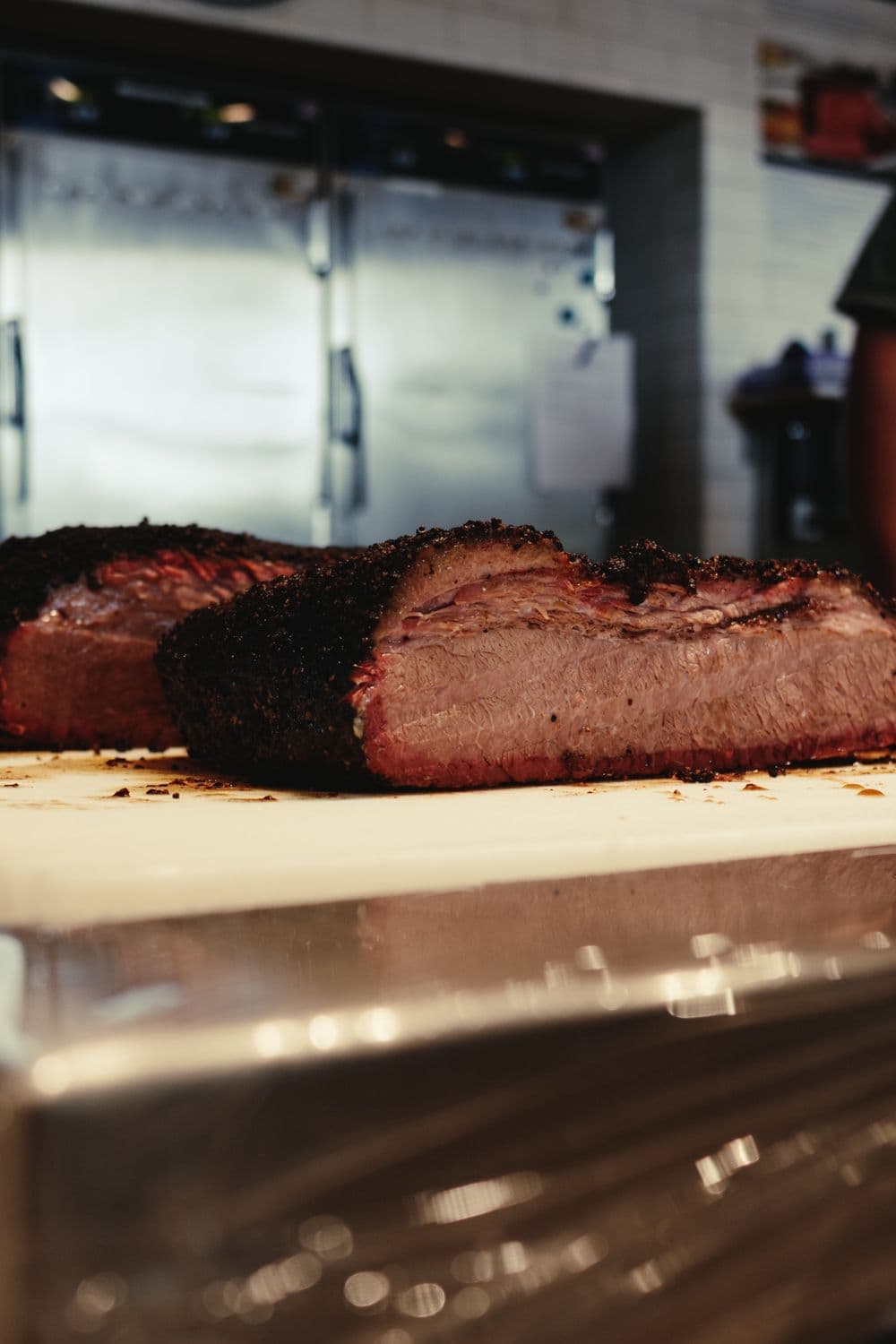
Texas Smoked Brisket Tacos
Slow-smoked Texas brisket in soft tortillas with pickled onions and cilantro.
About This Recipe
Texas smoked brisket tacos represent the collision of two great Lone Star traditions: the German-Czech barbecue culture of Central Texas that perfected low-and-slow oak smoking, and the Mexican border cooking that made the taco the state's unofficial format for everything. The brisket itself demands patience and precision — a whole packer or flat-cut brisket is trimmed to a quarter-inch fat cap, rubbed with the canonical Texas seasoning of coarse salt and black pepper (and sometimes garlic powder, but never more than that), then smoked over post oak or hickory at 225°F for the better part of a day. The low temperature lets the tough collagen in the point and flat slowly convert to gelatin, producing the impossibly moist, yielding texture that sets Texas brisket apart from every other preparation of the cut. The two-phase cook — open smoke to 165°F, then wrapped in butcher paper until the meat reaches 203°F internal temperature — is the Texas Crutch technique pioneered by Central Texas pitmasters to push the brisket through the plateau phase where evaporative cooling stalls the temperature for hours. Butcher paper (rather than foil) allows some steam to escape, which preserves the bark's texture better than a tight foil wrap. After cooking, a minimum 30-minute rest in a cooler lets the juices redistribute throughout the muscle fibers. Sliced thin against the grain and tucked into warm corn tortillas with quick-pickled red onions, fresh cilantro, and a squeeze of lime, the result is a taco of extraordinary depth — smoky, fatty, acidic, bright — and one that requires almost no additional sauce because the brisket carries all the flavor it needs.
Ingredients
Serves 8
- 1.5 kgbeef brisket flat or packer cut
- 2 tbspcoarse kosher salt
- 2 tbspcoarse black pepper
- 1 tspgarlic powder(optional)
- 1 cuppost oak or hickory wood chips(for smoking)
- 16corn tortillas
- 1 largered onion(thinly sliced)
- ½ cupapple cider vinegar(for pickling onions)
- 1 tbspsugar(for pickling)
- ½ cupfresh cilantro(roughly chopped)
- 2limes(quartered)
Instructions
- 1
Pickle the onions
At least 2 hours before serving (or ideally the night before), combine the thinly sliced red onion in a jar with apple cider vinegar, sugar, and a pinch of salt. Press down so the onion is submerged, seal the jar, and refrigerate. The onion will turn bright pink and mellow from sharp and pungent to pleasantly tangy.
Quick-pickled onions can be made up to a week ahead and kept in the refrigerator — they improve with time.
- 2
Trim and season the brisket
Using a sharp boning knife, trim the fat cap to a uniform quarter-inch thickness — enough to baste the meat during the long cook without leaving thick unrendered fat on the finished brisket. Mix the salt, pepper, and garlic powder (if using) and apply generously to all surfaces, pressing so the rub adheres. Let the seasoned brisket rest at room temperature for 30–60 minutes.
Salt and pepper alone is the authentic Central Texas rub — resist the temptation to add more spices, which can obscure the beef's flavor.
- 3
Set up the smoker
Preheat your smoker (or kettle grill set up for indirect heat) to a steady 225–250°F. Add post oak or hickory chunks — not chips — to the firebox; chunks sustain smoke longer than chips. Place a water pan in the smoker to maintain humidity, which slows the rate of moisture loss from the meat's surface.
- 4
Smoke to 165°F
Place the brisket fat-side up on the smoker grates, away from direct heat. Smoke at 225–250°F for approximately 4–5 hours, maintaining a consistent temperature throughout, until the internal temperature of the thickest part of the flat reaches 165°F on an instant-read thermometer. The surface should have developed a deep mahogany bark by this point.
Don't open the smoker more than once per hour — each peek drops the temperature and adds 15–20 minutes to the cook.
- 5
Wrap and finish
Remove the brisket and double-wrap it tightly in uncoated butcher paper (or two layers of heavy foil if paper is unavailable). Return to the smoker and continue cooking at 225–250°F for another 2–3 hours, until the internal temperature reaches 200–205°F and a probe or skewer slides into the thickest part of the flat with no resistance — it should feel like inserting it into warm butter.
Temperature is a guide but feel is the ultimate test — some briskets are done at 198°F, others need 207°F. Trust the probe resistance, not just the number.
- 6
Rest the brisket
Without unwrapping, place the brisket in a dry cooler (no ice) and close the lid. Rest for a minimum of 30 minutes and up to 2 hours — the longer rest produces noticeably juicier results as the muscle fibers relax and reabsorb the expelled juices. This step is not optional.
- 7
Slice and serve
Unwrap the brisket on a cutting board and pour any accumulated juices over the top. Slice against the grain into 1/4-inch slices — the grain runs perpendicular to the long side of the flat. Warm the corn tortillas directly over a gas flame or in a dry skillet. Assemble tacos with 2–3 slices of brisket, a pinch of pickled onions, fresh cilantro, and a hard squeeze of lime.
The point cut (fattier end) has more marbling and is preferred by many — offer slices from both the point and flat so guests can compare.
Did you make this?
Rate it and help other cooks find the recipes that actually work.
One tap to sign in, and we'll save the rating you just picked.
Everything you need to plan your week — free
- Meal calendar
- Grocery list
- AI recipe ideas
Track what you eat
Snap your meal to log calories and macros, run fasting timers and track water in the free SnapCal app.
Watch: Texas Smoked Brisket Tacos
Pro Tips
- →
A good instant-read thermometer (like a Thermapen) is not optional equipment for brisket — visual and time cues alone cannot reliably tell you when a brisket is done.
- →
The stall around 155–170°F is normal — evaporative cooling holds the internal temperature flat for hours. Don't panic, don't raise the heat; wrapping in butcher paper is the correct solution.
- →
Slice only what you plan to eat immediately; leave the rest of the brisket whole, wrapped, and in the cooler. Whole brisket stays moist far longer than pre-sliced pieces.
- →
Post oak is the wood of choice in Central Texas (Franklin Barbecue uses it almost exclusively); hickory is a slightly stronger-flavored alternative. Avoid mesquite for a cook this long — it turns bitter over hours.
- →
If you don't have a smoker, a charcoal kettle with the vents partially closed and wood chunks on the coals produces respectable results; the key is maintaining that 225–250°F range for the full cook time.
Variations
- •
Breakfast brisket tacos: substitute flour tortillas, add scrambled eggs, cheddar, and salsa verde alongside the brisket slices — a Texas morning institution.
- •
Brisket burnt ends: cube the fatty point section into 1-inch pieces, toss with BBQ sauce and brown sugar, and smoke uncovered at 275°F for another 90 minutes until lacquered and caramelized.
- •
Oven-braised version: sear the brisket on all sides in a Dutch oven, add 1 cup beef broth and a dash of liquid smoke, cover tightly, and braise at 275°F for 5–6 hours until probe-tender.
- •
Brisket tacos with salsa roja: blend 4 roasted roma tomatoes, 2 chipotles in adobo, half an onion, and 2 garlic cloves into a smooth sauce — spoon over the brisket for a Tex-Mex variation.
Storage
Sliced brisket keeps refrigerated for up to 4 days — store it in its own juices to prevent drying out. To reheat, warm in a 300°F oven wrapped in foil with a tablespoon of beef broth until just heated through, about 15 minutes. Shredded or sliced brisket freezes well for up to 3 months; thaw overnight in the refrigerator and reheat as above.
History & Origin
Central Texas barbecue evolved from the meat markets and butcher shops established by German and Czech immigrants in towns like Lockhart, Taylor, and Elgin in the mid-19th century. These communities brought their European smoking and meat-preservation traditions and applied them to local Texas beef, particularly the brisket cut that was affordable and abundant. The tradition of serving smoked meat on butcher paper with crackers and pickles dates to that era. Converting brisket into tacos reflects the deep Mexican cultural influence across Texas, particularly in San Antonio and along the Rio Grande Valley, where corn tortillas became the default vehicle for every ingredient imaginable.
Frequently Asked Questions
What's the pink smoke ring and is it safe to eat?
The smoke ring is a band of bright pink just below the brisket's surface caused by a chemical reaction between myoglobin (the protein that gives meat its red color) and nitric oxide from the wood smoke. It's completely safe to eat and has no effect on flavor — contrary to popular belief, a thick smoke ring is not a reliable indicator of smoke flavor penetration, but it is a visual signal that the cook used real wood smoke at low temperatures for an extended time.
What's the stall and how do I get through it?
The stall is a period during the cook — typically between 155–170°F internal temperature — where evaporative cooling from the meat's surface exactly offsets the smoker's heat input, holding the temperature flat for anywhere from 1–4 hours. It's completely normal and not a malfunction. The fastest solution is wrapping the brisket tightly in butcher paper or foil, which traps the evaporating moisture against the meat and allows the internal temperature to climb again.
Do I have to use a smoker, or can I cook brisket in the oven?
Oven-braised brisket is a legitimate and delicious result — it won't have the smoke ring or bark of a smoked brisket, but it will be equally tender. Sear the seasoned brisket on all sides in a hot Dutch oven, add 1 cup of beef broth, cover tightly, and braise at 275°F for 5–6 hours until a probe skewer meets no resistance. For a compromise, use a charcoal kettle grill with wood chunks and indirect heat setup.
How much brisket should I buy for a party?
A raw brisket loses approximately 30–40% of its weight during a long smoke — so a 1.5kg raw brisket yields roughly 900g–1kg of cooked meat. Plan on 150–180g of cooked brisket per person for tacos (where tortillas and toppings fill out the plate). A 1.5kg brisket comfortably makes tacos for 6–8 people.
Why does my brisket come out tough and dry?
Tough brisket almost always means it was pulled from the heat too early — the internal temperature needs to reach 200–205°F for the collagen to fully convert to gelatin, and many cooks pull at 190°F thinking it's done. Dry brisket usually means insufficient resting time after the cook; the minimum is 30 minutes but an hour or more produces noticeably juicier results. Slicing too early or against improper grain direction also contributes to a dry, stringy bite.
Nutrition Facts
Per serving (350g / 12.3 oz) · 8 servings total
Time Summary
Have Questions?
Ask our AI cooking assistant anything about this recipe — substitutions, techniques, scaling.
Chat with AI Chef →Featured in Guides
This recipe is featured in the following curated guides:
More American Recipes
You Might Also Like
Similar dishes from other cuisines around the world.
Browse by Ingredient
More recipes built around the same core ingredients.
Free Kitchen Tools
Calculators and converters that pair with this page — no signup needed.
Put This Into a Plan
Schedule it, shop for it, and track what you already have.
Read Next
Longer reads that go deeper on the ideas behind this dish.
Community
Join the conversation
Sign in to leave a comment and save your favourite recipes