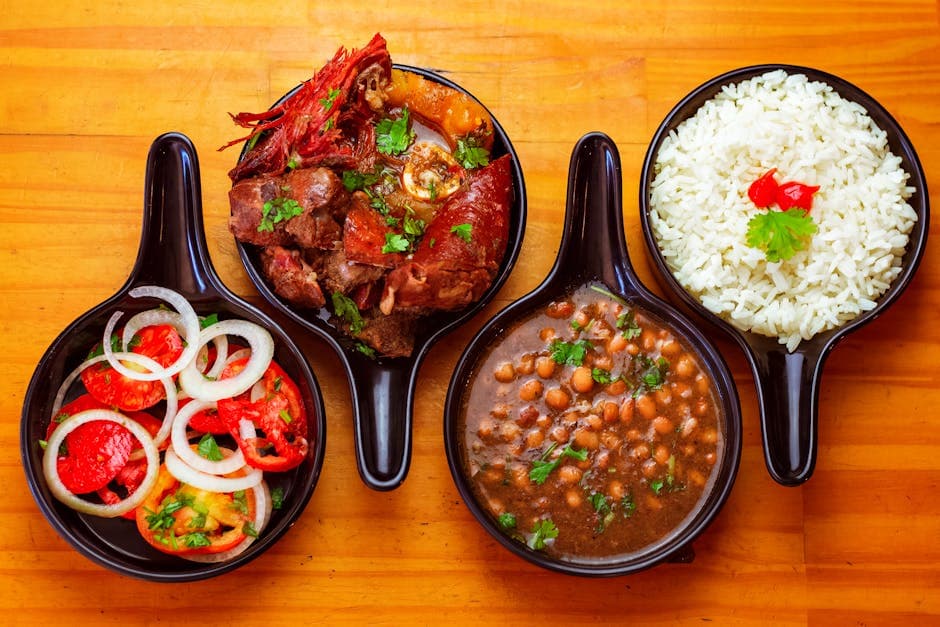
Senegal's national dish — fish stuffed with rof herb paste, simmered with vegetables, then rice cooked in the deeply red broth.
Thiéboudienne — known as ceebu jën in Wolof, meaning literally 'rice and fish' — is the national dish of Senegal and one of the most celebrated dishes of West Africa. The technique builds in three stages: first, whole or large pieces of firm white fish are stuffed with rof, a vibrant green paste of parsley, garlic, scotch bonnet and onion; second, the fish is fried briefly, then simmered with a brick-red broth of tomato paste, dried fish (yete), and a procession of root vegetables — cassava, sweet potato, carrot, cabbage, eggplant, and the bitter yet essential gourd called bitter aubergine (jakhatu). The vegetables and fish are removed, and broken jasmine rice is then cooked in the same intensely flavored broth until each grain stands separate and stained a deep terra-cotta. The dish is served on a huge round platter for communal eating — fish in the center, vegetables radiating around, rice underneath, with a small bowl of fiery raw chili-onion-lime sauce (kaani) and a scoop of caramelized brown rice crust (xooñ) from the pot bottom — the most fought-over part. UNESCO inscribed thiéboudienne on its Intangible Cultural Heritage list in 2021.
Serves 6
Pound parsley, garlic, Scotch bonnet, white pepper, and one Maggi cube in a mortar (or pulse in a food processor) into a coarse green paste. It should be thick and intensely fragrant.
Make a deep slit in each fish steak. Push 1–2 teaspoons of rof paste into each slit, packing tightly. Reserve the remaining rof.
Heat oil in a wide heavy pot. Fry stuffed fish steaks 90 seconds per side, just to seal — they will finish in the broth. Remove and set aside.
In the same oil, sauté the diced onions 8 minutes until deeply golden. Add tomato paste and cook 4 minutes until it darkens brick-red. Stir in crushed tomatoes, the remaining Maggi cube, and any leftover rof paste. Cook 5 minutes.
Pour in the water. Add the dried smoked fish, cassava, and carrots. Simmer 15 minutes. Then add sweet potato, cabbage, and eggplant. Simmer 10 minutes.
Nestle the fried fish steaks into the pot. Simmer gently 8 minutes — do not stir vigorously or the fish will break. Remove fish and all vegetables carefully and keep warm in a covered dish.
The broth should now be a deep red-orange and intensely flavored. Taste — it should be salty, spicy, and umami-rich. Adjust salt if needed.
Measure the remaining broth: you need exactly 1.25 L for the rice. Add water if short, or boil off if excess. Bring to a hard boil. Add the rinsed broken rice. Stir once. Drop heat to lowest, cover tightly, and cook 25 minutes — DO NOT lift the lid.
Crank heat to high for the final 2 minutes — this creates the prized caramelized crust at the pot bottom. You'll smell toasted rice. Remove from heat and rest covered 10 minutes.
Mound rice in the center of a huge round serving platter. Arrange fish and vegetables on top in a radiating pattern. Scrape up the xooñ crust and pile pieces on the side — they are the prize. Serve with kaani (raw chopped onion, chili, and lime juice mixed in a bowl) on the side.
Broken jasmine rice is non-negotiable for authentic texture — whole rice clumps. Asian supermarkets and online stores sell it; if unavailable, smash dry jasmine rice briefly in a food processor.
The yete (dried smoked fish) is what separates Senegalese ceebu jën from any other tomato-rice. Source from a Senegalese or West African grocer, or use a tablespoon of Vietnamese fish sauce as a quick approximation.
Don't lift the rice pot lid mid-cook. The dish stands or falls on letting steam build undisturbed.
Ceebu jën bu wekh (white version): skip tomato, use a clear broth — older, more rural style.
Ceebu yapp: swap fish for braised beef, the same dish with meat — Friday and Sunday version in many households.
Some Saint-Louis households add a small piece of pumpkin to the vegetable rotation.
Best fresh. Refrigerate components separately up to 3 days; reheat the rice in a covered pan with a splash of water. The xooñ crust does not store — make and eat that day.
Thiéboudienne was developed in Saint-Louis, Senegal, in the 19th century — most accounts credit a famous cook named Penda Mbaye in the kitchens of the colonial governor. The dish spread through Senegal and the wider Sahel and was inscribed on UNESCO's Representative List of the Intangible Cultural Heritage of Humanity in December 2021.
Broken rice was historically the cheaper grade imported into colonial Senegal, and Senegalese cooks discovered it absorbs broth better and stays fluffier in big communal pots than whole grains. It is now considered an essential textural element of authentic thiéboudienne.
A tablespoon of Vietnamese or Thai fish sauce gives a similar umami punch — not identical, but workable. A teaspoon of dashi powder also works in a pinch.
Xooñ is the caramelized rice crust at the bottom of the pot — the most coveted part of the dish, similar to Persian tahdig or Korean nurungji. It is portioned out as a final treat to honored guests.
They are cousins, not the same. Both are West African tomato-stained rice dishes. Jollof (Nigerian/Ghanaian) is the rice cooked in tomato sauce with meat mixed in or on the side, generally drier and party-style. Ceebu jën is wetter, fish-and-vegetable centric, with three distinct cooking stages.
Per serving (580g / 20.5 oz) · 6 servings total
Ask our AI cooking assistant anything about this recipe — substitutions, techniques, scaling.
Chat with AI Chef →Join the conversation
Sign in to leave a comment and save your favourite recipes