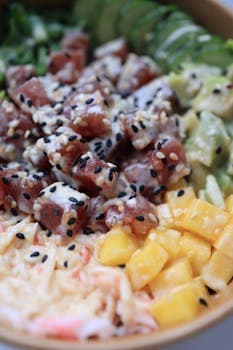
Fresh yellowfin tuna tossed with coconut cream, lime, spring onion, and chilli — a Micronesian take on the Pacific raw-fish bowl.
The Marshall Islands sit in some of the richest tuna waters on earth, and fresh tuna is the cornerstone of the local diet. This Marshallese poke diverges from the Hawaiian version by using coconut cream in place of sesame oil, and fresh lime instead of soy, giving it a distinctly tropical, bright character. It is eaten over rice or with breadfruit crackers.
Serves 2
Dice tuna into 1.5 cm cubes and place in a chilled bowl.
Add coconut cream, lime juice, salt, spring onions, and chilli. Toss gently to coat.
Let sit for 5 minutes in the refrigerator.
Spoon over steamed rice or serve in a coconut shell with breadfruit crackers.
Keep tuna refrigerated until the moment of serving.
Do not over-marinate — the lime will begin to cure the fish after 15 minutes.
Taste and adjust salt at the very end — flavors concentrate as liquids reduce, and a final pinch of flaky salt sharpens the whole dish.
Mise en place pays for itself: chop, measure and pre-mix everything before the heat goes on, especially for any step that moves fast.
Add diced avocado.
Replace lime with calamansi for a different citrus note.
Vegetarian: swap the protein for roasted king oyster mushrooms, smoked tofu or cooked chickpeas — adjust seasoning slightly upward to compensate.
Spicier: add a finely chopped fresh chile or a teaspoon of crushed Aleppo/Urfa pepper to the aromatics for warm, layered heat instead of a single sharp hit.
Consume within 1 hour of dressing.
Marshallese communities have eaten raw fish since ancient times. The Marshall Islands' exclusive economic zone covers 2 million square kilometres of ocean, supporting one of the world's largest tuna fisheries.
Any sashimi-grade tuna works. Bigeye tuna is particularly rich.
Yes — most of the components can be prepared up to a day in advance and refrigerated separately. Reheat gently and assemble just before serving so textures stay distinct.
Stay close to the role each ingredient plays: swap aromatics for similar ones (shallot for onion, lime for lemon), and keep the fat-acid-salt balance intact. Spice blends can usually be approximated with what's in the cupboard.
Authenticity sits on a spectrum — what matters more is honoring the technique and balance of flavors. If the dish tastes harmonious and respects how cooks in its home region would build it, you're on solid ground.
Per serving (200g / 7.1 oz) · 2 servings total
Ask our AI cooking assistant anything about this recipe — substitutions, techniques, scaling.
Chat with AI Chef →This recipe is featured in the following curated guides:
Join the conversation
Sign in to leave a comment and save your favourite recipes
Have feedback or need help?
We read every email and reply within 1–2 business days.
© 2026 MyCookingCalendar. All rights reserved.